HUM_YOT
 hybridtek
 HUM-200-Page4.2.1-EyeoftheBeholder_.pdf
Applied Humanities
Experience and Evidence Eye of the Beholder? By James Romaine 4 Module Four: Examining the Humanities, continued / Page 4.2.1 Eye of the Beholder? On this page: 0 of 4 attempted (0%) | 0 of 4 correct (0%) Objective: Consider the processes and criteria by which art historians examine and critically discuss art.
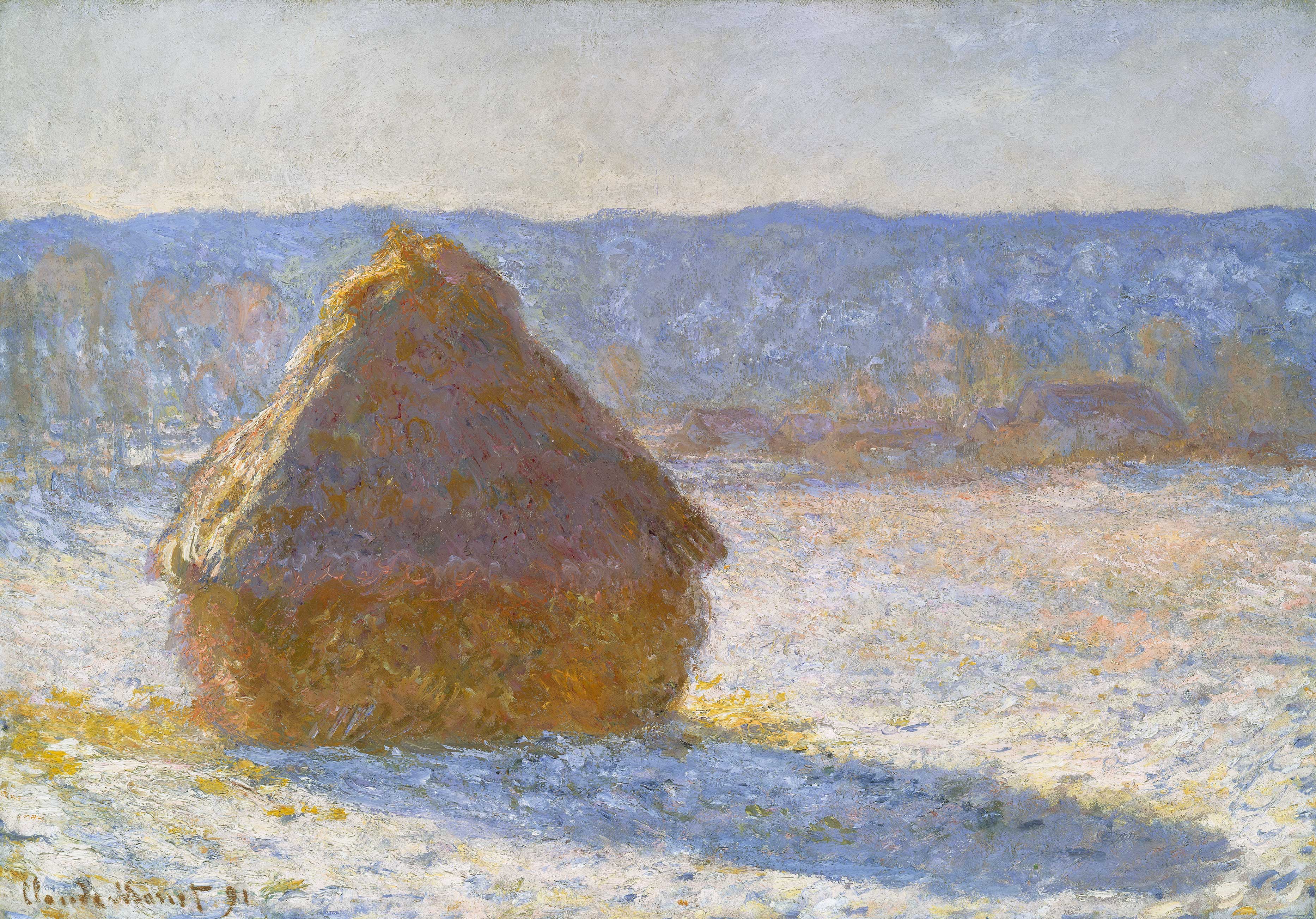
Grainstack (Snow Effect)
This is an impressionistic painting of a grain stack, or hay stack, in the snow with a long shadow stretching out from it, indicating that it is likely sunset. The stack, background, and sky are vague. The paintbrush strokes are wavy and undefined.
Grainstack (Snow Effect) by Claude Monet. Oil on canvas, 1891. 2′ 1.75″ × 3′ 0.5″.
Click to enlarge
Photograph © 2016 Museum of Fine Arts, Boston
Interpreting Impressionism
Claude Monet’s Grainstack (Snow Effect) seems like a straightforward painting. Depicting a winter landscape with a grainstack, this work evidences many of the characteristics, such as loosely applied paint in bright colors, that have made late 19th-
century art so universally popular. While this painting seems to exist primarily to delight the viewer, art historians have produced countless articles, books, and exhibition catalogs attempting to interpret Monet’s art. In fact, numerous (and sometimes contradictory) readings of Monet’s series of grainstack paintings have been proposed. Here we’ll use Monet as an example to consider the processes and criteria by which art historians examine and critically discuss art.
When expressing opinions about art, people often declare that “beauty is in the eye of the beholder.” Perhaps this approach could be called art appreciation (or, for a fancier term, connoisseurship). While each viewer should evaluate and interpret a work of art for him- or herself, art history depends on a more stringent set of criteria to debate— and perhaps even arrive at some consensus about—a work of art.
In art history, there are two main types of approaches for analyzing and appraising a work of art. One group of methods begins with the piece in question and works outward toward contextualizing that work in the world. The other type of approach, which is essentially the reverse, starts with the world outside of the art object and moves inward toward the work.
Approach 1: Start with the Art
Formalism
The methods that begin with the art object focus on what we can see in the work itself. One of the oldest of these methods, called formalism, is a study of aesthetics and design. When presented with a work of art, this approach focuses on elements of composition such as form, color, and line—examining these elements with an interest in scale, balance, proportion, harmony, and rhythm.
This method is not particularly concerned with interpreting the work but rather with evaluating and attributing it. If we compare two paintings, even two works by the same artist, does one work have a more unified composition? Does one work suggest movement better than the other? The formalist method can also help a historian attribute a work of art, on the basis of style, to a particular artist. Does this work evidence the type of color usage that we should expect in the work of a certain artist? Or, based on the use of line, is this an earlier or later work by the artist?
One of the advantages of formalism is that it is a rational approach. While no study can be absolutely objective, the discussion of an artist’s use of composition presents facts that can be checked by any careful viewer. While most art historians don’t stop with
formalism, studying the formal elements of a work of art provides foundational evidence for some of the methods that follow.
A formalist reading of Grainstack (Snow Effect) could help situate this particular work within the chronology of Monet’s oeuvre, or his complete body of work. Someone who has looked carefully at Monet’s art could identify this painting as a work from the late 1880s or early ’90s, based on the use of individualized brush marks. Monet’s oeuvre evidences an evolution toward abstraction in which the brush marks become increasingly independent of the depiction of a subject. In every painting there is a relationship between the subject depicted, such as the grainstack, and the actual material with which it is depicted—marks of paint applied to the surface of the canvas.
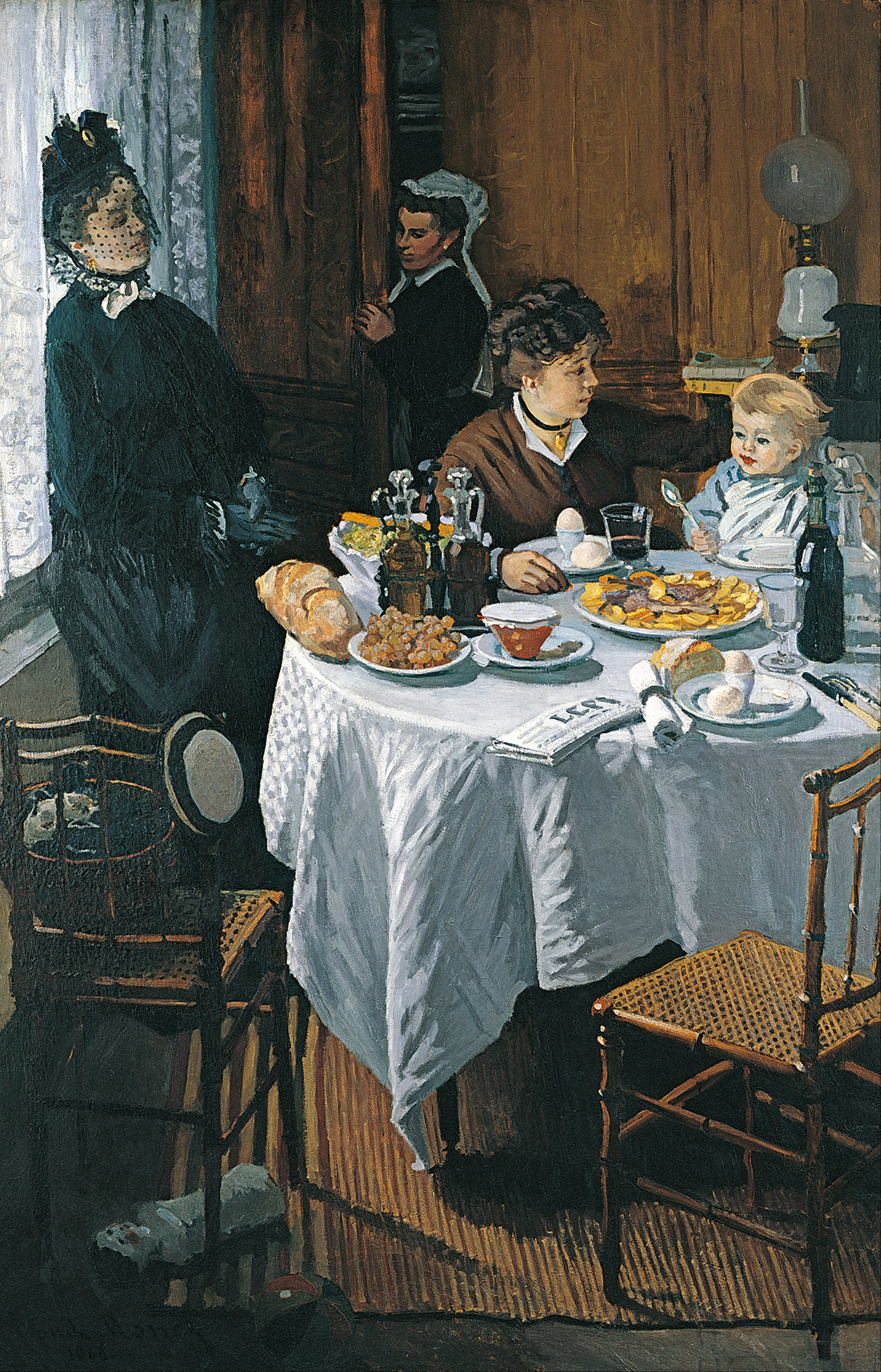
The Luncheon (Le Déjeuner)
This painting depicts a group of people at a dining table. There is a woman and child seated at the table. A maid stands in the background with her left hand on a door that leads to a pantry. A third woman, who is wearing a black dress with a black lace veil covering her face, stands in front of a window to the left of the table. There is food and a bottle of wine on the table, as well as a place set for another diner.
The Luncheon (Le Déjeuner) by Claude Monet. Oil on canvas, 1868–1869. 7′ 7.25″ × 4′ 11.5″.
Click to enlarge
Wikimedia
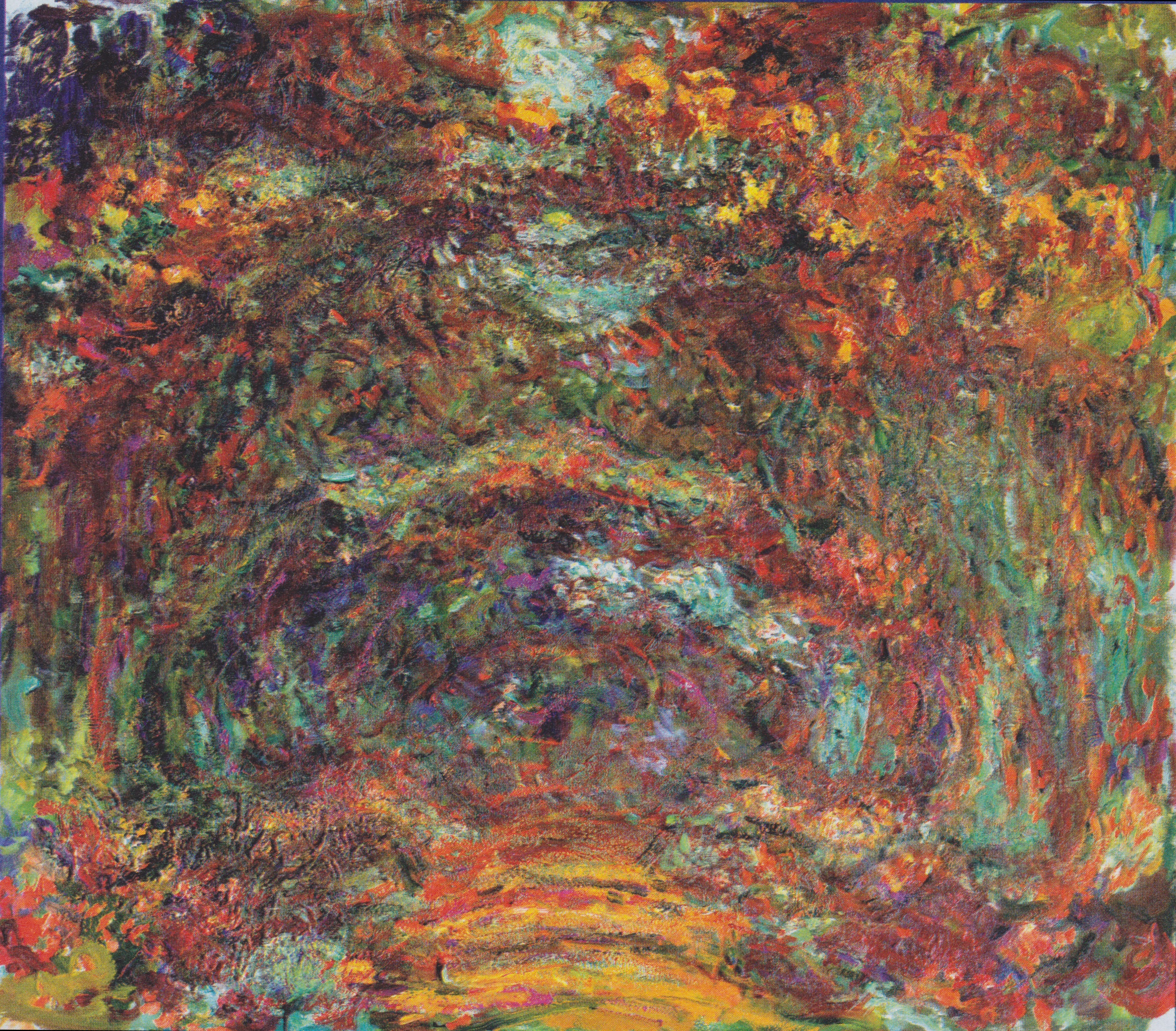
Over the course of Monet’s artistic life, his technique evolved from works such as The Luncheon (1868–1869), in which the marks of paint are integrated into the depiction of the subject, to works such as The Rose Walk, Giverny (1920–1922), in which the marks of paint begin to assert their own expressive potential. Compared to Monet’s painting method in the 1860s and 1870s, this work is more abstract.
The Rose Walk, Giverny
This is an impressionistic painting of a pathway through a garden of rosebushes that rise up all around and over the pathway. The details of the image are very vague, and the brushstrokes are wavy and undefined.
The Rose Walk, Giverny by Claude Monet. Oil on canvas, 1920–1922. 2′ 11″ × 3′ 3.25″.
Click to enlarge
Wikimedia
Iconography
While formalism is the study of the visual language developed by an artist, the study of the artist’s subject matter is called iconography. An iconographic analysis of a work focuses on what the artist depicts and what that subject matter might be intended to mean. Like formalism, iconography often depends on comparing works. In this case, an art historian might be looking for reoccurrences of certain motifs or repeated symbols.
For example, the motif of a skull and extinguished candle may develop, through repeated usage, an association with death.
Scholars of iconography may also depend on textual sources. Perhaps an artist mentioned what a certain motif meant in a letter or a diary. Or a motif may emerge from a text not written by the artist. In the Bible, for example, Christ refers to the Eucharistic wine as his blood, which led to an iconographic tradition of depicting the infant Christ holding grapes. In many cases, the formalist and iconographic methods can be used together.
Monet was not the only artist to paint the iconography of grainstacks, though he is perhaps the most famous. A few decades earlier, Jean-François Millet had painted Haystacks: Autumn (1874). Even earlier, the Limbourg brothers had included a row of grainstacks in a calendar page of a 1411–1416 illuminated manuscript depicting the month of June. In the context of these examples and others, it could be suggested that the grainstacks represent the abundance of nature and aim to call the viewer’s attention to the labor required to harvest the grain. The absence of laborers (which are prominent in the works of the Limbourg brothers and Millet) in Monet’s painting could represent an iconographic break with the past.
The iconographic method may be helpful not only in interpreting what Monet’s art might mean, but also in providing evidence of Monet’s importance in art history. An artist who takes existing iconography and successfully reinterprets it might be considered more important to art history than an artist who merely imitates the work of past artists.
Haystacks: Autumn
This painting depicts three large haystacks in an open field. The haystacks tower over a shepherd and a flock of sheep in the field in front of them. In the distance behind the haystacks, there is what appears to be the edge of a town. Dark storm clouds gather in the sky above the haystacks.
Haystacks: Autumn by Jean-François Millet. Oil on canvas, 1874. 2′ 9.5″ × 3′ 7.5″.
© The Metropolitan Museum of Art. Image source: Art Resource, NY.
Historical Context
After looking at both what a work of art depicts and how that motif is depicted, the next topic an art historian might look at is historical context. Historical context has at least three dimensions. These include the context of the artist’s history, the history of art, and the larger historical context in which the work was created.
1. The artist’s personal history: What do we know about the artist’s life? What biographical details might have contributed to this work?
2. The history of art: Where does Monet—and Impressionism—fit within the history of art? What type(s) of art came before, and what type(s) of art came after? This dimension may be helpful for both interpreting the artist’s work and assessing its importance.
3. The larger historical context: How does the artist’s work—both the visual language (formalism) and subject matter (iconography)—relate to his or her time?
An art historian may consider such factors as philosophy, religion, politics, science, or the other arts.
In the early 1870s, France was devastated by the Franco-Prussian War. Monet fled with his family first to England and then to the Netherlands for the duration of the war, returning to France in the fall of 1871. Combining this historical information with what we already know about the iconography of the grainstack as a motif associated with agrarian abundance, could we read Monet’s series of grainstack paintings as a celebration of French rebirth? Here the interpretation is less absolute, but it is still firmly grounded in established facts.
We also noted the absence of laborers, or any individuals, in Monet’s painting. Could this be a reference to the Industrial Revolution and an increasing mechanization of harvesting grain? There are aspects of Monet’s art, such as his paintings of railway stations, that certainly make references to the rapid industrialization of France during his lifetime. However, with this reading of Grainstack (Snow Effect), we need to be a bit more circumspect. For example, across his entire career Monet painted many landscapes with no figures. In art history, the scholar is often weighing seemingly contradictory evidence. Nevertheless, any interpretation should be based on the most complete evidence available.
Approach 2: Start with the World
The methodologies in the second group begin with a set of assumptions about the world and apply them to the work of art. Whereas the formalist, iconographic, and contextual readings—perhaps used together—begin from the work of art and extend outward, it is also possible to start from outside the work and the artist. For example, a psychoanalytical methodology proceeds from a belief that individuals act from unconscious motivations, which might be shaped by their experiences and environment. Compared to formalist methods, this type of psychoanalytic interpretation is more difficult to verify. If, by its very nature, the evidence is unconscious, this interpretation can’t be objectively tested.
Methodologies like formalism seem to imply that the artist, the work of art, and the art historian are all ideologically neutral. This neutrality, of course, is impossible. Methods that are sometimes grouped under the category of New Art History aim to acknowledge and critically investigate the layers of presumptions and prejudices that affect how art is created and received. Some methodologies of art history have developed out of theories concerning class, gender, race, religion, and other sociological factors that shape individual and collective identity. In many cases, these methodologies help expand and enrich the history of art. Feminist scholars, for example, have exposed how women
artists, such as Berthe Morisot, one of the leading figures of Impressionism, have been unjustifiably neglected.
At the same time, these methodologies that begin from outside the work of art have the potential to make connections that the artist may not have intended. Could a grainstack be read as a breast-like form extending from Mother Earth? There is nothing in Monet’s life, art, or the history of Impressionism to support such a reading. Nevertheless, there is still room in art history for making connections that the artist did not intend, as long as they are stated as such.
Any argument concerning a work of art proceeds with a set of criteria that must be capable of being examined, confirmed, and/or disproven by other scholars. The objective of an art historian is to make the work of art more widely and richly accessible. Great works of art remain as such because each viewer finds some personal connection to them. Art history helps facilitate those connections.
Multiple-Choice Question
The author of this essay divides analysis of art into which of these two approaches?
(1) Look first at the subject chosen and then the method chosen, or (2) look first at the method chosen and only then at the subject. (1) Start by looking closely at the work and later consider the context, or (2) start with the context and later examine the work. (1) First look at what is represented and then look at how it is represented, or (2) start with the style and genre and only then dig into what is presented. (1) Start with the place of a work in art history and then consider cultural events of the time, or (2) start with cultural events of the time and only then consider the place of the work in art history.
Multiple-Choice Question
What is formalism primarily concerned with?
the official purpose the painting was intended to serve, also known as its formal goal how a painting is structured and how that structure works to provide balance, harmony, etc.
the realism conveyed by the craft of the artist, with abstraction being considered informal empirical evaluation of a painting in terms of only that which can be objectively measured
Multiple-Choice Question
What is iconography primarily concerned with?
the inclusion of items meant to be read as symbols rather than literal portrayals what is depicted and what it represents the inclusion of small symbols the most memorable portions of any painting
Multiple-Choice Question
In art history, it is expected that the opinions offered will be which of the following?
provable beyond reasonable doubt in agreement with all other art historians reasonable and based on broad consideration of available evidence heavily informed by the historian’s own personal likes and dislikes
close