Task_Ass_Hist
 hybridtek
 HUM-200-Page2.1.3-David.pdf
11/4/2020 HUM-200 - Page 2.1.3 - David
https://www.webtexts.com/courses/39511-sanderovsky/traditional_book/chapters/4297817-module-two-introduction-to-the-humanities-continued/page… 1/6
Applied Humanities
Themes in Visual Art David By James Romaine 2 Module Two: Introduction to the Humanities, continued / Page 2.1.3 David On this page: 0 of 7 attempted (0%) Objective: Analyze a painting by Jacques-Louis David to identify its theme.
This work is a bit more cryptic than Gustave Caillebotte’s Paris Street; Rainy Day. The viewer’s first response to Jacques-Louis David’s painting might be, “Who are these people and what are they doing?” But once the identity of the subject is established, it is clear that both works touch on relatable themes.
On this page, you will examine elements of a neoclassical painting by Jacques-Louis David to determine its theme. Use the images and information provided to answer the questions below.
11/4/2020 HUM-200 - Page 2.1.3 - David
https://www.webtexts.com/courses/39511-sanderovsky/traditional_book/chapters/4297817-module-two-introduction-to-the-humanities-continued/page… 2/6
Oath of the Horatii
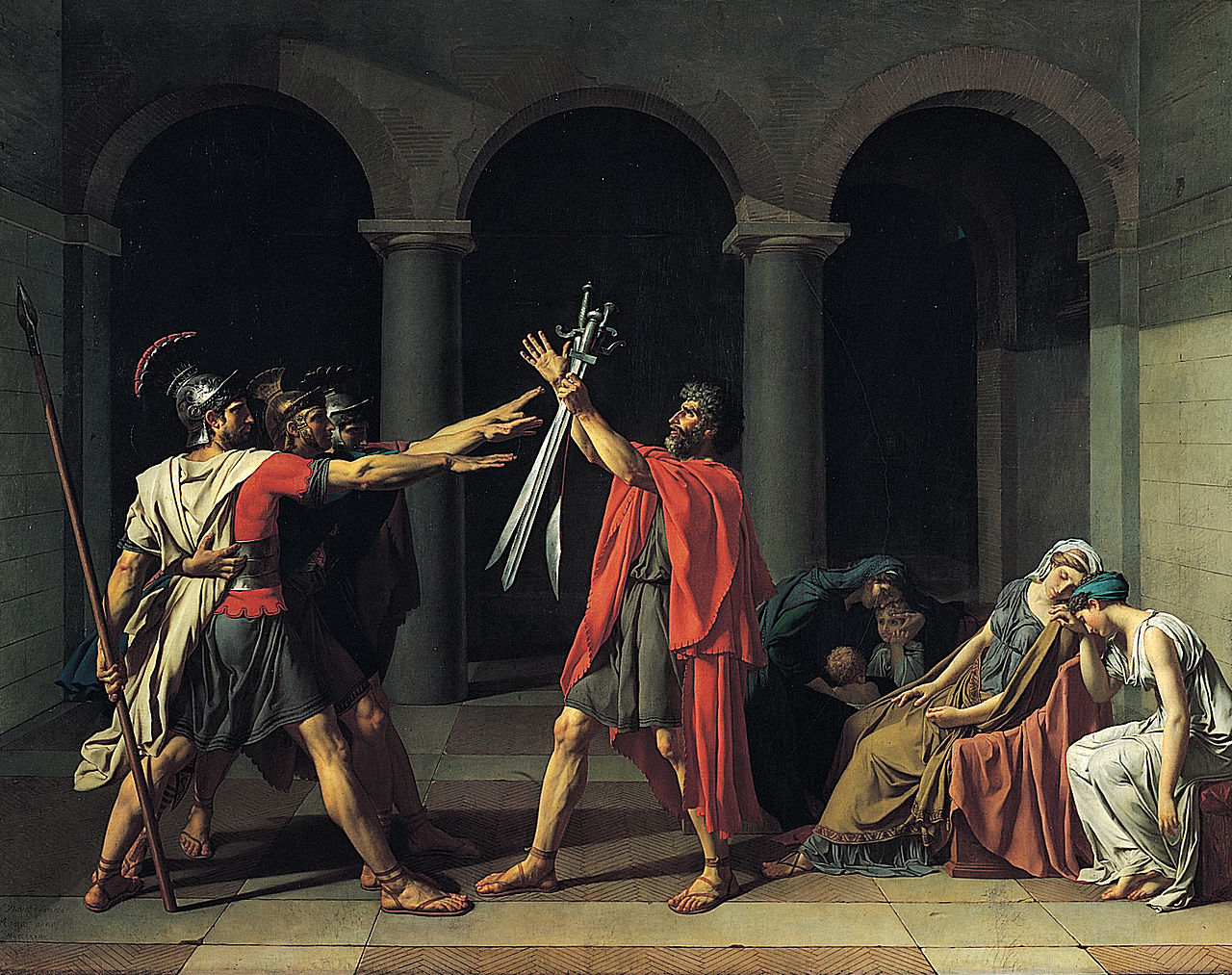
This painting is set in a Roman hall. On the left side are three Roman soldiers. The man closest to the viewer is holding a spear upright in his left hand. The man in the middle has his arm around the waist of the man holding the spear. All three soldiers are wearing sandals, short tunics, capes, and helmets. They are reaching toward swords being held by an older man who is centered in the painting. He is wearing sandals, a short tunic, and a cape. Behind the older man, three women are sitting on benches. One woman is comforting two small children. The other two women are comforting each other.
Click to enlarge
Erich Lessing/Art Resource, NY
Jacques-Louis David
Oath of the Horatii, 1784
Era/Culture/Movement: Neoclassicism
Medium: Oil on canvas
Dimensions: 10′ 8″ x 13′ 9″
Location: Louvre Museum, Paris
Three brothers of the Horatius family swear an oath to their father that they will fight to the death to defend the city of Rome.
11/4/2020 HUM-200 - Page 2.1.3 - David
https://www.webtexts.com/courses/39511-sanderovsky/traditional_book/chapters/4297817-module-two-introduction-to-the-humanities-continued/page… 3/6
Jacques-Louis David’s Oath of the Horatii captures a moment of dramatic climax, an act from which there could be no return. Three brothers of the Horatius family swear an oath to their father that they will fight to the death to defend the city of Rome. To demonstrate their allegiance, the brothers step forward, in unison, and raise their arms in salute to the swords held in the air by their father.
The Horatii will battle against three brothers of the Curiatius family from the neighboring city of Alba Longa. Around the year 669 BCE, war broke out between Alba Longa and Rome. Rather than having their full armies wage battle, potentially leaving both cities weak and vulnerable to other enemies, the opposing leaders agreed to settle their dispute by sending out three warriors apiece. The last man standing alive—and the city he represented—would be the victor. While two of the Horatii were killed in the fight, the remaining brother won the victory for Rome.
At the right side of the painting (David organized his composition to be viewed from left to right), the mother takes consolation in her grandchildren. The young boy looks on stoically as his father takes the oath. At the far right, two young women are forlorn. Their slumping posture is a contrast to the stiff resolve of the brothers, and David uses the pose of the woman at the far right to redirect the viewer toward the center of the composition. These women represent the family ties that connect the Horatii and Curiatii. One of the women is a Curiatius daughter, now married to a Horatius. She is united in grief with a Horatius daughter who is a betrothed to a Curiatius. For these women, any outcome will mean the loss of a loved one.
The stoic poses of the brothers and the mournful poses of the women illustrate a contrast of motivations between the honor of civic patriotism and the emotions of personal attachment. One of the criticisms of this painting, and of David’s art more broadly, is that he often depicted men as heroic and rational but women as passive and emotional. (He did, however, sometimes paint heroic women, most notably in his 1799 work titled The Intervention of the Sabine Women.)
On the basis of this painting, and others like it, David became the leading proponent of the neoclassical method. Inspired in part by the Enlightenment, this method was characterized by a clinical precision of depiction (clarity of form equaled clarity of thought) achieved through the careful delineation of every form. This exacting detail is particularly applied to the human—especially the male—body. Without taking anything away from David’s effective employment of color, such as his strong use of red to visually unite parts of the composition, the colors are applied very deliberately within a prearranged design.
11/4/2020 HUM-200 - Page 2.1.3 - David
https://www.webtexts.com/courses/39511-sanderovsky/traditional_book/chapters/4297817-module-two-introduction-to-the-humanities-continued/page… 4/6
Although he was a French painter, David created this 1784 work in Rome, and the frieze-like arrangement of overlapping figures evidences a classical-inspired visual language. Given the number of figures in the painting and the dramatic action of some of them, David’s composition is remarkably flat. All of the figures occupy a narrow space, between the implied space of the viewer and the architectural background. This horizontal flatness could be read like a classical frieze. Many buildings and monuments of ancient Greece and Rome were decorated with carved sculptural figures, often engaged in heroic activity. Because of the material and placement of these frieze sculptures, they employed almost no depth of space. Instead, the compressed action unfolded horizontally by means of overlapping figures. In employing a similar method, even though painting would have allowed him to depict depth of pictorial space, David asserts his own artistic allegiance.
While the subject is based on a history of classical antiquity, David could have expected his viewers to be familiar with this story. However, the scene of oath-taking that David depicts was actually his own invention. Despite the complicated nature of the narrative (even the description above is simplified), David was able to capture the moral essence of the story in a single moment, with clarity and immediacy. While the layers of the painting unfold over repeated viewings, the image also has an instantaneous impact. This visual articulation of virtuous sacrifice is achieved both through scale and through clarity of form. At nearly 11 feet by 14 feet, it is an imposing painting, amplified in particular by the severity of the figures and their poses.
Rather than showing the battle itself as a physical contest, David focuses on the will to fight as a moral choice. As such, the painting engages the viewer with the same choice of placing patriotic resolve above personal or even family loyalties. David visualizes this choice, for example, through the way in which the feet of the Horatii, as they step forward to take the oath, cross a line on the floor created by the design of the pavement.
When Oath of the Horatii was first exhibited in Paris, it was received with great admiration, even by the king of France, Louis XVI. Although it depicted a subject from antiquity, David’s contemporary viewers interpreted the painting as visualizing an absolute and single-minded obedience to the state (and the king). Today, this 1784 painting’s expression of patriotism, sacrifice, loyalty, and solidarity is generally interpreted as a premonition of the French Revolution, which commenced in 1789, and in which David actively participated.
11/4/2020 HUM-200 - Page 2.1.3 - David
https://www.webtexts.com/courses/39511-sanderovsky/traditional_book/chapters/4297817-module-two-introduction-to-the-humanities-continued/page… 5/6
Oath of the Horatii
This painting is set in a Roman hall. On the left side are three Roman soldiers. The man closest to the viewer is holding a spear upright in his left hand. The man in the middle has his arm around the waist of the man holding the spear. All three soldiers are wearing sandals, short tunics, capes, and helmets. They are reaching toward swords being held by an older man who is centered in the painting. He is wearing sandals, a short tunic, and a cape. Behind the older man, three women are sitting on benches. One woman is comforting two small children. The other two women are comforting each other.
Click to enlarge
Erich Lessing/Art Resource, NY
Short-Answer Question
How does the exacting precision of Jacques-Louis David’s composition visually reinforce the narrative of the Horatii brothers’ patriotic resolve?
No response saved yet. Short-Answer Question
How does David employ the architectural background to visually organize the unfolding (left to right) drama?
11/4/2020 HUM-200 - Page 2.1.3 - David
https://www.webtexts.com/courses/39511-sanderovsky/traditional_book/chapters/4297817-module-two-introduction-to-the-humanities-continued/page… 6/6
No response saved yet. Short-Answer Question
How does David’s composition focus the viewer’s eye on the swords?
No response saved yet. Short-Answer Question
How does David’s treatment of the men and women reflect late 18th- century perceptions of gender differences?
No response saved yet.
Response Board Can you think of a more recent example of an image or work of art that has been created or employed to stir patriotism?
No response saved yet.
Short-Answer Question
Imagery designed to call for war and revolution often doesn’t depict actual conflict; instead, it tends to focus on more abstract concepts, such as love of country. Why is this?
No response saved yet. Short-Answer Question
How can historical events, even events that occur after a work of art was created, potentially shape interpretations of that work of art?
No response saved yet. close
Share your thoughts with your peers...