Inspirational_Dev
 hybridtek
 HUM-200-Page1.2.3-SeeingGiotto.pdf
10/31/2020 HUM-200 - Page 1.2.3 - Seeing Giotto
https://www.webtexts.com/courses/39511-sanderovsky/traditional_book/chapters/4391571-module-one-introduction-to-the-humanities/pages/3897037 1/7
Applied Humanities
Learning To See Seeing Giotto By James Romaine 1 Module One: Introduction to the Humanities / Page 1.2.3 Seeing Giotto On this page: 0 of 6 attempted (0%) | 0 of 1 correct (0%) Objective: Evaluate a painting using the strategies identified on the previous page.
10/31/2020 HUM-200 - Page 1.2.3 - Seeing Giotto
https://www.webtexts.com/courses/39511-sanderovsky/traditional_book/chapters/4391571-module-one-introduction-to-the-humanities/pages/3897037 2/7
The Lamentation
10/31/2020 HUM-200 - Page 1.2.3 - Seeing Giotto
https://www.webtexts.com/courses/39511-sanderovsky/traditional_book/chapters/4391571-module-one-introduction-to-the-humanities/pages/3897037 3/7
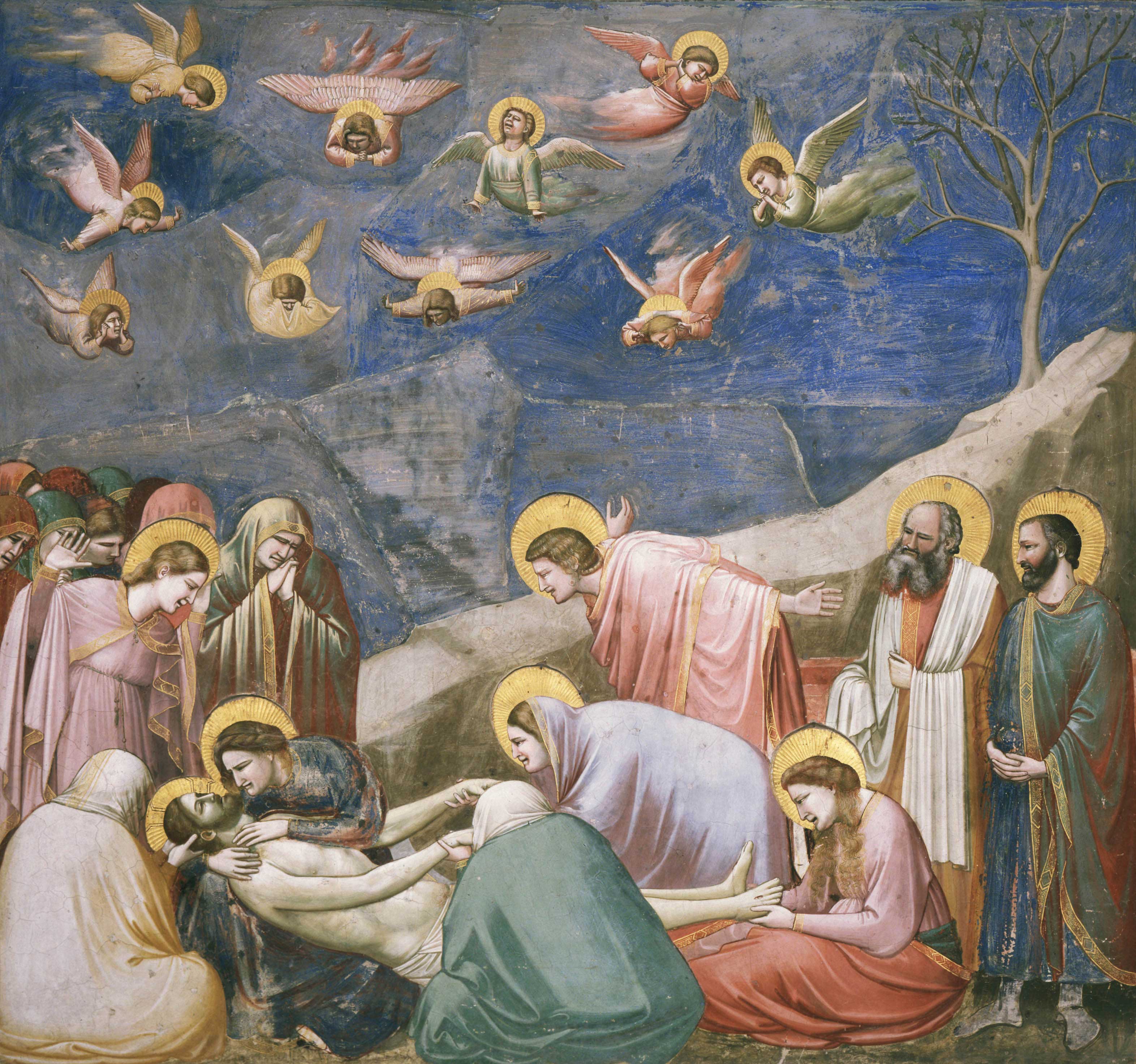
In the foreground, the body of Christ is surrounded by nine people. There is a group of mourners in the left near-background. In the center and right near-background are a mountain and tree. In the far background are more mountains. Above the groups of people are ten diminutive angels. Of the nine people in the foreground, four are women with halos, three are men with halos, and two, without halos, are indistinguishable because they are facing Christ and only their backs are visible. The body of Christ is held slightly off the ground by three, or possibly four, of the people surrounding Him. He has a halo and is unclothed except for a wrap around His waist. Of the two without halos, one is clothed in a blue robe and a white head covering. She or he is sitting on the ground at Christ’s right hip. That person may be helping to hold His body off the ground. The other person is clothed in a pale yellow robe and white head covering. She or he is holding her or his right hand under Christ’s head. One of the women with a halo is clothed in a pink gown trimmed with gold. She has an uncovered head. Her hair is brown. She is standing to the left of Christ’s head. Her right hand is raised with her palm facing outward. One of the women with a halo is clothed in dark blue. She has an uncovered head. Her hair is brown. She has a braid encircling her head. She is sitting at Christ’s left side, by His head and shoulders. She is cradling Christ’s head and torso in her lap. Her right arm is beneath His shoulders; her left arm rests on His chest. One of the women with a halo is clothed in pale blue or purple. She has a partially covered head. Her hair is brown. She is bending over Christ at His left side by His legs. She is holding His hands, one in each of hers. One of the women with a halo is clothed in a pink top, light red skirt, and green sash. She has an uncovered head. Her hair is brown. She has a braid encircling her head. Long strands of hair fall on each side of her face. She is sitting on the ground at Christ’s feet, holding a foot in each of her hands. Of the three men with halos, one is wearing a pink robe with gold trim. His hair is brown and wavy. He is standing, bent slightly at the waist, with his arms outstretched behind him. He is standing to the right of the woman holding Christ’s hands. The other two men with halos are standing behind and to the right of the woman holding Christ’s feet. One of the men is partially bald. He has graying hair. He also has a beard, mustache, and sideburns. He is wearing an orange robe with a white stole. His left hand is holding the right side of his stole. His right hand and arm are concealed under the right-hand side of his stole. The other man has dark hair, a beard, a mustache, and sideburns. He is wearing a blue robe with gold trim. His hands are clasped in front of him. The group of mourners in the left near-background bow their heads. Two of the mourners’ faces are partially concealed. One mourner’s face is clearly visible and expressing grief. One mourner is prominent and has her hands clasped together and is holding them against her cheek. The mountain in the center and right near-background slopes upward to a leafless tree. The angels all have wings, halos, and robes. They all are exhibiting sorrow in various ways, including weeping, praying, and holding their heads in their hands.
The Lamentation by Giotto di Bondone. Fresco painted ca. 1305 in the Scrovegni Chapel, Padua, Italy. 6′ 6.75″ × 6′ 0.75″.
Click to enlarge
Alfredo Dagli Orti/The Art Archive at Art Resource, NY
Now that you’ve been introduced to the basic strategies for analyzing visual artwork, we’re going to walk through an example.
10/31/2020 HUM-200 - Page 1.2.3 - Seeing Giotto
https://www.webtexts.com/courses/39511-sanderovsky/traditional_book/chapters/4391571-module-one-introduction-to-the-humanities/pages/3897037 4/7
Apply Strategies for Evaluating Visual Artwork
On this page, you will analyze a painting using the steps outlined on the previous page.
The painting at the top of this page is part of the Scrovegni Chapel in Padua, Italy (near Venice). It was painted as a fresco around 1305 by an artist named Giotto di Bondone.
1. Identify It
Artist: Giotto di Bondone Title: The Lamentation Time Period: 1305 Medium: Fresco Location: Scrovegni Chapel, Padua, Italy
2. Describe It
Response Board Before reading any further, take a shot at describing this image yourself. In three words, what are your first impressions?
No response saved yet.
Response Board What does the painting depict?
No response saved yet.
Response Board Can you identify some of the figures?
No response saved yet.
Compare your answers to the following responses provided by Dr. James Romaine, an art historian.
First impressions: drama, mourning, death
Share your thoughts with your peers...
Share your thoughts with your peers...
Share your thoughts with your peers...
10/31/2020 HUM-200 - Page 1.2.3 - Seeing Giotto
https://www.webtexts.com/courses/39511-sanderovsky/traditional_book/chapters/4391571-module-one-introduction-to-the-humanities/pages/3897037 5/7
What does the painting depict? This painting depicts a large group of figures surrounding and weeping over the body of a dead man. Some of the figures have halos, which suggests that they are holy. In the sky, there are ten angels.
Can we identify some of these figures? Since this work is part of a Christian chapel, we can assume that these figures are from the Bible. The dead man is Jesus Christ. He is held in the arms of his mother, the Virgin Mary. Other notable figures include Mary Magdalene, who is at Christ’s feet, and John (one of Christ’s disciples), who is bending over with his arms outstretched.
How is the subject depicted? This is a fresco, so the paint has been applied directly to wet plaster; the image is now part of the wall. Giotto has used a lot of colors. He depicts the figures with individual features and expressions. These are real and particular people, not just types. The positions of the figures and their gestures, as well as those of the angels, focus the viewer’s attention toward Christ.
3. Analyze It
What is the relationship between the subject depicted and the means of representation? While the subject, the death of Christ, is historically remote from the viewer, the visual realism, especially the vivid emotions of the figures, makes this scene feel close to the viewer.
As noted earlier, the fresco medium places the subject in the wall. Giotto depicts figures such as the angels breaking through the wall. Eternity is invading the viewer’s world.
In the figure of John, for example, Giotto has used the form of John’s body to visualize his internal (and therefore invisible) feelings. What does grief look like? Have you ever been so horrified and upset that your body reacted to this emotion? Here John is actually bent over by the weight of his suffering.
4. Contextualize It
Who was Giotto? Giotto was one of the most famous artists of his time. He was especially renowned for his realism and his ability to depict figures with expressive emotions.
When was this work painted? In Italy, the early 14th century was a time of transition between the medieval and
10/31/2020 HUM-200 - Page 1.2.3 - Seeing Giotto
https://www.webtexts.com/courses/39511-sanderovsky/traditional_book/chapters/4391571-module-one-introduction-to-the-humanities/pages/3897037 6/7
modern worlds. Religious subjects were often depicted against a gold background in medieval Christian art, but here Giotto has painted the sky blue. His sky is like our sky, and thus the event is happening in our world.
Where did Giotto get his materials? The ultramarine blue pigment that Giotto used was created by crushing a stone called lapis lazuli. This stone had to be imported from Afghanistan; ounce for ounce, this blue pigment was more expensive than gold. Nevertheless, Giotto covered almost half of the painted surface in this precious blue.
Why is this called the Scrovegni Chapel? Enrico Scrovegni, a banker, was the man who built the chapel and commissioned Giotto to paint it. Bankers, especially the ones who charged high rates of interest for lending money, weren’t any more popular in the 1300s than they are today. Enrico’s father, also a banker, was so disliked that the poet Dante depicted him in hell in his famous work titled the Inferno. The Scrovegni Chapel also has a fresco of heaven and hell in which Enrico Scrovegni can be found being admitted into heaven.
Short-Answer Question
Why is the blue sky remarkable for a painting made at this time?
No response saved yet. Multiple-Choice Question
How does the use of a blue sky, instead of a gold background, change the way the painting would be seen?
The cost of the blue for the sky would increase the perceived importance of the work. The blue sky was a clear indication that Giotto painted this work. The blue sky makes it easier to understand that the event is happening in this world. The blue sky established the work as intended for the Scrovegni Chapel.
5. Interpret It
10/31/2020 HUM-200 - Page 1.2.3 - Seeing Giotto
https://www.webtexts.com/courses/39511-sanderovsky/traditional_book/chapters/4391571-module-one-introduction-to-the-humanities/pages/3897037 7/7
Giotto’s realism makes his subject more immediate to the viewer. For the presumed Christian viewer in 1305, Giotto’s fresco might have evoked feelings of both grief and piety.
For the modern viewer, in addition to the feelings evoked by the piece, Giotto’s realism serves as a visual record of his time and offers a window into what it might have been like to be alive then. The particularity with which Giotto depicted each figure visualizes a philosophy called humanism.
6. Evaluate It
This work is successful because Giotto’s ability to depict each figure (especially that of John) and face (especially that of the Virgin Mary) makes me feel like I am there in the scene with them.
Response Board Evaluation is the most personal of the steps. The comment above is from Dr. Romaine. What do you think helps the painting to “work” or “succeed,” or what otherwise makes it one of the most referenced works from the 14th century?
No response saved yet.
close
Share your thoughts with your peers...