Inspirational_Dev
 hybridtek
 HUM-200-Page1.1.4-TheDance_AnArtistandYou.pdf
10/31/2020 HUM-200 - Page 1.1.4 - The Dance: An Artist and You
https://www.webtexts.com/courses/39511-sanderovsky/traditional_book/chapters/4391571-module-one-introduction-to-the-humanities/pages/3897030 1/13
Applied Humanities
Succeeding in This Course The Dance: An Artist and You 1 Module One: Introduction to the Humanities / Page 1.1.4 The Dance: An Artist and You On this page: 0 of 6 attempted (0%) | 0 of 3 correct (0%) Objective: Recognize the role of the viewer, reader, or listener in the experience of art.
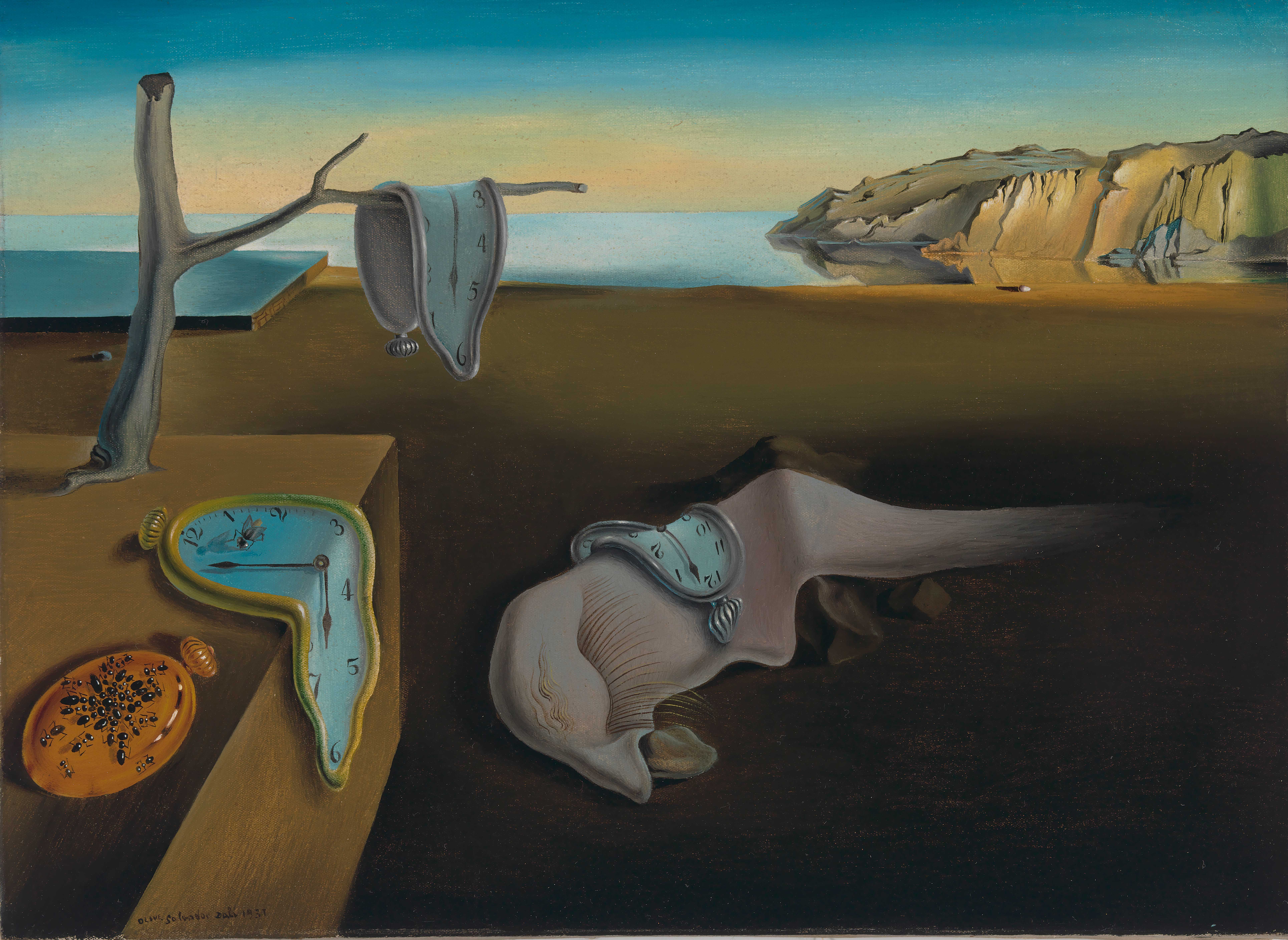
This oil painting depicts a landscape with several melting watches in it. In the background there are some cliffs, bordering an expanse of water. There is also a rectangular platform in the background that appears to be made of metal. In the foreground is a small dead tree with a single branch, over which is draped a floppy and melting watch. The tree is planted on a brown platform, and under the tree is another melting watch, this one draped over the edge of the platform. Next to this watch is another watch with a group of ants crowding its metal surface. Next to the brown platform and taking up most of the middle of the painting is a monstrous and indistinct fleshy creature draped across the ground. It looks vaguely like a man’s head in profile, and another melting watch is draped across this figure.
The Persistence of Memory by Salvador Dali. Oil on canvas, 1931. 9.5″ × 1′ 1″.
Click to enlarge
© Salvador Dali, Fundacio Gala-Salvador Dali, 2016 Arts Rights Society (ARS), New York 2016. © The Museum of Modern Art/Licensed by SCALA/Art Resource, NY.
10/31/2020 HUM-200 - Page 1.1.4 - The Dance: An Artist and You
https://www.webtexts.com/courses/39511-sanderovsky/traditional_book/chapters/4391571-module-one-introduction-to-the-humanities/pages/3897030 2/13
Art for Art’s Sake
In this section, you will take a broad look at what art is and how it can be studied.
What is art? This is a notoriously difficult question to answer. It’s right up there with other well-worn philosophical questions pushing us to consider the definitions of justice, truth, beauty, love, or even meaning itself. Of course, most of us have no trouble using these terms with confidence and without confusion in our everyday lives. But when asked to provide a single, clear, all-encompassing definition for each of them, we find it nearly impossible.
Supreme Court justice Potter Stewart famously declared that there is no clear definition of obscenity; “but,” he went on, “I know it when I see it” (Jacobellis v. Ohio, 1964). Likewise, every person reading this can probably tell an artistic painting from, say, a road sign. The more combative reader, however, might argue that road signs are a form of art and that even an artistic painting can help you understand where you’re going— hence the challenges in providing a single, clear, all-encompassing definition of “art.”
Let’s start with a dictionary definition:
art (noun)
The expression or application of human creative skill and imagination, typically in a visual form such as painting or sculpture, producing works to be appreciated primarily for their beauty or emotional power.
Not bad. We could dive into hours of debate on any particular word or phrase from this definition, but it’s a useful starting point. In this course, we’ll focus on literature and music as well as visual art. What you need to notice right now is the fundamental purpose behind works of art: “to be appreciated... for their beauty or emotional power.”
Appreciating Art
Consider a song: “Purple Rain” by Prince. You might argue that the song is art even if no one ever hears it. Or that as long as it sounds to Prince the way he wants it to sound, then the work is complete. But Prince released it. And millions of people bought it. It received extensive airplay on commercial radio. It was copied onto countless mixtapes and playlists. And Prince performed it live hundreds (if not thousands) of times. All these uses suggest that the song was meant to be heard. In this case, Prince is the artist and his creation is the song; he created it anticipating that other people would hear it and enjoy it. Art is arguably meant to be appreciated.
10/31/2020 HUM-200 - Page 1.1.4 - The Dance: An Artist and You
https://www.webtexts.com/courses/39511-sanderovsky/traditional_book/chapters/4391571-module-one-introduction-to-the-humanities/pages/3897030 3/13
But what does it mean to appreciate a work of art? Is it fair to say this means finding something of value in it? If we think of communication as moving a chunk of meaning from one person to another, then the artist has a meaning to convey, while we, the audience, are open to receiving it. The work of art is the vessel through which the meaning is transferred. Of course, “meaning” is not physical and can’t be quantified, rendering it invisible to scientific scrutiny and placing it firmly in the realm of the humanities. But millions of people have found “Purple Rain” to be meaningful, and most would likely agree that the song is about the pain of a relationship ending. If you’ve experienced a breakup or seen a friend go through one, then the song may resonate with you as capturing those emotions and thoughts remarkably well.
Imagine that you and the artist are partners in a kind of dance. The artist steps forward to offer a work of art, and you take a step back to observe and appreciate it. For the dance to flow smoothly, both partners must fulfill their role. The role of the artist, obviously, is to create something—a work of art. As the viewer, reader, or listener, you have a role as well: experiencing the work and seeking to understand what it means, what it expresses, how it makes you feel, what it makes you think. While the subject may be as reality-distorting as purple rain or melting clocks, if you open yourself to the work, you may find that it still contains echoes of your experience as a human being. When a work effectively captures the essence of some human experience, we often describe it as moving, powerful, or true.
Multiple-Choice Question
What does it mean to appreciate a work of art?
to experience the artwork as efficiently as possible to consider the monetary value of the artwork to try to understand what the artwork is communicating to form a positive or negative opinion about the artwork
Response Board Describe a painting, book, song, film, or other work of art you find meaningful. Offer enough detail so that your classmates could tell someone else about what you like and why you like it.
No response saved yet.
Share your thoughts with your peers...
10/31/2020 HUM-200 - Page 1.1.4 - The Dance: An Artist and You
https://www.webtexts.com/courses/39511-sanderovsky/traditional_book/chapters/4391571-module-one-introduction-to-the-humanities/pages/3897030 4/13
What Does the Artist Do?
Let’s examine the artist’s role a little more deeply. We can consider what the artist does in two parts: first, selecting a subject, and second, depicting the subject in a way that transcends mere representation.
Selecting a Subject
The first thing the artist does is select a subject. Selection of the subject is important because this process is also one of assigning value; subject A is “worthy” of being depicted, and, by consequence of not being selected, subjects B, C, D, etc. are not. So if you look at the work of Dutch masters from the 17th century, you’ll note many paintings of people deemed important, and none at all of scenes from the life of the Buddha.
Of course, artists have often been hired to depict a particular subject. This was especially true prior to the 20th century. But even in these cases, the artist chose to accept the commission, and the patron making the commission was assigning value simply by commissioning art on a particular subject.
We should not rush past the fact that a given subject was selected. The first question we should ask ourselves is “Why was this subject selected?” Most works of art require a lot of effort—hours upon hours at the least, years or even decades of toil at the most. Why undertake all that work to portray this subject? A great deal of insight into the work, the artist who created it, and the society in which that artist lived and worked can be gleaned by examining the subject selected.
Choosing a Means and Style of Depiction
The second thing the artist does is depict the subject. So the second question we can ask ourselves is “What method of depiction is the artist using?” Some of the methods are known as famous styles or movements, like Impressionism and Cubism.
Other methods of depiction are simply referred to by the period in which the artist worked. Italian art of the 17th century, typically classified as the Baroque style, employs different methods than Italian art of the 14th century, which usually falls under the umbrella of the Renaissance.
Short-Answer Question
It’s important to consider why an artist would choose a particular subject to depict, write about, or compose music about. Why might an artist choose one subject over another?
10/31/2020 HUM-200 - Page 1.1.4 - The Dance: An Artist and You
https://www.webtexts.com/courses/39511-sanderovsky/traditional_book/chapters/4391571-module-one-introduction-to-the-humanities/pages/3897030 5/13
No response saved yet.
Practice Looking at Art
In this section, you’ll closely examine various works of art. Use the “Click to enlarge” link below each image to open a high-resolution version in a new browser tab. Use your browser’s tools to zoom in on various parts of the image. Take your time and look closely at each artwork.
For many viewers, “great” art is realistic art—an image that looks exactly like the subject depicted, or a fairly close rendition. This drawing of a horse really looks like a horse, so it must be good, whereas this painting of a woman with two eyes on the same side of her face means the artist must have been blind or insane. However, a survey of the history of art indicates that pure realism is rare. If the history of art were a two-hour movie, pure realism would be a 30-second clip. Furthermore, even pure realism is a deliberate method.
As you examine the paintings below, recall the two questions we should ask ourselves about each work of art:
Why was the subject selected? What method of depiction is the artist using?
After we have identified the method (whether we have given it a name or simply observed that the artist is using a certain method), we can put the two questions about subject and method together:
How does the method that the artist uses to depict this subject affect how I see and think about the subject?
10/31/2020 HUM-200 - Page 1.1.4 - The Dance: An Artist and You
https://www.webtexts.com/courses/39511-sanderovsky/traditional_book/chapters/4391571-module-one-introduction-to-the-humanities/pages/3897030 6/13
Impressionism: Arrival of the Normandy Train, Gare Saint-Lazare
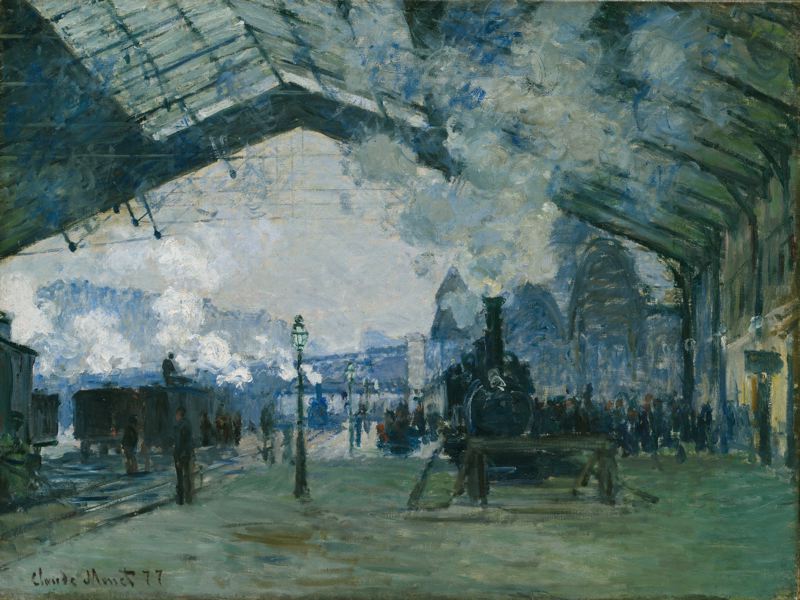
This is an oil painting. It depicts a steam-powered train inside a Parisian train station. The train station is large. It is partially roofed in glass. The smoke from the train’s smokestack is dull gray inside the station, and bright white outside the station. The end of the station that the viewer can see is open to the outside. The train is black. Passengers appear to be waiting to board. This is an Impressionist painting and, as such, the train, the station, the passengers, and the smoke are rendered with brush strokes that are not blended or delineated.
Click to enlarge
Claude Monet. Arrival of the Normandy Train, Gare Saint-Lazare, 1877. Oil on canvas. 60.3 x 80.2 cm (23 3/4 x 31 1/2 in.). Mr. and Mrs. Martin A. Ryerson Collection,
1933.1158. The Art Institute of Chicago.
Claude Monet
Arrival of the Normandy Train, Gare Saint-Lazare, 1877
Era/Culture/Movement: Impressionism
Medium: Oil on canvas
Dimensions: 1′ 11.75″ × 2′ 7.5″
Location: Art Institute of Chicago
10/31/2020 HUM-200 - Page 1.1.4 - The Dance: An Artist and You
https://www.webtexts.com/courses/39511-sanderovsky/traditional_book/chapters/4391571-module-one-introduction-to-the-humanities/pages/3897030 7/13
Monet transforms this smoke-filled modern train station into a cathedral of industrial progress.
17th-Century Italian Baroque: The Conversion of Saint Paul
This is an oil painting depicting the moment Jesus spoke to Saul (before he became Paul) on the road to Damascus. Saul is shown lying on the ground on his outer garment beneath his horse. His eyes are closed and his arms upraised. He is wearing a leather Roman breastplate. His sword is by his left side. A man is holding his horse by the bit. The horse has his right foreleg raised and is looking at Saul.
Click to enlarge
Niday Picture Library/Alamy
Caravaggio
The Conversion of Saint Paul, 1601
Era/Culture/Movement: Italian Baroque
Medium: Oil on canvas
Dimensions: 7′ 7″ × 5′ 9″
Location: Santa Maria del Popolo, Rome
10/31/2020 HUM-200 - Page 1.1.4 - The Dance: An Artist and You
https://www.webtexts.com/courses/39511-sanderovsky/traditional_book/chapters/4391571-module-one-introduction-to-the-humanities/pages/3897030 8/13
On the road to Damascus, Saul has a physically blinding and spiritually transforming vision of Jesus and is converted to Paul.
10/31/2020 HUM-200 - Page 1.1.4 - The Dance: An Artist and You
https://www.webtexts.com/courses/39511-sanderovsky/traditional_book/chapters/4391571-module-one-introduction-to-the-humanities/pages/3897030 9/13
14th-Century Italian Renaissance: The Lamentation
10/31/2020 HUM-200 - Page 1.1.4 - The Dance: An Artist and You
https://www.webtexts.com/courses/39511-sanderovsky/traditional_book/chapters/4391571-module-one-introduction-to-the-humanities/pages/3897030 10/13
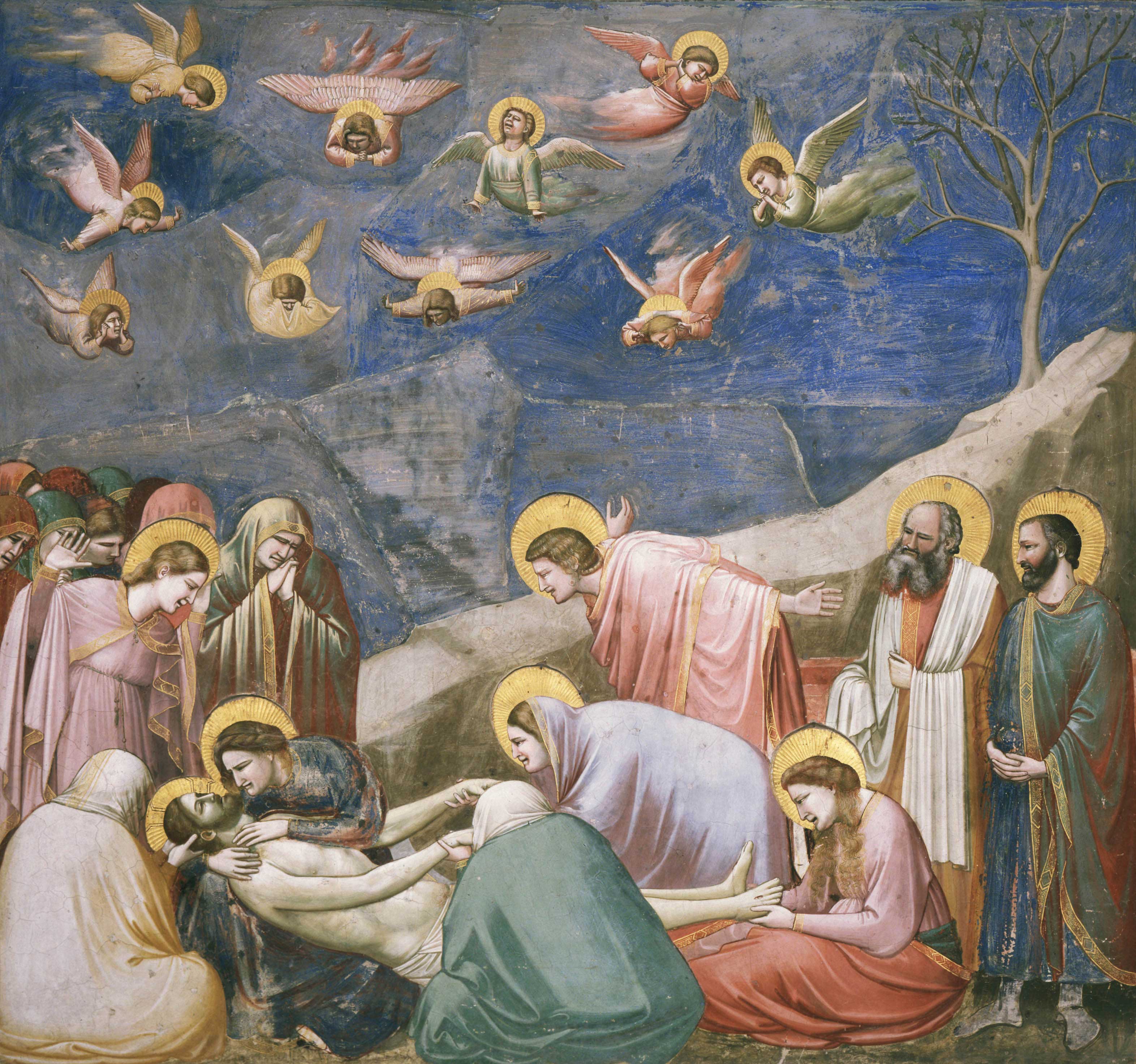
In the foreground, the body of Christ is surrounded by nine people. There is a group of mourners in the left near-background. In the center and right near-background are a mountain and tree. In the far background are more mountains. Above the groups of people are ten diminutive angels. Of the nine people in the foreground, four are women with halos, three are men with halos, and two, without halos, are indistinguishable because they are facing Christ and only their backs are visible. The body of Christ is held slightly off the ground by three, or possibly four, of the people surrounding Him. He has a halo and is unclothed except for a wrap around His waist. Of the two without halos, one is clothed in a blue robe and a white head covering. She or he is sitting on the ground at Christ’s right hip. That person may be helping to hold His body off the ground. The other person is clothed in a pale yellow robe and white head covering. She or he is holding her or his right hand under Christ’s head. One of the women with a halo is clothed in a pink gown trimmed with gold. She has an uncovered head. Her hair is brown. She is standing to the left of Christ’s head. Her right hand is raised with her palm facing outward. One of the women with a halo is clothed in dark blue. She has an uncovered head. Her hair is brown. She has a braid encircling her head. She is sitting at Christ’s left side, by His head and shoulders. She is cradling Christ’s head and torso in her lap. Her right arm is beneath His shoulders; her left arm rests on His chest. One of the women with a halo is clothed in pale blue or purple. She has a partially covered head. Her hair is brown. She is bending over Christ at His left side by His legs. She is holding His hands, one in each of hers. One of the women with a halo is clothed in a pink top, light red skirt, and green sash. She has an uncovered head. Her hair is brown. She has a braid encircling her head. Long strands of hair fall on each side of her face. She is sitting on the ground at Christ’s feet, holding a foot in each of her hands. Of the three men with halos, one is wearing a pink robe with gold trim. His hair is brown and wavy. He is standing, bent slightly at the waist, with his arms outstretched behind him. He is standing to the right of the woman holding Christ’s hands. The other two men with halos are standing behind and to the right of the woman holding Christ’s feet. One of the men is partially bald. He has graying hair. He also has a beard, mustache, and sideburns. He is wearing an orange robe with a white stole. His left hand is holding the right side of his stole. His right hand and arm are concealed under the right-hand side of his stole. The other man has dark hair, a beard, a mustache, and sideburns. He is wearing a blue robe with gold trim. His hands are clasped in front of him. The group of mourners in the left near-background bow their heads. Two of the mourners’ faces are partially concealed. One mourner’s face is clearly visible and expressing grief. One mourner is prominent and has her hands clasped together and is holding them against her cheek. The mountain in the center and right near-background slopes upward to a leafless tree. The angels all have wings, halos, and robes. They all are exhibiting sorrow in various ways, including weeping, praying, and holding their heads in their hands.
Click to enlarge
Alfredo Dagli Orti/The Art Archive at Art Resource, NY
Giotto di Bondone
The Lamentation, 1305
Era/Culture/Movement: Italian Renaissance
10/31/2020 HUM-200 - Page 1.1.4 - The Dance: An Artist and You
https://www.webtexts.com/courses/39511-sanderovsky/traditional_book/chapters/4391571-module-one-introduction-to-the-humanities/pages/3897030 11/13
Medium: Fresco
Dimensions: 6′ 6.75″ × 6′ 0.75″
Location: Scrovegni Chapel, Padua, Italy
The artist effectively humanizes Christ by depicting the dead body of Jesus being mourned by his mother and followers as an emotion-filled moment in a naturalistic space.
Gold Marilyn
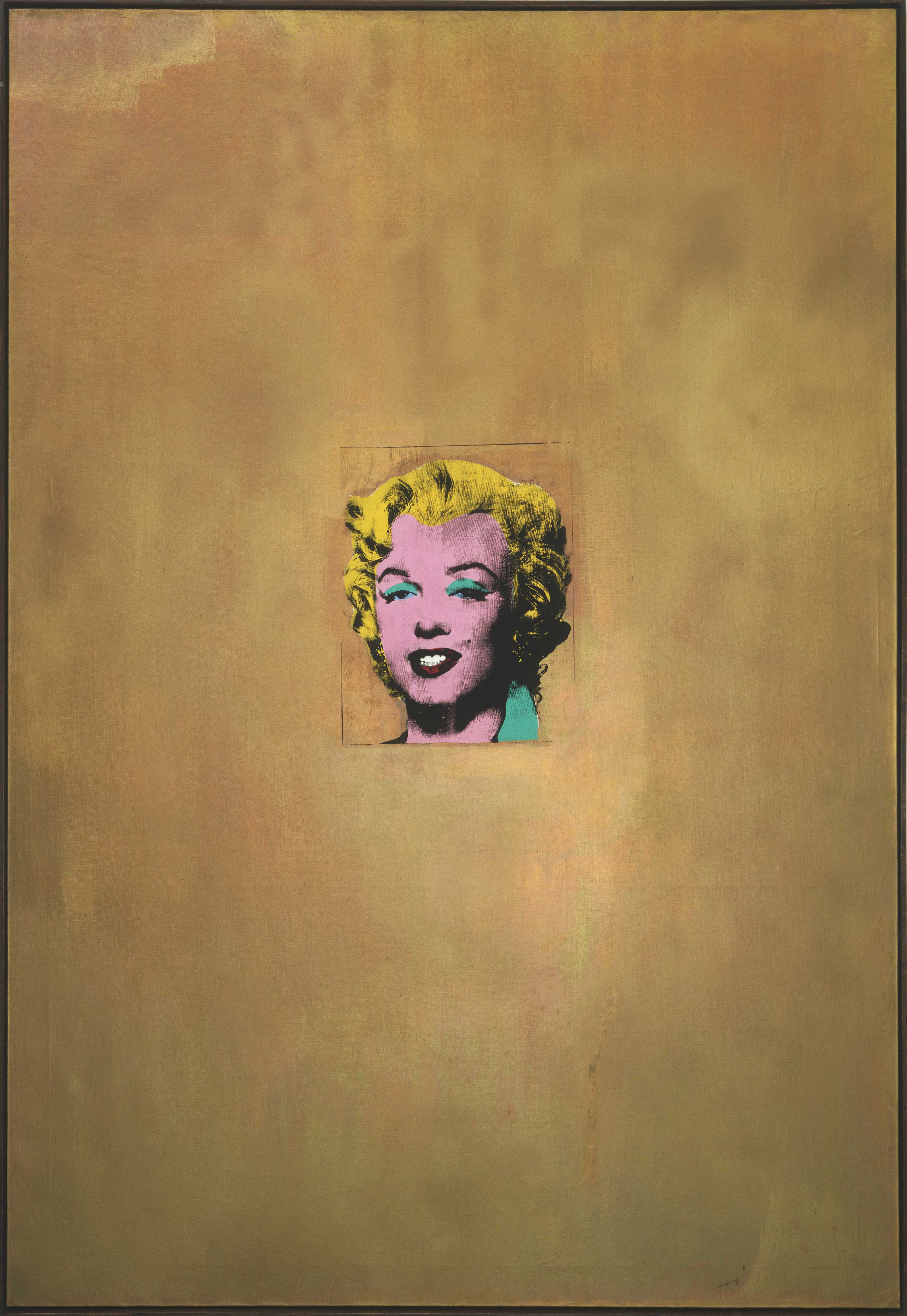
This portrait is on a publicity still from the 1953 film Niagara. The portrait of the actress, Marilyn Monroe, is painted on a background of gold. Her hair is bright yellow. Her eyelids and shirt collar are bright green. Her lips are vivid red. Her teeth are bright white. Her face and neck are pink.
Click to enlarge
© 2016 The Andy Warhol Foundation for the Visual Arts, Inc./Artists Rights Society (ARS), New York/Digital Image © The Museum of Modern Art/Licensed by SCALA/Art
Resource, NY
Multiple-Choice Question
Looking at just the style of the last painting above, when and where do you think it was created?
10/31/2020 HUM-200 - Page 1.1.4 - The Dance: An Artist and You
https://www.webtexts.com/courses/39511-sanderovsky/traditional_book/chapters/4391571-module-one-introduction-to-the-humanities/pages/3897030 12/13
United States, 20th century Britain, 18th century China, 12th century Italy, 14th century
What Is Expected of the Viewer?
A great deal can be gained from just viewing a work of art. That might seem simple, but it is actually a high bar for many people. Most people are not concentrating on, paying attention to, or thinking about what they are looking at. This is not an elitist condemnation. I spend most of my time not concentrating on, paying attention to, or thinking about what I am looking at. But art offers us a break from that routine of distraction and invites us to spend some time on focused looking, reading, or listening.
In fact, in a circular fashion, engaging with the visual arts and humanities is a means of developing the very skills that are required to engage with them. The more time spent looking at art, the easier it becomes to look carefully. This thoughtful observation is a skill that translates to every part of life.
A great work of art is usually a work that rewards sustained looking. There are lots of images and objects in the world, and most of them do not reward anything more than a passing glance. But looking at a painting by Rembrandt for more than five seconds is worth your time. (And if you don’t connect with Rembrandt, maybe Monet will do.)
What is required of you as the viewer? Not much and a lot. Like most viewers, you probably already have what you need in order to have a meaningful experience with a work of art. You don’t need a PhD. All you need is patience and a willingness to engage in careful observation.
If patient observation isn’t your strong suit, don’t worry. Thankfully, you and the artist usually aren’t alone on the dance floor. The art historian is standing by to help you. What does the art historian contribute? In many cases, an art historian is someone who has developed the skill of careful and thoughtful observation. A good art historian is someone who can take others through the process of looking in a way that enables them to better develop this skill.
The art historian also brings external knowledge to the process of looking at the work. This could be knowledge about the subject depicted, the artist, the historical context, the method used, and so on. This knowledge can further enhance the experience of looking. Knowing a little about the book of Genesis and the Italian Renaissance, for
10/31/2020 HUM-200 - Page 1.1.4 - The Dance: An Artist and You
https://www.webtexts.com/courses/39511-sanderovsky/traditional_book/chapters/4391571-module-one-introduction-to-the-humanities/pages/3897030 13/13
example, will enhance the experience of looking at the ceiling of the Sistine Chapel. With the art historian helping you understand what you’re looking at, you’ll be able to connect with the artist and the work in a dance of creation and appreciation.
Multiple-Choice Question
Which of the following is the BEST way to engage with a work of art?
Share how you feel about art in general with a classmate or friend. Search the internet for information about the artwork. Take your time and experience the artwork with your full attention. Observe the artwork quickly to save time.
Response Board Describe your experience with a work of art you spent considerable time with, such as a book you’ve read multiple times or a favorite song, film, photograph, or sculpture. What did you come to appreciate in that work as a result of the additional time you spent with it?
No response saved yet.
close
Share your thoughts with your peers...