2 pages essay
 xiaoxiliuuu
 GoogleSearch_Hyper-visibilityasaMeansofRenderingBlackWomenandGirlsInvisible_InVisibleCulture_AnElectronicJournalforVisualCulture.pdf
1/3/17, 3:31 PMGoogle Search: Hyper-visibility as a Means of Rendering Black Women and…nvisible | InVisible Culture: An Electronic Journal for Visual Culture
Page 1 of 40http://ivc.lib.rochester.edu/google-search-hyper-visibility-as-a-means-of-rendering-black-women-and-girls-invisible/
ABOUT CONTACT CONTRIBUTE
ISSUE 19 , PAST ISSUES
Published on October 29, 2013 — Leave a comment
Google Search: Hyper-visibility as a Means of Rendering Black Women and Girls Invisible
written by IVC Author
Sa!ya Umoja Noble
Introduction
Google has become a central object of study for digital media scholars due to the power
and impact wielded by the necessity to begin most engagements with social media via a
search process, and the near-universality with which Google has been adopted and
embedded into all aspects of the digital media landscape to respond to that need.
Therefore, the near-ubiquitous use of search engines, and Google, in particular, in the
United States demands a closer inspection of what values are assigned to race and gender in
classi!cation and web indexing systems and the search results they return. It also calls for
explorations into the source of these kinds of representations and how they came to be so
fundamental to the classi!cation of human beings. In this research, I am interested in
knowing two things: what kinds of results do Google’s search engine provide about Black
girls when keyword searching, and what do the results mean in historical and social
1
1/3/17, 3:31 PMGoogle Search: Hyper-visibility as a Means of Rendering Black Women and…nvisible | InVisible Culture: An Electronic Journal for Visual Culture
Page 2 of 40http://ivc.lib.rochester.edu/google-search-hyper-visibility-as-a-means-of-rendering-black-women-and-girls-invisible/
contexts? I also want to know in what ways does Google reinforce hegemonic narratives. To
answer these questions, I use Critical Discourse Analysis as a method to explore the ways
that Google Search results on the words “Black girls” discursively re"ect hegemonic social
power and racist and sexist bias. This research points toward a type of cultural hegemony
within Google’s results on racialized and gendered identities, which prioritize the interests
of its commercial partners and advertisers, rather than rendering the social, political and
economic interests of Black women and girls visible.
It is dominant narratives about the objectivity and popularity of web search results that
make misogynist or racist search results appear to be natural. Not only do they seem
“normal” due to the technological blind spots of users who are unable to see the
commercial interests operating in the background of search (deliberately obfuscated from
their view), they also seem completely unavoidable because of the perceived “popularity”
of sites as the factor that li#s websites to the top of the results’ pile. Furthermore, general
belief in myths of digital democracy emblematized in Google and its search results means
that users of Google give consent to the algorithms’ legitimacy through their continued use
of the product, despite its ine$ective inclusion of websites that are decontextualized from
social meaning, and Google’s wholesale abandonment of responsibility for its search
results.
To start revealing some of the processes involved, it is important to think about how results
appear. Although one might believe that a query into a search engine will produce the most
relevant and therefore useful information, it is actually predicated upon a matrix of ways in
which pages are hyperlinked and indexed on the web, which has been carefully detailed by
Mark Levene. Rendering web content (pages) !ndable via search engines is an expressly
social, economic, and human project —in which this goal is turned into a set of steps
(algorithm) implemented by programming code, and then naturalized as “objective.” This
process is algorithmic, scienti!c and mathematical by virtue of the procedural and
mechanistic practices of tracing links among pages and legitimated as a process of
“voting.” For the most part, many of these processes have been automated or they happen
through Graphical User Interfaces (GUIs) that allow people who are not programmers (i.e.
not working at the level of coding) to engage in sharing links to and from websites.
Research shows that users typically use very few search terms when seeking information in
2
3
4
5
6
1/3/17, 3:31 PMGoogle Search: Hyper-visibility as a Means of Rendering Black Women and…nvisible | InVisible Culture: An Electronic Journal for Visual Culture
Page 3 of 40http://ivc.lib.rochester.edu/google-search-hyper-visibility-as-a-means-of-rendering-black-women-and-girls-invisible/
a search engine and rarely use Advanced Search queries, as most queries are di$erent from
traditional o%ine information seeking behavior. This front-end behavior of users appears
to be simplistic. However, the information retrieval systems are complex, and the
formulation of users’ queries involves cognitive and emotional processes that are not
necessarily re"ected in the system design. In essence, while users use the most simple
queries they can in a search box because of the way interfaces are designed, this does not
always re"ect how search terms are mapped against more complex thought patterns and
concepts that users have about a topic. This disjunction between, user queries and their real
questions on the one hand, and information retrieval systems on the other, makes
understanding the complex linkages between the content of the results that appear in a
search, and their import as expressions of power and social relations of critical importance.
Additionally, the public generally trusts information found in search engines. Yet, much of
the content surfaced in a web search in a commercial search engine is linked to paid
advertising, in part, which helps drive it to the top of the page rank, and searchers are not
typically clear about the distinctions between “real” information and advertising.
Racial and gender bias in Google search
Search is one of the most under-examined aspects of power and consumer protections
online, and regulation in the provision of information to the public through the
Internet. I contend that there is value in expanding the discourse about search engine
results by examining its intersecting racial and gendered bias. By taking a deep look at a
snapshot of the web, at a speci!c moment in time and interpreting the results against the
history of race in U.S. society, there is an opportunity to make visible processes that are
biased in their impact, but obscured through the rhetoric of technology’s neutrality and
popular acceptance in being merely a tool for human use. Therefore, this study is
theoretically concerned with using critical race theory and Black feminism, to examine
the commercial co-optation of keywords on Black identity. Google and other information
monopolies like it have the ability to prioritize web search results based on a variety of
interests. In this case, the clicks of users coupled with the commercial processes that allow
paid advertising to be prioritized in search results mean that representations of women
(particularly Black women who are codi!ed as “girls”) are frequently ranked on a search
engine page in ways that underscore their lack of status in society. Although I have
collected searches on many racialized and gendered identities in the United States, the
7
8
9
10
11 12
13
1/3/17, 3:31 PMGoogle Search: Hyper-visibility as a Means of Rendering Black Women and…nvisible | InVisible Culture: An Electronic Journal for Visual Culture
Page 4 of 40http://ivc.lib.rochester.edu/google-search-hyper-visibility-as-a-means-of-rendering-black-women-and-girls-invisible/
scope of this article is limited to a discussion of a search on “Black girls.” Certainly, there
are many misrepresentations of identity in commercial search, and comparisons and
critical analysis of these identities will be the subject of future research. Searches on girls of
color, as demonstrated by the speci!c discussion of Black girls, show the ways in which
membership in gendered and racialized groups is highly sexualized and even stigmatized.
This is not unlike the ways in which men, boys and Whites are characterized or
represented, as even these are not without challenge due to lack of historical and social
context for the nuances and importance of identity. My research is focused on leveraging
the knowledge stemming from the digital humanities and social sciences to improve upon
how identity information is portrayed in search engines, free from commercial in"uence,
constraint and co-optation. Moreover, and this close reading of Black girls is intended to
inform our recognition that there are problems with the way in which community based
identities are unprotected and continually subject to the in"uence of commercialization.
Google’s algorithmic practices of biasing information toward the interests of the powerful
elites in the United States, while at the same time presenting its results as generated from
objective factors has resulted in a provision of information that perpetuates the
characterizations of women and girls through misogynist and porni!ed websites. Stated
another way, it can be argued that Google functions in the interests of its most in"uential
(i.e. moneyed) advertisers or through an intersection of popular and commercial interests.
Yet Google’s users think of it as a public resource, generally free from commercial interest
—this fact likely bolstered by Google’s own posturing as a company for whom the informal
mantra, “Don’t be evil,” has functioned as its motivational core.
Further complicating the ability to contextualize Google’s results is the power of its social
hegemony. At the heart of the public’s general understanding and trust in commercial
search engines like Google, is a belief in the neutrality of technology—a technologically
deterministic blind spot to the embedded social values in technology design itself—which
only obscures our ability to understand the potency of misrepresentation that further
marginalizes and renders the interests of Black women, coded as girls, invisible. On its
own, commercial search does not provide appropriate social, historical, and contextual
meaning to those who historically have been portrayed in racialized and hyper-sexualized
ways. In this study, the reader will !nd a more meaningful understanding of the kind of
harm that such limitations can cause for users reliant upon the web as an artifact of both
14
15
16
17
1/3/17, 3:31 PMGoogle Search: Hyper-visibility as a Means of Rendering Black Women and…nvisible | InVisible Culture: An Electronic Journal for Visual Culture
Page 5 of 40http://ivc.lib.rochester.edu/google-search-hyper-visibility-as-a-means-of-rendering-black-women-and-girls-invisible/
formal and informal culture.
Online racial disparities cannot be ignored in search because it is part of the organizing
logic within which information communication technologies proliferate, and the Internet
is both reproducing social relations and creating new forms of relations based on our
engagement with it. Search technologies themselves and their design do not dictate racial
ideologies; rather, they both re"ect and re-instantiate the current social climate and
prevailing social and cultural values. As users engage with technologies like search engines,
they dynamically co-construct content within the technology itself. For example, clicking
on links and hyperlinking websites together is one way of a$ecting search results—but only
one. Results are partially a matter of algorithms, which include the ways that users have
engaged with sites in the past. Online information and content available in search is also
structured systemically by the infusion of advertising revenue and the surveillance of user
searches, over which the subjects of such practices have very little ability to reshape or
reformulate.
Hyper-visibility as a Means of Rendering Black Women and Girls Invisible Online
The potency of Google is that it functions as the dominant “symbol system” of society due
to its prominence as the most popular search engine to date, and through its market
dominance. Yet, rather than !nd access to empowerment on the !rst page of search, we
!nd another site of struggle. The narrative of Black girls as pornographic object diminishes
the prioritization of feminist knowledge and information in commercial search.
Black Feminist scholars are increasingly looking at how Black women are portrayed in the
media across a host of stereotypes, including pornography, and I am adding to this
tradition by looking at the web. Jennifer C. Nash foregrounds the complexities of Black
women and pornography in ways that are helpful by theorizing that the ways in which
Black women are sexualized is contingent upon racist narratives, which are both historical
and pro!table. As a result, Black feminists have typically aligned with anti-pornography
rhetoric and scholarship to respond to this phenomenon. While this research is not a
speci!c study in the nuances of Black women’s agency in Internet pornography, which
Mireille Miller-Young has covered in detail, or the virtues and problematics of
pornography; in general, this literature is helpful in explaining how women are displayed
17
18
19
20
21
22
23
1/3/17, 3:31 PMGoogle Search: Hyper-visibility as a Means of Rendering Black Women and…nvisible | InVisible Culture: An Electronic Journal for Visual Culture
Page 6 of 40http://ivc.lib.rochester.edu/google-search-hyper-visibility-as-a-means-of-rendering-black-women-and-girls-invisible/
as pornographic search results. I therefore integrate Nash’s expanded views about racial
iconography into a Black feminist visual studies framework to help interpret and evaluate
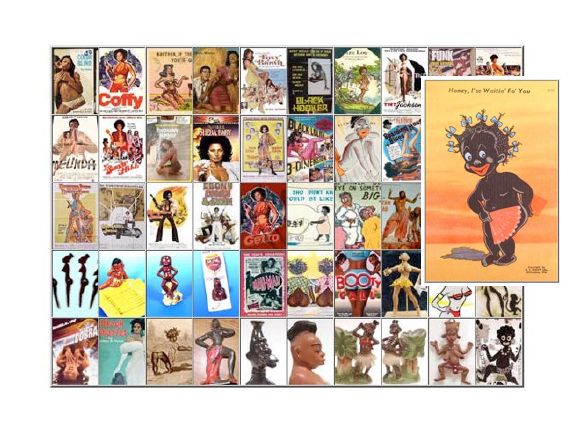
the Google search results. These iconic representations can be seen over time in Fig. 1.
Figure 1.Figure 1. One dominant narrative stereotype of Black women: The Jezebel Whore, depicted in more than 100 years of cultural artifacts. Source: Jim Crow Museum of Racist Memorabilia at Ferris State University.
It is important then to locate the current online narratives in historical and social context,
which I believe re"ect the furthering of hegemonic, dominant narratives of Black women
as hypersexualized and oversexed, and serve as a silencing mechanism in the e$orts to gain
greater social, political, and economic agency. Speci!cally, cultural images and symbols
inject dominant social biases into search engine results by transmitting a coherent set of
meanings that evolve historically. By foregrounding pornography as the most important or
meaningful kind of information about Black women, as Google did in the 2011 rankings I
have examined, these narratives are made most meaningful.
24
1/3/17, 3:31 PMGoogle Search: Hyper-visibility as a Means of Rendering Black Women and…nvisible | InVisible Culture: An Electronic Journal for Visual Culture
Page 7 of 40http://ivc.lib.rochester.edu/google-search-hyper-visibility-as-a-means-of-rendering-black-women-and-girls-invisible/
In the !eld of Internet and media studies, much of the research interest and concern of
scholars about harm in imagery and content online has been framed around the social and
technical aspects of addressing Internet pornography, but less so about the existence of
commercial porn, which is a less desirable subject of study. As a result, Black women and
girls are both under-studied by scholars and associated with “low culture” forms of
representation. This blind spot in research is directly linked to the positionality of Black
women and women of color as less suitable subjects of inquiry in scholarly publishing, in
general.
The porn industry was valued at $96 billion in 2006 and encompasses an estimated 420
million pages of porn on the Internet, 4.2 million websites dedicated to porn, and 68
million search engine requests for porn every day. There is a robust political economy of
pornography, which is an important site of commerce and technological innovation that
includes !le sharing networks, video streaming, e-commerce and payment processing, data
compression, search, and transmission. Gail Dines discusses this web of relations that she
characterizes as stretching “from the backstreet to Wall Street.” Black women are more
racialized and stereotyped in pornography—explicitly playing o$ of the media
misrepresentations of the past, and leveraging the notion of the Black woman as “ho”
through the most graphic types of porn in the genre. Miller-Young underscores the
fetishization of Black women that has created new markets for porn, explicitly linking the
racialization of Black women in the genre, as evidenced in the kinds of representations
Google surfaced to the top.
Women’s bodies serve as the site of sexual exploitation and representation under
patriarchy, but Black women serve speci!cally as the deviant of sexuality when mapped in
opposition to White women’s bodies. Identities of Black women and black girls are a
pro!table site of taboo sexuality and are positioned as a type of “truth” based on public
trust in the credibility of Google search. bell hooks details the ways that Black women’s
representations are o#en porni!ed by White and patriarchally-controlled media, and that,
while some women are able to resist and struggle against these violent depictions of Black
women, others co-opt these exploitative vehicles and expand upon them as a site of
personal pro!t. Miller-Young’s research on the political economy of pornography is
important to understanding how Black women are commodi!ed through the
“‘porni!cation’ of hip-hop and the mainstreaming and ‘diversi!cation’ of pornography.”
25
26
27
28
29
30
31
32
33
34
35
1/3/17, 3:31 PMGoogle Search: Hyper-visibility as a Means of Rendering Black Women and…nvisible | InVisible Culture: An Electronic Journal for Visual Culture
Page 8 of 40http://ivc.lib.rochester.edu/google-search-hyper-visibility-as-a-means-of-rendering-black-women-and-girls-invisible/
The web itself has opened up new centers of pro!t and pushed the boundaries of
consumption. Never before have there been so many points for the transmission and
consumption of these representations of Black women’s bodies. It is in this tradition, then,
that studying the discursive realm of text, image, and meaning prioritized in web search
can be bene!cial to studying race and gender on the Internet. This, coupled with the
advertising costs associated with racial and gender identities brokered by Google can help
make sense of the trends that make Black women and girls’ sexualized bodies a lucrative
marketplace on the web. In this case, I contextualize porn on the Internet as an expansion
of capitalist interests.
The Reproduction of Racialized and Gendered Power Relations
Noticeably absent in the discussions of Google’s near-monopoly status is the broader, social
and technical interplay that exists dynamically in how technology is increasingly mediating
public access to information, from libraries to the search engine. Lack of attention to the
current exploitative nature of online keyword searches only further entrenches the
problematic misrepresentations in the media for women of color, since the Internet and its
landscape o$er up and eclipse traditional media distribution channels, and serve as a new
infrastructure for delivering all forms of prior media: television, !lm, and radio, as well as
new media which are more social and interactive. Taking these old and new media
together, it can be argued, as Jessica L. Davis and Oscar H. Gandy do, that the Internet has
signi!cant in"uence on forming opinions on race and gender. Representations of women
and people of color in the traditional mass media, akin to those I discuss here in search
results, have been problematized by many scholars and the Internet is part of the
landscape of new media where race and representation are being investigated. Despite
the rhetoric of freedom, and the contradictions that Wendy Chun articulates in her work
on how the Internet has been sold as a source of freedom, the reorganization of
economic and social relations in the shi# from the industrial to “information society” has
led to even more uneven distributions of capital around the globe and a reconstitution of
social and economic relations predicated upon “information haves and have nots.” What
this analysis underscores is that biased traditional media processes are being replicated, if
not more aggressively, around Black girls (and women’s) misrepresentations in search. This
is important because the web has been embraced as a liberating tool in the age of digital
technology. Information, knowledge, and culture are central to human freedom and
36
37
38
39
40
1/3/17, 3:31 PMGoogle Search: Hyper-visibility as a Means of Rendering Black Women and…nvisible | InVisible Culture: An Electronic Journal for Visual Culture
Page 9 of 40http://ivc.lib.rochester.edu/google-search-hyper-visibility-as-a-means-of-rendering-black-women-and-girls-invisible/
human development. How these are produced and exchanged in our society critically
a$ects the way we see the state of the world as it is and might be; who decides these
questions; and how we, as societies and polities, come to understand what can and ought to
be done.
In fact, many aspects of these uneven distributions of power are predicated upon racialized
and gendered practices—from extraction practices in the making of microchip processors,
to computer hardware manufacturing through the disposal of e-waste. These practices are
o#en hidden from view and rendered invisible. Sarah T. Roberts’ research underscores, for
example, the various hidden aspects of digital labor that are o#en racialized and gendered
in video content moderation—a key service used by giant media companies like Facebook
or Google’s subsidiary, YouTube. She notes that practices of determining which kind of
content (video) is allowed to proliferate in online commercial spaces, which:
…introduces the existence of actors unknown to and unseen by the vast majority of end-users who are nevertheless critical in the production chain of social media-making
decisions… It paints a disturbing view of an unpleasant work task that the existence of social media and the commercial, regulated Internet, in general, necessitate.
These labor pools are o#en racialized and gendered, as are the values upon which
moderation takes place. What this work underscores are the myriad ways that decision-
making processes are happening within the platform, via both human and algorithmic
protocols and other human interventions.
Roberts’s research intersects the !ndings of this study by pointing to how the results that
surface on the web in commercial spaces like Google are not neutral processes—they are
linked to human experiences, decision-making, and culture. Amidst a host of complaints
about the lack of transparency in Google’s search technology, the company released an
infographic in early 2013 on how its algorithm works. The company explained that it
currently indexes over 30 trillion web pages through hyperlinks, sorts the content based on
more than 200 factors, and !lters out spam to ensure high quality information is provided
in its search technology. What is important about this latest information release from
Google is its acknowledgement that its employees make programs and algorithms in “The
Search Lab” and that the ideas for search are a product not of the algorithm on its own (as it
41
42
43
44
45
1/3/17, 3:31 PMGoogle Search: Hyper-visibility as a Means of Rendering Black Women and…nvisible | InVisible Culture: An Electronic Journal for Visual Culture
Page 10 of 40http://ivc.lib.rochester.edu/google-search-hyper-visibility-as-a-means-of-rendering-black-women-and-girls-invisible/
suggests in its explanation for why we get objectionable content on some searches ) but as
a product of its engineers.
Search is Not Democratic for Black Women and Girls
There are many myths about Internet search engines that proliferate, including the notion
that what rises to the top of the information pile is strictly what is most popular as
indicated by hyperlinking. Indeed, what is most popular on the web is not necessarily what
is most trustworthy or truthful. It is on this basis I contend there is work to be done to
contextualize and reveal the many ways that Black women are framed in sexist language
that renders them “girls” and misrepresented commercial search. This warrants an
exploration into the complexities of whether the content surfaced is a result of popularity,
credibility, commerciality—or even a combination thereof. Borrowing from Matthew S.
Hindman’s critique of the "awed logic that web results are the result of democratic
processes (e.g., we vote with our clicks and only what is most popular rises to the top), the
outcome of the searches I studied in 2011 would suggest that both sexism and pornography
were, at that time, the most “popular” values on the Internet when it came to women,
especially Black women and Black female children. In reality, there is more to result-
ranking than just how we vote with our clicks and various expressions of sexism and
racism are related, as my research shows.
At the time this study was conducted, Google had not yet launched its new
“personalization” tools which are designed to incorporate past search histories and help
shape and tailor search results based on past places that have been visited online, so it is
important to understand how this new protocol by Google might impact future results. A
2011 study by Martin Feuz, Matthew Fuller, and Felix Stalder found that personalization is
not simply a service to users, but rather a mechanism for better matching consumers with
advertisers, and that Google’s personalization or aggregation is about actively matching
people to groups; that is, categorizing individuals. Personalization is, to some degree,
giving people the results they want based on what Google knows about its users, but it is
also generating results for viewers to see that Google calculates might be good for its
advertisers. As a result of these practices, increasing attention is being paid to how the
Internet acts as the space within which the attention, desires, and free labor of users are
harnessed into surplus value. This new wave of digital interactivity, and its blind spots, is
45
46
47
48
49
1/3/17, 3:31 PMGoogle Search: Hyper-visibility as a Means of Rendering Black Women and…nvisible | InVisible Culture: An Electronic Journal for Visual Culture
Page 11 of 40http://ivc.lib.rochester.edu/google-search-hyper-visibility-as-a-means-of-rendering-black-women-and-girls-invisible/
on the minds of many critical communications scholars, and has been an extensive site of
inquiry about labor and the digital age.
Not only do search engines o#en track and remember the digital traces of where we have
been and what links we have clicked in order to provide more custom content (a practice
that has begun to gather more public attention a#er Google announced it would use past
search practices and link them to users in its privacy policy change in 2012 ), but search
results also vary depending on whether !lters to screen out pornography are enabled on
computers. Information that surfaces to the top of the search pile is not exactly the same
for every user in every location, and a variety of commercial advertising, political, social,
and economic decisions are linked to the way search results are coded and displayed. At the
same time, results are generally quite similar, and complete search personalization—
customized to very speci!c identities, wants and desires—had yet to be developed in 2011.
Personal-identity personalization has less impact on a variation in results than generally
believed by the public.
Understanding Identity Online
This research focuses on the capture of search results at one moment in time, and I use
Critical Discourse Analysis as a method to make sense of what it means to get such results.
Although I am focusing on Black women and girls, I try to resist the notion of essentializing
the racial and gender binaries; however, I do acknowledge that the discursive existence of
these categories, “Black” and “women/girls,” is shaped in part by power relations in the
United States that tend to essentialize and reify such categories. Thomas Nakayama and
Robert Krizek discuss the possibilities for understanding how racial identities are
constructed and otherized in relation to largely under-examined sites of White
identity. In seeking this object of analysis, I am actively engaging in an e$ort to unveil the
hegemonic ways in which intersecting racialized and gendered identities are portrayed and
legitimated through Google search. André Brock adds that “the rhetorical narrative of
‘Whiteness as normality’ con!gures information technologies and so#ware designs” and is
reproduced through digital technologies. Thus, hegemonic discourses about the
hypersexualized Black woman, which exist o%ine in traditional media, are instantiated
online as evidenced by my discussion of search results in Google.
50
51
52
53
54
1/3/17, 3:31 PMGoogle Search: Hyper-visibility as a Means of Rendering Black Women and…nvisible | InVisible Culture: An Electronic Journal for Visual Culture
Page 12 of 40http://ivc.lib.rochester.edu/google-search-hyper-visibility-as-a-means-of-rendering-black-women-and-girls-invisible/
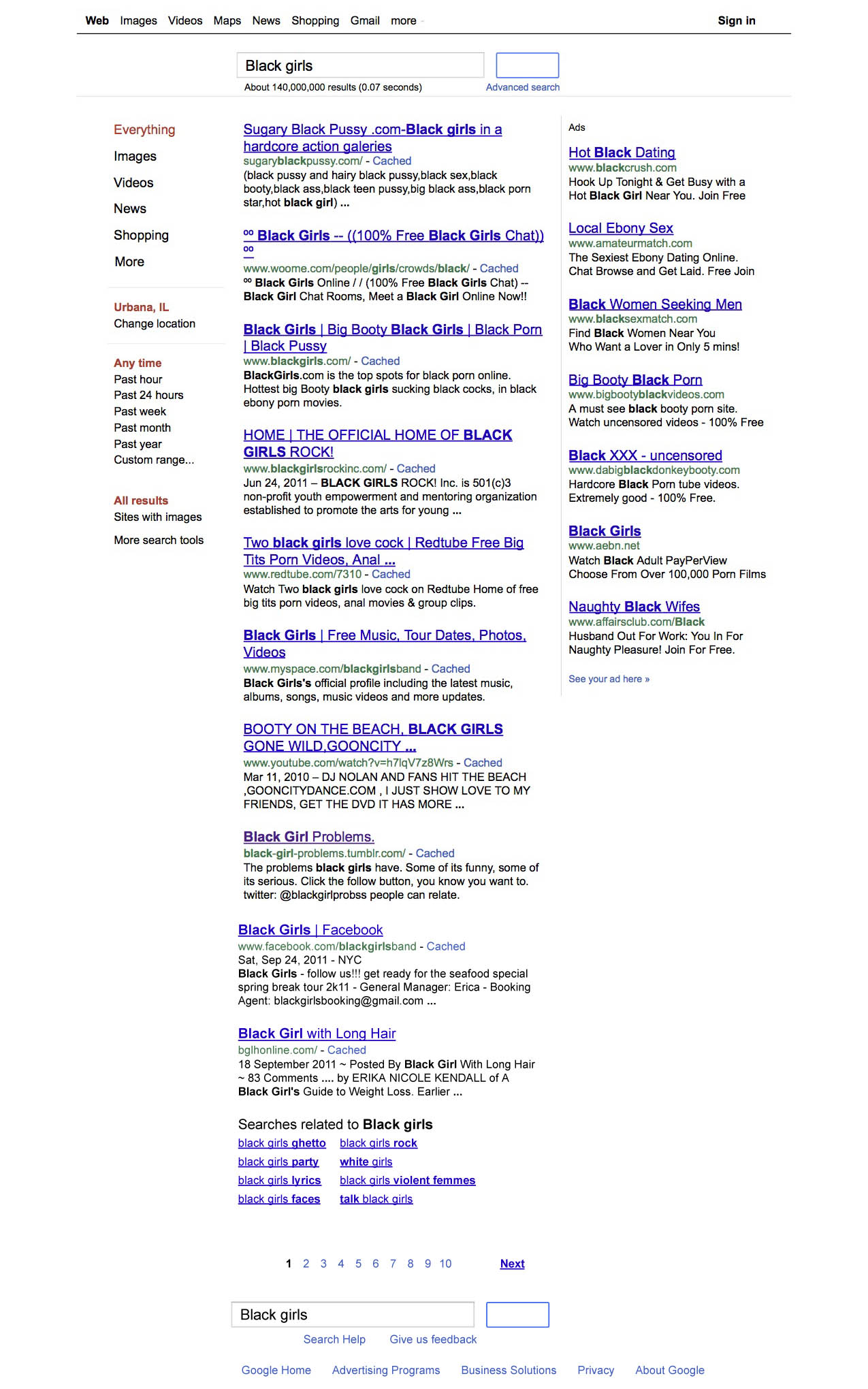
The following screen shot [Fig. 2] was captured on September 18, 2011 and re"ects the way
in which results were prioritized from Google’s indexed pages on the web:
1/3/17, 3:31 PMGoogle Search: Hyper-visibility as a Means of Rendering Black Women and…nvisible | InVisible Culture: An Electronic Journal for Visual Culture
Page 13 of 40http://ivc.lib.rochester.edu/google-search-hyper-visibility-as-a-means-of-rendering-black-women-and-girls-invisible/
Figure 2.Figure 2. Search on the keywords Black Girls on September 18, 2011
In Fig. 2, Black girls are sexualized or porni!ed in half (50%) of the !rst ten results on the
keyword search “Black girls.” Only three of ten results (30%) are blogs focused on aspects of
social or cultural life for Black women and girls. One of the !rst ten results is a U.K. music
band comprised of White men, and is coded as non-racial and non-gendered.
What these results point to is the commodi!ed nature of Black women’s bodies on the web
—and the little agency that Black female children (girls) have had in securing non-porni!ed
narratives and ideations about their identities on the !rst page of search engine results.
These results can be thought of as a visible representation of the ways in which Black girls
as a sector of society are represented on any given day in Google’s search process. It is
plausible at any given moment under the current search engine mechanism at play that
other results might be prioritized. In fact, a year prior to this search, in 2010, the website
www.hotblackpussy.com was the !rst result in a search on the term “Black girls.” By the end
of 2012, Google’s algorithm had changed or search optimization techniques had been
employed and the results had shi#ed to www.blackgirlsareeasy.com. As these results shi#
over time, what is clear is that the relationship between advertising and keywords, and that
there is a lack of broader agency that exists at the abstracted level of community or group
for women to in"uence their porni!ed representations.
A Critical Approach to Search
This raises questions about who owns identity and identity markers in cyberspace, and
1/3/17, 3:31 PMGoogle Search: Hyper-visibility as a Means of Rendering Black Women and…nvisible | InVisible Culture: An Electronic Journal for Visual Culture
Page 14 of 40http://ivc.lib.rochester.edu/google-search-hyper-visibility-as-a-means-of-rendering-black-women-and-girls-invisible/
whether racialized and gendered identities are ownable property rights that can be
contested in cyberspace. One can argue, as I am, that social identity is both a process of
individual actors participating in the creation of identity, but also a matter of social
categorization that happens at a socio-structural level and as a matter of personal de!nition
and external de!nition. According to Mary Herring, Thomas B. Jankowski and Ronald E.
Brown, Black identity is de!ned by an individual’s experience of common fate with others
in the same group. The questions of speci!c property rights to naming and owning
content in cyberspace are an important topic. I argue that racial markers are a social
categorization that is both imposed and adopted by groups. Thus, racial identity terms
could be claimed as the property of such groups, much the way Whiteness has been
constituted as a property right for those who possess it. This is a way of thinking about
how mass media has co-opted the external de!nitions of identity —racialization —which
also applies to the Internet and its provision of information to the public:
Our relationships with the mass media are at least partly determined by the perceived
utility of the information we gather from them… Media representations play an important role in informing the ways in which we understand social, cultural, ethnic,
and racial di$erence.
Davis and Gandy argue that media have a tremendous impact on informing our
understandings of race and racialized others as an externality—but this is a symbiotic
process that includes internal de!nitions that allow people to lay claim to racial identity.
Critical Race Theory and critical discourse analysis allows for a deeper reading of what it
means for identity to be in the dialectical tension between the struggles for social justice
organized around collective identities and histories, and the commercialization of such
identities to sell products, services, and ideologies in an e$ort to accumulate greater pro!ts.
Using Critical Race Theory as a framework for implementing Norman Fairclough’s critical
discourse analysis means that I focus on the signi!ers that make up a text, the speci!c
linguistic selections that are apparent, the way in which they are juxtaposed, the sequencing
and layout on the page and so on. According to Fairclough, the study of texts and images
and the discursive ways they are used to represent people is important because it has direct
impact on what the receptive public believes. Images and the visual culture in the United
States are critical to the shaping of identity. This is not to say that people do not have
55
56
57
58
59
60
61
62
63
64
1/3/17, 3:31 PMGoogle Search: Hyper-visibility as a Means of Rendering Black Women and…nvisible | InVisible Culture: An Electronic Journal for Visual Culture
Page 15 of 40http://ivc.lib.rochester.edu/google-search-hyper-visibility-as-a-means-of-rendering-black-women-and-girls-invisible/
agency in re-shaping and re-constituting identity through texts, institutions, organizations,
political action, and other such engagements. However, what Fairclough stresses is the
causal e!ect of visual texts on belief—as they “contribute to establishing, maintaining and
changing social relations of power, domination and exploitation.” This critical view on
ideology is a fundamental part of understanding how to evaluate texts and images beyond
the descriptive content analysis methods that can report the kinds of words that appear in a
URL, sentence description, or advertisement, but fall short of being contextualized in
terms of power or domination among various social groups. Moreover, Mikhail Bakhtin
elucidates this idea that “utterances” are deeply embedded in speci!c cultural contexts:
The linguistic signi!cance of a given utterance is understood against the background of
language, while its actual meaning is understood against the background of other
concrete utterances on the same theme, a background made up of contradictory
opinions, points of view and value judgments—that is precisely that background that,
as we see, complicates the path of any word toward its object.
Indeed, the text and images on a web page also constitute “utterances” in the Bakhtinian
sense, and they operate and are positioned in a deeper context of racist and sexist cultural
representations and mischaracterizations of Black women and children over the course of
centuries.
By comparing the results and ads on the search for “Black girls” to broader social narratives
about Black women and girls in the dominant U.S. popular culture, we can see the ways in
which search engine technology replicates and instantiates derogatory notions. These
discourses include narratives of Black women as a series of historical and modern
stereotypes such as “Jezebel,” “Sapphire” and the “Mammy,” which are o#en met with
resistance by Black women and girls, and simultaneously, woefully internalized. During
slavery, stereotypes were used to justify the sexual victimization of Black women by their
property owners, given that under the law, Black women were property and therefore
could not be considered victims of rape. Manufacture of the Jezebel stereotype served an
important role in portraying Black women as sexually insatiable and gratuitous.
Understanding the power relations embedded in texts includes examining the actors
involved. In the case of looking at Internet search, I concede that there are a number of
65
66
67
68
69
70
1/3/17, 3:31 PMGoogle Search: Hyper-visibility as a Means of Rendering Black Women and…nvisible | InVisible Culture: An Electronic Journal for Visual Culture
Page 16 of 40http://ivc.lib.rochester.edu/google-search-hyper-visibility-as-a-means-of-rendering-black-women-and-girls-invisible/
actors and artifacts: the producers of websites, the words or text chosen for the URL,
sentence descriptions and advertisements, search engine algorithms and optimizers, media
conglomerates, advertisers, and search engine users who come across search results—all of
which are involved in the production of meaning. Published text and images on the web
can have a plethora of meanings, so attention must be paid to the implicit and explicit
messages about Black women as girls in both the texts of Internet search results or hits and
the paid ads that accompany them on the web page.
Analyzing Discursive Representations: Black Girls as Commodity Objects
There are theoretical ways to contextualize and analyze what it means to be characterized
through texts and images and how this is an expression of power relations. Michel Foucault
o$ers a meaningful way to think about the ways that discourse is located in “external
conditions of existence, for that which gives rise to the chance series of these events and
!xes its limits.” The porni!cation of identity, or its co-optation by industries that can
pro!t from it, are given rise from the current conditions upon which information access on
the web is largely a commercial venture in search. The conditions of Black women
identities (as girls) are also conditioned by the long history of media misrepresentation.
Therefore, in my analysis of search results, I do not look deeply at what advertisers or
Google may be intending to do. Instead, I focus on the social conditions that surround the
lives of Black people as they have been a$ected by conditions that allow such
representations to come to the fore. In order to more fully comprehend the Foucauldian
call for an examination of the “external conditions of existence,” Barney Warf and John
Grimes explore the counter-hegemonic discourses of the Internet by noting the stable
hegemonic notions of the web, which have persisted, and are part of the external logic that
buttresses and obscures social aspects of the web:
Much of the Internet’s use, for commercialism, academic, and military purposes,
reinforces entrenched ideologies of individualism and a de!nition of the self through
consumption. Many uses revolve around simple entertainment, personal
communication, and other ostensibly apolitical purposes… particularly advertising and shopping but also purchasing and marketing, in addition to uses by public agencies that
legitimate and sustain existing ideologies and politics as “normal,” “necessary,” or
“natural.” Because most users view themselves, and their uses of the Net, as apolitical,
71
72
73
1/3/17, 3:31 PMGoogle Search: Hyper-visibility as a Means of Rendering Black Women and…nvisible | InVisible Culture: An Electronic Journal for Visual Culture
Page 17 of 40http://ivc.lib.rochester.edu/google-search-hyper-visibility-as-a-means-of-rendering-black-women-and-girls-invisible/
hegemonic discourses tend to be reproduced unintentionally…Whatever blatant perspectives mired in racism, sexism, or other equally unpalatable ideologies pervade
society at large, they are carried into, and reproduced within, cyberspace.
One way of evaluating the quality of Google’s search results on identity is to try to make
sense of identity markers and the results found in search against what Foucault might
characterize as part of the logic of the web. Brock characterizes these transgressive
practices that couple technology design and practice with racial ideologies “as a social
structure, represents and maintains White, masculine, bourgeois, heterosexual and
Christian culture through its content…. These practices neatly recreate social dynamics online that mirror o%ine patterns of racial interaction by marginalizing women and
people of color.” What Brock points to is the way in which discourses about technology
are explicitly linked to racial and gender identity—normalizing Whiteness and maleness in
the domain of digital technology and as a presupposition for the prioritization of
resources, content, and even the design of information and communication technologies.
I use Fairclough’s critical discourse analysis model, which involves text analysis
(description), processing analysis (interpretation) and social analysis (explanation). I looked
at the page of search results and I clicked on the links to understand more deeply the
content that these headlines, URLs and sentences are describing:
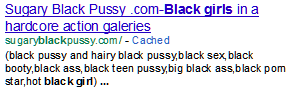
Figure 3.Figure 3. First result on the "rst page of a keyword search for Black girls in Google search engine on 09/18/11.
In the text for the !rst result [Fig. 3], the word “pussy,” as a noun, is used four (4) times to
describe Black girls. This necessitates an examination of the process by which the search
result is being produced and received. Another way of processing meaning and
interpreting the text as described above is to click on the links to see if the content of the
site being described is accurately re"ected in the description, URL and headline:
74
75
1/3/17, 3:31 PMGoogle Search: Hyper-visibility as a Means of Rendering Black Women and…nvisible | InVisible Culture: An Electronic Journal for Visual Culture
Page 18 of 40http://ivc.lib.rochester.edu/google-search-hyper-visibility-as-a-means-of-rendering-black-women-and-girls-invisible/
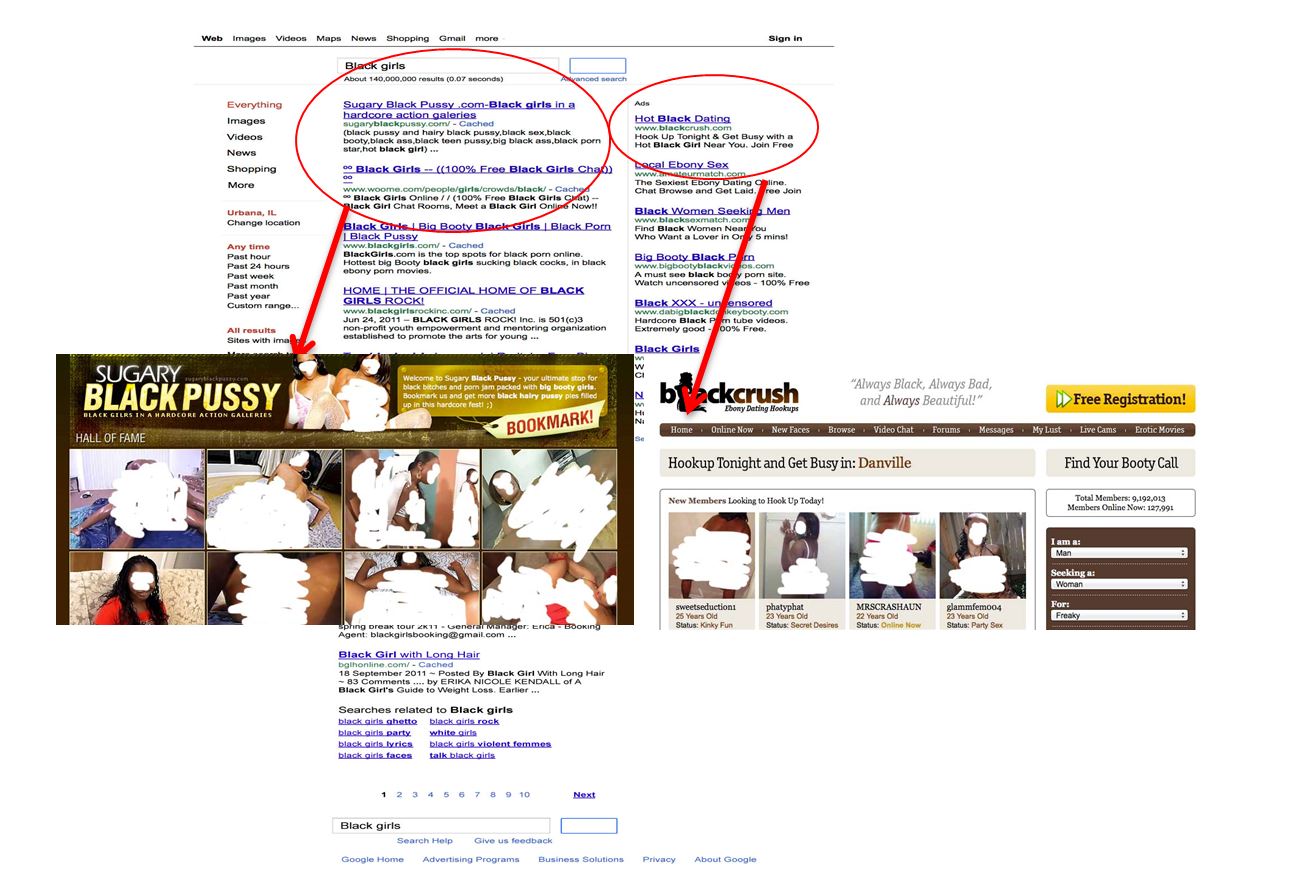
Figure 4.Figure 4. First page (partial) of results on Black girls in a Google Search with "rst result detail and advertising.
In the case of the !rst page of results on Black girls, I clicked on the link for both the top
search result (unpaid) and the !rst paid result, re"ected on the right hand side bar, where
advertisers who are willing to spend money through Google AdWords™ are able to have their content appear in relationship to these search queries [Fig. 4]. The advertising in
relationship to Black girls is hyper-sexualized and pornographic, even if it feigns to be
dating or social in nature. Additionally, some of the results like the U.K. rock band “Black
Girls” lack any relationship to Black girls. This is an interesting co-optation of identity, and
because of their fan following and possible search engine optimization strategies, they are
able to secure strong placement for the band’s fan site on the front page of Google.
What I am arguing is that it does not matter if searches for Black girls and porn are highly
popular, because a search on Black girls without including the word porn still gets you
76
1/3/17, 3:31 PMGoogle Search: Hyper-visibility as a Means of Rendering Black Women and…nvisible | InVisible Culture: An Electronic Journal for Visual Culture
Page 19 of 40http://ivc.lib.rochester.edu/google-search-hyper-visibility-as-a-means-of-rendering-black-women-and-girls-invisible/
porn. Because we cannot see Google’s algorithm to understand precisely why Black girls
and porn are linked, without including the term “porn” in the search, I am calling attention
to what the output is (the results), regardless of whether Google was intending a shortcut
because of the popularity of searching for Black girls (like many other women and girls’
identities), in 2011. Further, if all the Black girls were involved in looking for themselves
using the myth of digital democracy, they would still be outnumbered by porn searchers.
Thus, their identity is subject to control by people looking for porn, and porn searches do
not even have to be explicit. It is precisely this shortcut, if you will, of making porn and
Black girls synonymous that I am trying to point to as problematic for many women’s
identities. I use the search for Black girls, in this study, as an example that boldly illustrates
the point. Make no mistake, however, there are many identities that are grossly
misrepresented in commercial search.
Co-optation of identity has been discussed in broad terms for many individuals and
communities alike. As such, practices like “Google-bombing” (also known as Google-
washing), where people co-opt contents or terms and redirect them to unrelated content,
are impacting both SEO (Search Engine Optimization) companies and Google
alike. While Google is invested in maintaining quality of search results in PageRank™ and policing companies that attempt to “game the system”—as Brin and Page foreshadowed—
SEO companies do not want to lose ground in pushing their clients or their brands up in
PageRank™. Google-bombing is the practice of excessively hyperlinking to a website to cause it to rise to the top of PageRank™, but it is also seen as a type of “hit and run” activity that can deliberately co-opt terms and identities on the web for political, ideological, and
satirical purposes. Bar-Ilan has studied this practice to see if the e$ect of forcing results to
the top of PageRank™ has lasting e$ect on the result’s persistence, which can happen in well-orchestrated campaigns. A recent media spectacle of this nature is the case of
Republican Senator Rick Santorum of Pennsylvania, whose website and name was
associated with insults in order to drive objectionable content to the top of
PageRank™. Others who have experienced this kind of co-optation of identity or less than desirable association of their name to an insult include former President George W.
Bush and pop singer Justin Bieber.
At the level of community identity co-optation, Vaidhyanathan chronicles recent attempts
by the Jewish community and Anti-Defamation League to challenge Google’s priority
77
78
79
80
81
1/3/17, 3:31 PMGoogle Search: Hyper-visibility as a Means of Rendering Black Women and…nvisible | InVisible Culture: An Electronic Journal for Visual Culture
Page 20 of 40http://ivc.lib.rochester.edu/google-search-hyper-visibility-as-a-means-of-rendering-black-women-and-girls-invisible/
ranking to the !rst page of anti-Semitic, Holocaust-denial websites. So troublesome were
these search results that in 2011 Google issued a statement about its search process,
encouraging people to use “Jews” and “Jewish people” in their searches, rather than the
seemingly pejorative term “Jew”—claiming that they can do nothing about its co-optation
by White supremacist groups. It is important to note that Google has conceded the fact
that anti-Semitism as the primary information result about Jewish people is a problem,
despite its disclaimer that tries to put the onus for bad results on the searcher. Equally
troubling, in November of 2009, a Google image search for Michelle Obama produced a
Photoshopped image of the First Lady as a monkey. Vaidhnayatan reminds us that rather
than remove the image from its database, Google again posted the disclaimer about
o$ensive search results and skewed the algorithm to push her image further down the
image rankings.
Without such limits on derogatory, racist, sexist or homophobic materials, Google allows
its algorithm—which is laden with “sociopolitics” —to stand without debate while it
protests its ability to remove pages or addresses these injustices as a function of its
algorithm. I o$er that we must revisit the socio-historical and commercial conditions that
allow for some bodies to be sold as sexual commodity while others are assumed into the
role of consumer under the organizing principles of the private sector and the heterosexual
male gaze. In this case, Black women coded as girls’ online identities have been put back on
the auction block for sale to the highest bidders or the most technically savvy at web
optimization. The narratives of neutrality and objectivity dissuade those with legitimate
protests from powerfully arguing over misrepresentation—a practice that o#en renders
them invisible in having any e$ective power. Under the current rhetoric of search fairness
and objectivity, the seemingly neutral algorithms by Google cannot be held responsible,
nor can the authors of the mathematical language of the web search tool.
When I evaluated the types of advertising on the right hand side of the page for the term
“Black girls” it became apparent that these, too, were situated in the socio-historical
contexts of systemic forms of racism and sexism that make plausible a space for such
misrepresentation to both exist, and be legitimated. All of the ads were pornographic or
hypersexual and featured Black women who appear to be adults o$ering sex as the product
for sale. This is how we are to make sense of the results and tie them to the conditions of
possibility which created them: the hypersexualization and hyper-visibility of Black girls as
81
82
83
1/3/17, 3:31 PMGoogle Search: Hyper-visibility as a Means of Rendering Black Women and…nvisible | InVisible Culture: An Electronic Journal for Visual Culture
Page 21 of 40http://ivc.lib.rochester.edu/google-search-hyper-visibility-as-a-means-of-rendering-black-women-and-girls-invisible/
sex commodities renders other possibilities of Black girls representations non-existent for,
“Without much exaggeration one could say that to exist is to be indexed by a search
engine.” These conditions for such results are equally predicated upon the legacy of
domination over Black people in the United States, the entrapments of rape culture
under patriarchy, and the commodi!cation of women as pornographic objects. Taken
together, they articulate the disturbing commercial viability of Black girls as web
commodities.
Color-blindness and Neutrality as a Means of Silencing
Formulations of post-racialism presume that racial disparities no longer exist, within which
the color-blind ideology !nds momentum. George Lipsitz suggests that the challenge to
recognizing racial disparities and the social (and technical) structures that instantiate them
is a re"ection of the possessive investment in Whiteness—the inability to recognize how
hegemonic ideas about race and privilege mask the ability to see real social problems. In
the midst of the changing social and legal environment, inventions of terms and ideologies
of “color-blindness” disingenuously portend a more humane and non-racist worldview
alongside celebrations of “multiculturalism” and “diversity,” which obscure structural and
social oppression in !elds like computer and information sciences that are shaping
technological practices. Despite these conventions and ideologies that attempt to obscure
the salience of race in the United States, a critical look at Google search tells a di$erent
story about representation and the forms of legitimacy that are conferred upon women’s
identities. What is crucial about keyword searching is that Blacks’ and women’s status
o%ine is re"ected in the constructs of the Internet. Speci!cally, claims that the U.S. society
is moving toward greater social equality are undermined by data that show a substantive
decrease in access to home ownership, education, and jobs—especially for Black
Americans. Making race the problem of those who are racially objecti!ed, particularly
when seeking remedy from discriminatory practices, obscures the role of government and
the public to solve systemic issues.
Central to these “color-blind” ideologies is a focus on the inappropriateness of “seeing
race.” In sociological terms, color-blindness precludes the use of racial information and
does not distinguish any classi!cations or distinctions. Yet, despite the claims of color-
blindness, research shows that those who report higher racial color-blind attitudes are
84
85
86 87
88
89
90
91
92
93
94
1/3/17, 3:31 PMGoogle Search: Hyper-visibility as a Means of Rendering Black Women and…nvisible | InVisible Culture: An Electronic Journal for Visual Culture
Page 22 of 40http://ivc.lib.rochester.edu/google-search-hyper-visibility-as-a-means-of-rendering-black-women-and-girls-invisible/
more likely to be White, and more likely to condone or not be bothered by derogatory
racial images viewed in online social networking sites. In the midst of re-energizing the
e$ort to connect every American, and to stimulate new economic markets and innovations
that the Internet and global communications infrastructures will a$ord, the real lives of
those on the margin are being re-engineered. New terms and ideologies make a discussion
about such conditions problematic, if not impossible. This rhetoric of post-racialism and
colorblindness places the onus of discrimination or racism on the individual, or in the case
of Google, on the algorithm. Rather than situating problems a$ecting racialized groups in
social structures, those who call attention to the problems are made the problems
themselves.
These explorations of web results on the !rst page of a Google search also reveal the
default identities that are protected on the Internet or are less susceptible to
marginalization, porni!cation, and commodi!cation. Don Heider and Dustin Harp showed
that, in the early days of the web, even though women comprised just slightly over half of
Internet users, their voices and perspectives were not as loud nor did they have as much
impact online as those of men. Their research demonstrates how some users of the
Internet have more agency and can dominate the web, despite the utopian and optimistic
view of the web as a socially equalizing and democratic force. Their research on the male
gaze and pornography on the web argues, consistent with Annette Kuhn’s argument that
the Internet is a communication environment that privileges the male, pornographic
gaze, and marginalizes women as objects. Consistent with other forms of pornographic
representations, pornography both structures and reinforces the domination of women.
The previous articulations of the male gaze continue to apply to other forms of advertising
and media—particularly on the Internet, and this research expands the conversation about
the porni!cation of women on the web as an expression of racist and sexist hierarchies.
When these images are present, White women are the norm and Black women are over-
represented, while Latinas are under-represented. T. A. Gardner characterizes the nature
of the depictions of Black women in pornography by noting, “pornography capitalizes on
the underlying historical myths surrounding and oppressing people of color in this country
which makes it racist.” These characterizations translate from old media representations
to new media forms, which I have shown in this discrete artifact captured at one moment
in time.
95
96
97
98
99
100
101
102
103
1/3/17, 3:31 PMGoogle Search: Hyper-visibility as a Means of Rendering Black Women and…nvisible | InVisible Culture: An Electronic Journal for Visual Culture
Page 23 of 40http://ivc.lib.rochester.edu/google-search-hyper-visibility-as-a-means-of-rendering-black-women-and-girls-invisible/
The Internet has also been a contested space where the possibility of organizing women
along feminist values in cyberspace has had a long history. Judy Wajcman contributes a
feminist framework for theorizing the ways in which information and communication
technologies are posited as the domain of men, marginalizing not only the contributions of
women to ICT development, but in using these narratives to further instantiate
patriarchy. For Wajcman, men have used their control and monopoly over the domain
of technology to further consolidate their social, political and economic power in society:
“Instead of treating artifacts as neutral or value-free, social relations (including gender
relations) are materialized in tools and techniques. Technology was seen as socially shaped,
but shaped by men to the exclusion of women.” Equally, the rendering of people of color
as non-technical, the domain of technology “belongs” to Whites, and reinforces
problematic conceptions of African-Americans.
The work of Wajcman and Anna Everett outlines the historical development of narratives
about women and people of color, speci!cally African-Americans. Each of their projects
points to the speci!c ways in which technological practices prioritize the interests of men
and Whites. For Wajcman, “people and artifacts co-evolve, reminding us that ‘things could
be otherwise,’ that technologies are not the inevitable result of the application of scienti!c
and technological knowledge…The capacity of women users to produce new, advantageous readings of artifacts is dependent upon the broader economic and social
circumstances.” Adding to the historical tracings that she provides about early African-
American contributions to cyberspace, Everett notes that these contributions have been
obscured by “colorblindness” in mainstream and scholarly media. Institutional relations
predicated upon gender and race situate women and people of color outside of the power
systems from which technology arises. Dominance is mutually constituted within
technologies, and the marginalization of women and non-Whites is a byproduct of such
entrenchments, design choices, and narratives about technical capabilities.
In the face of dominant narratives of the Internet as a mechanism for progress and
advancement, and of increased pluralism through computer mediated
communications, both of which notions have been contested, I agree with previous
scholars that the structural inequalities of society are being reproduced on the Internet,
and that the quest for a race-, gender- and classless cyberspace could only “perpetuate and
reinforce current systems of domination.” This includes reinforcing narratives of
104
105
106
107
108
109
110
111
112 113
114
1/3/17, 3:31 PMGoogle Search: Hyper-visibility as a Means of Rendering Black Women and…nvisible | InVisible Culture: An Electronic Journal for Visual Culture
Page 24 of 40http://ivc.lib.rochester.edu/google-search-hyper-visibility-as-a-means-of-rendering-black-women-and-girls-invisible/
commercial search engines as value-free, neutral sites on the web. More than !#een years
later, the present research corroborates past concerns about uneven racial and gender
power relations on the web.
Women, particularly Black women, are manifested on the Internet in search queries
against the backdrop of a White male gaze that functions as a monopolistic lenses on the
U.S. Internet. Group identity as invoked by keyword searches reveals this profound power
di$erential that is re"ected in contemporary U.S. social, political, and economic life. It begs
the question that if the Internet is a tool for progress and advancement as has been argued
by many media scholars, then, cui bono—to whose bene!t is it? Tracing these historical
constructions of race and gender o%ine provides more information about the context in
which technological objects like commercial search engines function as an expression of a
series of social, political, and economic relations that are o#en obscured in technological
practices.
Conclusion
The impetus for my work comes from theorizing Internet web search results from a
Critical Race Theory and Black Feminist Perspective; which means, I ask questions about
the structure and results of web searches in relationship to social justice—a standpoint that
drives me to ask di$erent questions than have been previously posed about how Google
search works. This study builds on previous research that looks at the ways in which both
Whiteness and racialization are a salient factor in various engagements with digital
technology represented in video games, websites, virtual worlds, and digital media
platforms. A Black Feminist and Critical Race Theory perspective o$ers an opportunity
to ask questions about the quality and content of racial hierarchies and stereotyping that
appear in results from commercial search engines like Google; it contextualizes them by
decentering Whiteness and maleness as the lens through which results about Black women
and girls are interpreted. By doing this, I am purposefully theorizing from a feminist
perspective, while addressing o#en-overlooked aspects of race in feminist theories of
technology.
In this research, I sought to critique the political economic framework and representative
discourse that surround racial and gendered identities on the web. Traditional media
115
116 117 118
119
1/3/17, 3:31 PMGoogle Search: Hyper-visibility as a Means of Rendering Black Women and…nvisible | InVisible Culture: An Electronic Journal for Visual Culture
Page 25 of 40http://ivc.lib.rochester.edu/google-search-hyper-visibility-as-a-means-of-rendering-black-women-and-girls-invisible/
misrepresentations have been instantiated in digital platforms like search engines, and web
search itself has been interwoven into the fabric of American culture. Although rhetorics of
the Information Age broadly seek to disembody users, or at least minimize the
White/majority hegemonic framework and backdrop of the technological revolution,
Blacks/African-Americans have embraced, modi!ed, and contextualized technology into
signi!cantly di$erent frameworks despite the relations of power expressed in the socio-
algorithms that privilege certain representations about Blackness and gender over others
(e.g., a search of “Black girls”). I believe this study can open up a dialog about radical
interventions on socio-technical systems in a more thoughtful way that does not re-
inscribe racist and sexist images of women. Search is, and will continue to be, contextually
relevant with culture and gender leading these identity formations among people of color
in the United States.
Search engine optimization strategies and budgets are rapidly increasing to sustain
momentum and status for websites in Google search. David Harvey and Fairclough point to
the ways that the political project of neoliberalism has created new conditions and
demands upon social relations in order to open new markets—tensions I argue, in the case
of search, are at the expense of certain members of society, namely, non-majority and
minority populations. This has negative consequences for maintaining and expanding
upon social, political, and economic organization around common identity-based
interests–-interests not solely based on race and gender, although these are stable
categories through which we can understand disparity and inequality.
In the case of Google searches conducted in 2011, there was a limited lens through which
Black girls and women could be represented on the !rst page of Google’s search engine
results, one that rendered the social, political, and economic aspects of Black women and
girls’ lives largely invisible. Although the algorithm shi#ed the results on Black girls in
August 2012, other women and girls of color including Latinas and Asians are still
hypersexualized and all of these processes deserved detailed attention. These increasing
trends in the unequal distribution of wealth and resources, including assets online and
control over credible representative information in commercial search are contributing to
a closure of public debate and a weakening of democracy. These conditions are making
discussions about problematic results in commercial platforms a matter of litigation by
individuals, but leave little recourse for groups of people because of the ways in which
120
1/3/17, 3:31 PMGoogle Search: Hyper-visibility as a Means of Rendering Black Women and…nvisible | InVisible Culture: An Electronic Journal for Visual Culture
Page 26 of 40http://ivc.lib.rochester.edu/google-search-hyper-visibility-as-a-means-of-rendering-black-women-and-girls-invisible/
hateful speech or harm must be proven in court. Google is protected by its reliance upon
corporate free speech or lack of control over search results while simultaneously expanding
its economic interests. This unbridled expansion of commercial control over information
and identity deserves attention, especially as identity markers like, “Black girls,” are for sale
on the web to the highest bidder.
The near-ubiquitous use of search engines in the U.S. and perhaps worldwide, demands a
closer inspection of what values are assigned to race and gender in classi!cation and web
indexing systems, and warrants exploration into the source of these kinds of
representations and how they came to be so fundamental to the classi!cation of human
beings. Commercial search implodes when it comes to providing reliable, credible, and
historically contextualized information about women and people of color, especially Black
women and girls, which serves as a means of silencing Black women and girls as social and
political agents. Continued study of these phenomena is an opportunity to contest the
alleged neutrality of technology, while creating new opportunities for social justice and fair
representation online.
1. See Helen Nissenbaum and Lucas D. Introna, “Shaping the Web: Why the Politics of
Search Engines Matters,” in The Internet in Public Life, ed. Verna V. Gehring (Lanham,
MD: Rowman & Little!eld, 2004), 7-27; Shiva Vaidhyanathan, The Googlization of
Everything (And Why We Should Worry) (Berkeley, CA: University of California Press ,
2011); Elad Segev, Google and the Digital Divide: The Bias of Online Knowledge (Oxford:
Chandos Pub, 2010); Alejandro M. Diaz, “Through the Google Goggles:
Sociopolitical Bias in Search Engine Design,” in Web Searching: Multidisciplinary
Perspectives, eds. Amanda Spink and Michael Zimmer (Dordrecht, The Netherlands:
Springer, 2008), 11–34.
2. For the concept of cultural hegemony, see Antonio Gramsci, Prison Notebooks, ed. J. A.
Buttigieg (NY: Columbia University Press, 1992).
3. See Matthew S. Hindman, The Myth of Digital Democracy (Princeton, NJ: Princeton
University Press, 2009).
4. Mark Levene, An Introduction to Search Engines and Navigation (Harlow, England:
Addison Wesley, 2006).
5. Vaidhyanathan, Googlization.
1/3/17, 3:31 PMGoogle Search: Hyper-visibility as a Means of Rendering Black Women and…nvisible | InVisible Culture: An Electronic Journal for Visual Culture
Page 27 of 40http://ivc.lib.rochester.edu/google-search-hyper-visibility-as-a-means-of-rendering-black-women-and-girls-invisible/
6. Sergey Brin, and Lawrence Page, “The Anatomy of a Large-Scale Hypertextual Web
Search Engine,” Computer Networks and ISDN Systems 30(1-7) (1998), 107-117.
7. Amanda Spink, Dietmar Wolfram, B. J. Jansen, and Te&o Saracevic, “Searching the
Web: ThePublic and Their Queries,” Journal of the American Society for Information
Science and Technology 52(3) (2001), 226-234; Bernard J. Jansen and Udo Pooch, “A
Review of Web Searching Studies and a Framework for Future Research,” Journal of
the American Society for Information Science and Technology 52(3) (2001), 235-246;
Dietmar Wolfram, “Search Characteristics in Di$erent Types of Web-Based IR
Environments: Are They the Same?” Information Processing and Management, 44(3)
(2008), 1279-1292.
8. Karen Markey, “Twenty-Five Years of End-User Searching, Part 1: Research !ndings,”
Journal of the American Society for Information Science and Technology, 58(8) (2007), 1071-
1081.
9. Nissenbaum and Introna, “Shaping the Web.”
10. The debates over Google as a monopoly were part of a Congressional Antitrust
Subcommittee hearing on Sept. 21, 2011 and the discussion centered around whether
Google is causing harm to consumers through its alleged monopolistic practices.
Google has responded to these assertions. See P. Kohl and M. Lee, “Letter to
Honorable Jonathan D. Leibowitz, Chairman, Federal Trade Commission,”
December 19, 2011.
11. Kimberle W. Crenshaw, “Mapping the Margins: Intersectionality, Identity Politics,
and Violence Against Women of Color,” Stanford Law Review 43(6) (1991), 1241–1299.
12. Patricia Hills Collins, Black Feminist Thought: Knowledge, Consciousness, and the Politics
of Empowerment (New York, NY: Routledge, 1991); bell hooks, Black Looks: Race and
Representation (Boston, MA: South End Press, 1992).
13. Diaz, “Through the Google Goggles”; Segev, Google and the Digital Divide;
Nissenbaum and Introna, “Shaping the Web.”
14. Diaz, “Through the Google Goggles”; Segev, Google and the Digital Divide;
Nissenbaum and Introna, “Shaping the Web”; Vaidhyanathan, Googlization of
Everything.
15. See Kristen Purcell, Joanna Brenner, and Lee Rainie, Search Engine Use 2012,
1/3/17, 3:31 PMGoogle Search: Hyper-visibility as a Means of Rendering Black Women and…nvisible | InVisible Culture: An Electronic Journal for Visual Culture
Page 28 of 40http://ivc.lib.rochester.edu/google-search-hyper-visibility-as-a-means-of-rendering-black-women-and-girls-invisible/
retrieved on 23 March 2012.
16. Segev, Google and the Digital Divide.
17. Cameron McCarthy, “Multicultural Discourses and Curriculum Reform: A Critical
Perspective,” Educational Theory 44(1) (1994), 81-98.
18. Christian Fuchs, “Labor in Informational Capitalism and on the Internet,” The
Information Society 26 (2010), 179-196.
19. For the concept of “symbol system” as domination, see Gerda Lerner, The Creation of
Patriarchy (New York: Oxford University Press, 1986).
20. See Jacqueline Bobo, Black Women as Cultural Readers (New York: Columbia University
Press (1995); Maria St. John, M. “It Ain’t Fittin’,” Studies In Gender & Sexuality 2(2)
(2001), 129; Janell Hobson, “Digital Whiteness, Primitive Blackness,” Feminist Media
Studies 8 (2008), 111-126; Jennifer C. Nash, “Strange Bedfellows: Black Feminism and
Antipornography Feminism,” Social Text 26(4 97) (2008), 51-76.
21. Nash, “Strange Bedfellows.”
22. Nash, “Strange Bedfellows.”
23. See Mireille Miller-Young, “Hip-Hop Honeys and Da Hustlaz: Black Sexualities in
the New Hip-Hop Pornography,” Meridians: Feminism, Race, Transnationalism 8(1)
(2007), 261-292.
24. See also Bobo, Black Women; Miriam Thaggert, “Divided Images: Black Female
Spectatorship and John Stahl’s Imitation of Life,” African American Review 32(3)
(1998), 481; St. John, “It Ain’t Fittin’.”
25. See Susanna Paasonen, “Trouble with the Commercial: Internets Theorised and
Used,” in The International Handbook of Internet Research, eds. Jeremy Hunsinger,
Lisbeth Klastrup, and Matthew Allen (Dordrecht: Springer, 2010), 411-422.
26. Paasonen, “Trouble with the Commercial.”
27. Gail Dines, Pornland: How Porn Has Hijacked Our Sexuality (Boston: Beacon Press,
2010).
28. Dines, Pornland, 48.
29. Dines, Pornland, 47.
30. Miller-Young, “Hip-Hop Honeys.”
31. hooks, Black Looks.
1/3/17, 3:31 PMGoogle Search: Hyper-visibility as a Means of Rendering Black Women and…nvisible | InVisible Culture: An Electronic Journal for Visual Culture
Page 29 of 40http://ivc.lib.rochester.edu/google-search-hyper-visibility-as-a-means-of-rendering-black-women-and-girls-invisible/
32. Miller-Young, “Hip-Hop Honeys.”
33. Purcell, Brenner, and Rainie, Search Engine Use 2012.
34. hooks, Black Looks.
35. Miller-Young, “Hip-Hop Honeys,” 262.
36. Jessica L. Davis and Oscar H. Gandy, “Racial Identity and Media Orientation:
Exploring the Nature of Constraint,” Journal of Black Studies 29(3) (1999), 367-397.
37. Wendy Chun, Control and Freedom: Power and Paranoia in the Age of Fiber Optics
(Cambridge, MA: The MIT Press, 2006); Jean Kilbourne, Can’t Buy My Love: How
Advertising Changes the Way We Think and Feel (NY: Simon and Schuster, 2000);
Anthony J. Cortese, Provocateur: Images of Women and Minorities in Advertising
(Lanham, MD: Rowman and Little!eld Publishers, 2008); William M. O’Barr, Culture
and the Ad: Exploring Otherness in the World of Advertising (Boulder, CO: Westview
Press, 1994).
38. See Lisa Nakamura, Cybertypes: Race, Ethnicity, and Identity on the Internet (New York:
Routledge, 2002); Nakamura, Digitizing Race: Visual Cultures of the Internet,
(Minneapolis, MN: University of Minnesota Press, 2008); Lisa Nakamura and Peter
Chow-White, eds., Race a#er the Internet (New York: Routledge, 2011); Anna Everett,
Digital Diaspora: A Race for Cyberspace (Albany, NY: SUNY Press, 2009); André Brock,
“Beyond the Pale: The Blackbird Web Browser’s Critical Reception,” New Media and
Society 13(7) (2011), 1085-1103; André Brock, Lynette Kvasny, and Kayla Hales,
“Cultural Appropriations of Technical Capital,” Information, Communication and Society
13(7) (2010), 1040-1059; Latanya Sweeney, “Discrimination in online ad delivery,”
Queue Magazine 11(3) (2013), preprint available here; Sa!ya Umoja Noble, “Missed
Connections: What Search Engines Say About Women,” Bitch 12(54) (2012), 37-41.
39. Chun, Control and Freedom.
40. Dan Schiller, How to Think about Information (Urbana, IL: University of Illinois Press,
2007); Vincent Mosco, The Political Economy of Information (Madison, WI: University
of Wisconsin Press, 1988).
41. Yochai Benkler, The Wealth of Networks: How Social Production Transforms Markets and
Freedom (New Haven, CT: Yale University Press, 2006.
42. Sarah T. Roberts, Behind the Screen: Unveiling the Digital Labor of Online Content
Moderation (forthcoming 2013).
1/3/17, 3:31 PMGoogle Search: Hyper-visibility as a Means of Rendering Black Women and…nvisible | InVisible Culture: An Electronic Journal for Visual Culture
Page 30 of 40http://ivc.lib.rochester.edu/google-search-hyper-visibility-as-a-means-of-rendering-black-women-and-girls-invisible/
43. Roberts, Behind the Screen, 16.
44. Google’s infographic can be found here
45. See Google’s Disclaimer here
46. Hindman, The Myth of Digital Democracy.
47. Hindman, The Myth of Digital Democracy.
48. Martin Feuz, Matthew Fuller, and Felix Stalder, “Personal Web Searching in the Age
of Semantic Capitalism: Diagnosing the Mechanisms of Personalization,” First
Monday, 16(2-7) (2011).
49. See Michael A. Peters and Ergin Bulut, eds., Cognitive Capitalism, Education and Digital
Labor (New York: Peter Lang, 2011); Ergin Bulut, “Labor and Totality in ‘Participatory’
Digital Capitalism,” in New Times: Making Sense of Critical/Cultural Theory in a Digital
Age, eds. Cameron McCarthy, Heather Greenhalgh-Spencer, and Robert Mejia (New
York: Peter Lang, 2011), 51–70.
50. See Fuchs, “Labor in Informational”; Jonathan Burston, Nick Dyer-Witheford, and
Alison Hearn, “Digital labor: Workers, authors, citizens,” Ephemera 10(3/4) (2010), 214-
221.
51. Google Web History is designed to track signed-in users’ searches in order to better
track their interests. Considerable controversy followed Google’s announcement and
many online articles were published with step-by-step instructions on how to
protect privacy by ensuring that Google Web History was disabled. See the
Washington Post for more information on the controversy (last accessed on June 12,
2012). Google has posted o'cial information about its project here (last accessed on
June 22, 2012).
52. Feuz, Fuller, and Stalder, “Personal Web Searching.”
53. Thomas Nakayama and Robert Krizek, “Whiteness: A Strategic Rhetoric,” Quarterly
Journal of Speech 81(3) (1995): 291-309.
54. Brock, “Beyond the Pale,” 1088.
55. See Fredrik Barth, Models of Social Organization (London: Royal Anthropological
Institute, 1966); Richard Jenkins, “Rethinking Ethnicity: Identity, Categorization and
Power,” Ethnic and Racial Studies 17(2) (1994), 197-223.
56. Mary Herring, Thomas B. Jankowski, and Ronald E. Brown, “Pro-Black Doesn’t Mean
Anti-White: The Structure of African-American Group Identity,” Journal of Politics
1/3/17, 3:31 PMGoogle Search: Hyper-visibility as a Means of Rendering Black Women and…nvisible | InVisible Culture: An Electronic Journal for Visual Culture
Page 31 of 40http://ivc.lib.rochester.edu/google-search-hyper-visibility-as-a-means-of-rendering-black-women-and-girls-invisible/
61(2) (1999), 363.
57. Vaidhyanathan, Googlization; Oscar H. Gandy, “Consumer Protection in Cyberspace,”
Triple C: Cognition, Communication, Co-operation 9(2) (2011), 175-189, retrieved October
1, 2010.
58. Jenkins, “Rethinking Ethnicity.”
59. Cheryl Harris, “Whiteness As Property,” in Critical Race Theory: The Key Writings that
Formed the Movement, eds. Kimberlé Crenshaw, et al (New York, NY: The New Press,
1995).
60. Jenkins, “Rethinking Ethnicity.”
61. Davis and Gandy, “Racial Identity,” 367.
62. Jenkins, “Rethinking Ethnicity.”
63. Norman Fairclough, Critical Discourse Analysis (London: Longman, 1995).
64. Norman Fairclough, Analysing Discourse: Textual Analysis for Social Research (London:
Routledge, 2003).
65. Fairclough, Analysing Discourse: Textual Analysis, 9.
66. Norman Fairclough, Analysing Discourse (Taylor and Francis, 2007).
67. Mikhail M. Bakhtin, The Dialogic Imagination: Four Essays (Austin, TX: University of
Texas, 2006, 1981), 281.
68. Carolyn M. West, “Mammy, Sapphire, and Jezebel: Historical Images of Black
Women and Their Implications for Psychotherapy,” Psychotherapy 32(3) (1995), 458-
466.
69. hooks, Black Looks.
70. Deborah Gray White, Ar’n’t I a Woman? Female Slaves In The Plantation South (New
York: Norton, 1999).
71. Fairclough, Analysing Discourse.
72. Michel Foucault, The Archaeology of Knowledge, trans. R. Swyer (London: Tavistock
Publishing, 1972), 229.
73. Foucault, Archaeology of Knowledge, 229.
74. Barney Warf and John Grimes, “Counterhegemonic Discourses and the Internet,”
Geographical Review 87(2) (1997), 260.
75. Brock, “Beyond the Pale,” 1088.
1/3/17, 3:31 PMGoogle Search: Hyper-visibility as a Means of Rendering Black Women and…nvisible | InVisible Culture: An Electronic Journal for Visual Culture
Page 32 of 40http://ivc.lib.rochester.edu/google-search-hyper-visibility-as-a-means-of-rendering-black-women-and-girls-invisible/
76. To protect the identity of subjects in the websites and advertisements, I intentionally
erased faces and body parts using Adobe Photoshop while still leaving enough visual
elements for a reader to make sense of the content and discourse of the text and
images.
77. Internet lore attributes the creation of the term “Googlebombing” to Adam Mathes
who associated the term “talentless hack” with a friend’s website in 2001. A website
dedicated to the history of web memes attributes the pre-cursor to the term to
Archimedes Plutonium, a Usenet celebrity, for creating the term
“searchenginebombing” in 1997. See here for more information (last accessed on
June 20, 2012). Others still argue that the !rst Google-bomb was created by Black
Sheep who associated the terms “French Military Victory” to a redirect to a mock-
page that looked like Google and listed all of the French military defeats, with the
exception of the French Revolution where the French were allegedly successful in
killing their own French citizens. The !rst, most infamous instance of this was the
case of Hugedisk magazine linking the text “dumb motherfucker” to a site that
supported George W. Bush. See: Michael Calore; Scott Gilbertson ( January 26, 2001),
“Remembering the First Google Bomb,” Wired News, archived from the original on
February 25, 2007, retrieved January 27, 2007 for more information.
78. Brin and Page note that in the Google prototype, a search on “cellular phone” results
in PageRank™ making the !rst result a study about the risks of talking on a cell phone while driving.
79. Judith Bar-Ilan, “Google Bombing from a Time Perspective,” Journal of Computer-
Mediated Communication 12(3) (2007), article 8.
80. In 2003, radio host and columnist Dan Savage encouraged his listeners to go to a
website he created: http://santorum.com/ and post de!nitions of the word
“santorum” a#er the Republican Senator made a series of anti-gay remarks that
outraged the public.
81. Vaidhyanathan, Googlization.
82. See Google’s Disclaimer here.
83. Diaz, “Through the Google Goggles.”
84. Nissenbaum and Introna, “Shaping the Web,” 9.
85. See Harris, “Whiteness As Property”; hooks, Black Looks; Collins, Black Feminist;
1/3/17, 3:31 PMGoogle Search: Hyper-visibility as a Means of Rendering Black Women and…nvisible | InVisible Culture: An Electronic Journal for Visual Culture
Page 33 of 40http://ivc.lib.rochester.edu/google-search-hyper-visibility-as-a-means-of-rendering-black-women-and-girls-invisible/
George Lipsitz, The Possessive Investment in Whiteness: How White People Pro"t from
Identity Politics (PA: Temple University Press, 1998); Robert Jensen, The Heart of
Whiteness: Confronting Race, Racism, and White Privilege (San Francisco, CA: City
Lights, 2005); Richard Dyer, White (London: Routledge, 1997).
86. See Joseph C. Dorsey, ‘“It Hurt Very Much at the Time’: Patriarchy, Rape Culture,
and the Slave Body-Semiotic,” in The Culture of Gender and Sexuality in the Caribbean,
ed. Linden Lewis (Gainesville, FL: University Press of Florida, 2003), 294-322.
87. hooks, Black Looks; Susanne Kappeler, The Pornography of Representation (Minneapolis,
MN: University of Minnesota Press, 1986).
88. See Michael K. Brown, et. al., Whitewashing Race: the Myth of a Color-Blind Society
(Berkeley: University of California Press, 2003).
89. Lipsitz, The Possessive Investment; see also Brown, Whitewashing Race; and Jensen, The
Heart of Whiteness.
90. See Helen A. Neville, M. Nikki Coleman, Jameca Woody Falconer, and Deadre
Holmes, “Color-Blind Racial Ideology and Psychological False Consciousness Among
African Americans,” Journal of Black Psychology, 31(1) (2012), 27-45.
91. See Christine Pawley, “Unequal Legacies: Race and Multiculturalism in the LIS
Curriculum,” Library Quarterly, 76(2) (2006), 149-169.
92. Brown, Whitewashing Race; Jensen, The Heart of Whiteness; Chris McGreal, “A $95,000
Question: Why are Whites Five Times Richer than Blacks in the US?” Guardian, UK,
retrieved September 15, 2010.
93. Brown, Whitewashing Race; and Crenshaw, “Mapping the Margins.”
94. Lipsitz, The Possessive Investment; Brown, Whitewashing Race; Pamela Burdman, “Race-
blind Admissions,” retrieved September 14, 2010.
95. See for instance, Brendesha M. Tynes and Suzanne L. Markoe, “The Role of Color-
Blind Racial Attitudes in Reactions to Racial Discrimination on Social Network Sites,”
Journal of Diversity in Higher Education, 3(1) (2010), 1-13.
96. Brown, Whitewashing Race.
97. Don Heider and Dustin Harp, “New Hope or Old Power: Democracy, Pornography
and the Internet,” Howard Journal of Communications 13(4) (2002), 285-299.
98. David J. Gunkel and Ann Hertzel Gunkel, “Virtual Geographies: The New Worlds of
Cyberspace,” Critical Studies in Mass Communication 14 (1997), 123-137; John Vernon
1/3/17, 3:31 PMGoogle Search: Hyper-visibility as a Means of Rendering Black Women and…nvisible | InVisible Culture: An Electronic Journal for Visual Culture
Page 34 of 40http://ivc.lib.rochester.edu/google-search-hyper-visibility-as-a-means-of-rendering-black-women-and-girls-invisible/
Pavlik, New Media Technology: Cultural and Commercial Perspectives (Boston: Allyn and
Bacon, 1996); Douglas Kellner, “Intellectuals and New Technologies,” Media, Culture
and Society 17 (1995), 427-448; John Perry Barlow, “A Declaration of the Independence
of Cyberspace,” retrieved May 10, 2011.
99. Annette Kuhn, The Power of the Image: Essays on Representation and Sexuality (NY
Routledge, 1985).
100. Heider and Harp, “New Hope.”
101. Heider and Harp, “New Hope.”
102. Alice Mayall and Diana E. Russell, “Racism in Pornography,” Feminism and Psychology
3(2) (1993), 295.
103. T. A. Gardner, “Racism in Pornography and the Women’s Movement,” in Take Back
The Night: Women on Pornography, ed. Laura Lederer (NY: William Morrow, 1980),
105-106.
104. See Susanna Paasonen, “Revisiting Cyberfeminism,” Communications: The European
Journal of Communication Research 36(3) (2011), 335-352; Stacy Gillis, “Neither Cyborg
Nor Goddess: The (Im)possibilities of Cyberfeminism,” in Third Wave Feminism: A
Critical Exploration, eds. Stacy Gillis, Gillian Howie and Rebecca Munford (London:
Palgrave, 2004), 185-196; Cornelia Sollfrank, “The Final Truth about
Cyberfeminism,” in Very Cyberfeminist International, eds. Helene von Oldenburg and
Claudia Reiche (Hamburg: OBN, 2002), 108-113; Donna J. Haraway, Simians, Cyborgs,
and Women: The Reinvention of Nature (London: Free Association Books, 1991).
105. Judy Wajcman, Feminism Confronts Technology (University Park, PA: Pennsylvania
State University Press, 1991); Wajcman, “Feminist Theories of Technology,”
Cambridge Journal of Economics 34 (2010), 143–152.
106. Wajcman, Feminism Confronts, 5.
107. See Bruce Sinclair, “Integrating the Histories of Race and Technology,” in Technology
and the African American Experience: Needs and Opportunities for Study, ed. Bruce Sinclair
(Cambridge, MA: MIT Press, 2004), 1-17; Everett, Digital Diaspora; Rayvon Fouché,
“Say It Loud, I’m Black and I’m Proud: African Americans, American Artifactual
Culture, and Black Vernacular Technological Creativity,” American Quarterly 58(3)
(2006), 639-661; Alondra Nelson, Thuy Linh N. Tu, and Alicia Hedlam Hines,
Technicolor: Race, Technology, and Everyday Life (NY: New York University Press, 2001);
1/3/17, 3:31 PMGoogle Search: Hyper-visibility as a Means of Rendering Black Women and…nvisible | InVisible Culture: An Electronic Journal for Visual Culture
Page 35 of 40http://ivc.lib.rochester.edu/google-search-hyper-visibility-as-a-means-of-rendering-black-women-and-girls-invisible/
Nakamura, Digitizing Race; Alexander G. Weheliye, “‘I Am I Be’: The Subject of Sonic
Afro-Modernity,” Boundary 2 30(2) (2003), 97-114; Ron Eglash, “Race, Sex, and Nerds:
From Black Geeks to Asian American Hipsters,” Social Text 20(2) (2002), 49-64.
108. Wajcman, “Feminist Theories,” 150.
109. Everett, Digital Diaspora, 149.
110. See Everett, Digital Diaspora.
111. See Hazel Dicken-Garcia, “The Internet and Continuing Historical Discourse,”
Journalism and Mass Communication Quarterly 75 (1998), 19-27.
112. See Nancy K. Baym, “The Emergence of Community in Computer Mediated
Communication,” in Cybersociety: Computer-Mediated Communication and Community,
ed. Steven G. Jones (Thousand Oaks, CA: Sage, 1995), 138-163.
113. See Tom Postmes, Russell Spears, and Martin Lea, “Breaching or Building Social
Boundaries? SIDE-E$ects of Computer-Mediated Communication,” Communication
Research 25 (1998), 689-715.
114. Gunkel and Gunkel, “Virtual Geographies,” 131.
115. Langdon Winner, The Whale and the Reactor: A Search for Limits in an Age of High
Technology (Chicago, IL: University of Chicago Press, 1986); Arnold Pacey, The Culture
of Technology (Cambridge: MIT Press, 1983).
116. David J. Leonard, “Young, Black (or Brown), and Don’t Give A Fuck: Virtual Gangstas
in the Era of State Violence,” Cultural Studies Critical Methodologies 9(2) (2009), 248-
272.
117. Nakamura, Cybertypes.
118. Lori Kendall, Hanging Out in the Virtual Pub: Masculinities and Relationships Online
(Berkeley, CA: University of California Press, 2002).
119. Chun, Control and Freedom; André Brock, “Life on the Wire,” Information,
Communication and Society, 12(3) (2009), 344-363.
120. David Harvey, A Brief History of Neoliberalism (Oxford: Oxford University Press,
2005); Fairclough, Analysing Discourse.
FILED UNDER: Issue 19, Past Issues
1/3/17, 3:31 PMGoogle Search: Hyper-visibility as a Means of Rendering Black Women and…nvisible | InVisible Culture: An Electronic Journal for Visual Culture
Page 36 of 40http://ivc.lib.rochester.edu/google-search-hyper-visibility-as-a-means-of-rendering-black-women-and-girls-invisible/
PREVIOUS POST
Art Forever New
NEXT POST
De"nite Indeterminacy: Blindness in the Civil War Imagery of Ambrose Bierce and Winslow Homer
InVisible Culture: An Electronic Journal for Visual Culture (IVC) is a student run interdisciplinary journal published
online twice a year in an open access format. Through peer reviewed articles, creative works, and reviews of
books, films, and exhibitions, our issues explore changing themes in visual culture. Fostering a global and
current dialog across fields, IVC investigates the power and limits of vision.
C F P
B L O G
Announcements, Blog, CFP
Call For Papers: Issue 27, Speculative Visions
For its twenty-seventh issue, InVisible Culture: An Electronic Journal for Visual Culture invites scholarly articles and creative works that address the complex and multiple meanings of speculative visions. The last…
December 13, 2016 — comments 0
1/3/17, 3:31 PMGoogle Search: Hyper-visibility as a Means of Rendering Black Women and…nvisible | InVisible Culture: An Electronic Journal for Visual Culture
Page 37 of 40http://ivc.lib.rochester.edu/google-search-hyper-visibility-as-a-means-of-rendering-black-women-and-girls-invisible/
December 13, 2016
Call For Papers: Issue 27, Speculative Visions
October 2, 2016
(In)Visibility: Film Series at the Dryden Theatre
April 18, 2016
Lynching 2.0
January 22, 2016
Representing Anti-Vaccination: From James Gillray to Jenny...
1/3/17, 3:31 PMGoogle Search: Hyper-visibility as a Means of Rendering Black Women and…nvisible | InVisible Culture: An Electronic Journal for Visual Culture
Page 38 of 40http://ivc.lib.rochester.edu/google-search-hyper-visibility-as-a-means-of-rendering-black-women-and-girls-invisible/
Embed View on Twitter
Tweets by @IVCjournal
02 Jan
InVisible Culture Retweeted
Rest in power John Berger (1926-2017) twitter.com/simonmcburney/…
InVisible Culture Retweeted
RIP John Berger (1927-2017). Watch his classic "Ways of Seeing" (1972) in its entirety: ubu.com/film/berger_se…
Verso Books @VersoBooks
UbuWeb @ubuweb
1/3/17, 3:31 PMGoogle Search: Hyper-visibility as a Means of Rendering Black Women and…nvisible | InVisible Culture: An Electronic Journal for Visual Culture
Page 39 of 40http://ivc.lib.rochester.edu/google-search-hyper-visibility-as-a-means-of-rendering-black-women-and-girls-invisible/
I N F O
About
Contact
Contribute
N AV I G AT I O N
Past Issues
Current Issue
Artworks
Reviews
Blog
R E L AT E D S I T E S
1/3/17, 3:31 PMGoogle Search: Hyper-visibility as a Means of Rendering Black Women and…nvisible | InVisible Culture: An Electronic Journal for Visual Culture
Page 40 of 40http://ivc.lib.rochester.edu/google-search-hyper-visibility-as-a-means-of-rendering-black-women-and-girls-invisible/
Graduate Program in Visual and Cultural Studies
On Film
VCS Graduate Conference
R E C O M M E N D E D J O U R N A L S
Flow
Forum
Mediascape
Shift
View