paper
 amazinggirl
 ExampleAncestorScavengerHunt.docx
James John
Paragraph description of the term including its historical significance (Instructions: 4a)
HIS 111
May 30, 2017
Ancestor Scavenger Hunt
Cherokee
The Cherokee believe they always lived in the southern Appalachian Mountains. They trace their history back 13,000 years when they were hunters and gatherers. During the Woodland period (1000 b.c.e. – 900 c.e.), they planted some crops, hunted, fished, and gathered wild food. They also made pottery, textiles, carved wood and stone. During the Mississippian period (900 – 1500 c.e.), they moved into towns permanently. They developed the “Three Sisters” agricultural technique: they planted corn, beans, and squash. They hung birdhouses around the field. This agricultural technique produced an increase in food, which gave the tribe leisure time. They built mounds, celebrated religious ceremonies, and created new art forms like shell gorgets. Between 1789 and 1839, the Cherokee became “civilized”: they developed writing, they created a constitution modeled after the U.S. Constitution, 10% of the population converted to Christianity, and they opened schools to teach their children to read and write in English.
Your instinct will be to number your sources. Don’t. None of the formats allow this.
You are only required to provide identifying information for your sources. You are not required to format them in one of the approved styles (APA, MLA, or Chicago) on this assignment, but if you would like to practice please do so.
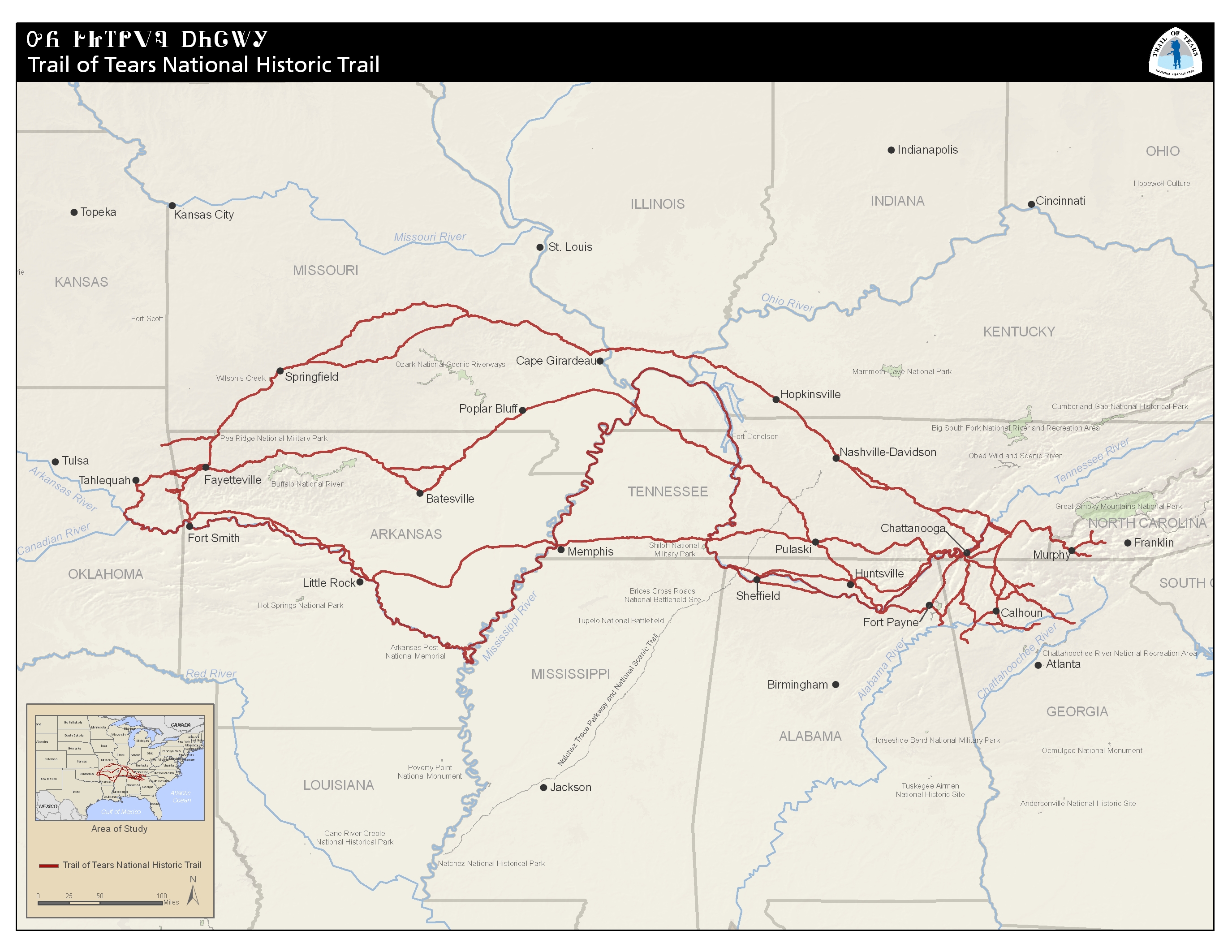
National Park Service, “Trail of Tears National Historic Trail”
https://www.nps.gov/trte/upload/TRTE_ContextMap_20091104.jpg
The National Park Service publishes this map. It outlines the trails the Cherokee traveled during the Trail of Tears. It starts in South Carolina to the north and Georgia to the south. It moves across Tennessee, Kentucky, Arkansas, and Missouri on the way to Tahlequah, Oklahoma. Although the map describes a historic migration, it is a secondary source.
Films on Demand, “Cherokee Assimilation as Survival (2:03)” in The Story We Tell – The Power of an Illusion,
fod.infobase.com/PortalPlaylists.aspx?wID=151823&xtid=49735
Paragraph description of the source and how it relates to the term. (4b)
This video clip describes the ways the Cherokee Nation tried to assimilate into the new United States. The Cherokee ceded 90% of its land to its neighbor. They implemented Jefferson’s Civilization Policy, where they transformed their society within a generation. They educated their children in western-style schools, converted to Christianity, created a constitution patterned after the U.S.A. Constitution, and published bi-lingual newspapers. This is a secondary source.
Pulley, Angela F. “Cherokee Phoenix,” New Georgia Encyclopedia
Don’t forget the URL (link) on all your sources.
This website discusses the first Native American newspaper, the Cherokee Phoenix. Its first issue was in 1828 and its last issue was in 1834. Elias Boudinot was the editor. The newspaper was printed in both the Cherokee and English languages. Boudinot was forced to resign in 1832, because he favored the removal of the tribe. The leaders argued members of the press were voice pieces of the leadership and not guaranteed the freedom of the press. The Georgia Guard seized the printing press in 1835 to anyone printing opposition to the Trail of Tears. This is a secondary source.
“The Story of the Cherokee Exhibit.” Museum of the Cherokee Indian.
http://www.cherokeemuseum.org/exhibits/story-of-the-cherokee
The exhibit tells the 13,000 year history of the Cherokee. The tribe asserts the Creator placed them in the southern Appalachian Mountains in the beginning, as well as giving it language and customs. During the Woodland period, they permanently moved into towns. During the Mississippian period, they developed the eastern flint corn that they grew with beans and squash. This is a secondary source, although it includes photos of artifacts that are primary sources.
Identify your source as a primary or secondary source. (4c)
“Baker Roll, 1924-1929.” National Archives.
https://www.archives.gov/research/native-americans/rolls/baker-roll.html
Congress established the Eastern Cherokee Enrolling Commission in 1924 to determine membership in the tribe. The Commission collected data from older tribal censuses in the Baker Roll. The data included indexes, application, testimony, correspondence, decisions, and reports. In order to claim membership in the Cherokee nation, a person needs to prove s/he has an ancestor on the Baker Roll or 1/16 blood quantum. This is a primary source.
“To the Public (1828)” Cherokee Phoenix vol 1(1), 3.
http://www.teachushistory.org/indian-removal/resources/cherokee-phoenix
The Cherokee Phoenix was the first newspaper published by a Native American tribe. It was written in both Cherokee and English. This is its inaugural article. It describes the paper’s principles and purposes. It specifically mentions it will avoid religious controversy and the affairs of its neighbors. This is a primary source.
You may include images in your work if you want to, but you aren’t required to do so. Make sure your URL goes directly to the image and your description is thorough and you won’t need to include the picture.
Figure 1: The front page of the Cherokee Phoenix newspaper.
Accessed at http://www.georgiaencyclopedia.org/articles/history-archaeology/cherokee-phoenix
Denson, Andrew. “Remembering Cherokee Removal in Civil Rights-Era Georgia,” Southern Cultures (Winter 2008): 85-101. Academic Search Premier, EBSCOhost (accessed May 25, 2017).
This journal article, found through EBSCO at the CCCOnline Library, discussed how southern monuments do not include Native Americans. It claims the Trail of Tears is the most well-known event in 19th century U.S.-Native American relations. The author claims race relations in Georgia are seen in terms of black and white, even though the capital of the Cherokee Nation (New Echota) was in Georgia. He concludes the restored site of New Echota allows whites to think about race relations, as Native American history is safe and not contentious. This is a secondary source, though there are some primary source images and maps included.
A Cherokee Law from 1822.
http://www.cherokee.org/About-The-Nation/History/Trail-of-Tears/A-Cherokee-Law-from-1822
This law was in response to the state of Georgia appropriating money for Cherokee lands, which it planned to obtain through a treaty. President Monroe appointed commissioners to negotiate the treaty. The Cherokee Nation Chiefs agreed not to enter into negotiations for any Cherokee property or lands, although they would receive the commissioners cordially. This is a primary source.
Digital History. “Indian Removal.”
http://www.digitalhistory.uh.edu/disp_textbook.cfm?smtID=2&psid=3545
This textbook chapter discussed the background for removing Native Americans from their lands. It begins with the two conflicting policies the U.S. enacted to deal with the “Indian Problem”: assimilation and removal. President Monroe sent a plan to Congress in 1825 on moving all eastern Native American tribes into western lands where white settlers would not be allowed to live. The Cherokee responded by writing its own constitution declaring sovereignty over their land. It did not work. The U.S. army evicted the Cherokee in 1838. This is a secondary source.
Marshall, John. Cherokee Nation v. State of Georgia (1831).
http://www.cherokee.org/About-The-Nation/History/Trail-of-Tears/Cherokee-Nation-v-State-of-Georgia
Chief Justice John Marshall wrote this U.S. Supreme opinion. Following the discovery of gold in Cherokee lands, the U.S. chose to remove the Cherokee from their lands. The Indian Removal Act was signed in 1830. The Cherokee Nation asked the U.S. Supreme Court for an injunction. The Supreme Court decided no Indian tribe was a foreign state under the definition provided by the U.S. Constitution. This is a primary source.
Don’t forget the URL (link) on all your sources.
Don’t forget the URL (link) on all your sources.