hi I have 12 questions need answer for them please
 ip7o
ip7o DayOneSlides.pdf
© The Grain & Feed Trade Association
@Gaftaworld
Gafta GPD Trade Foundation Course
23-26 April 2019 London
Day One
© The Grain & Feed Trade Association
@Gaftaworld
Welcome and introduction
Jaine Chisholm Caunt
Director General
Gafta
© The Grain & Feed Trade Association
@Gaftaworld
Housekeeping • Course Materials: Available via Dropbox –
Please access via the link that was sent to you. • Fire: There will be a fire alarm test on Friday
morning. • Mobiles: Switch to silent mode, but please feel
free to use social media! @Gaftaworld #TFC2019
• Networking details & programme are in delegate packs
© The Grain & Feed Trade Association
@Gaftaworld
Basic principles of contracting
Jonathan Waters
LLB, LLM, MCIARB, CMC Registered Mediator, Barrister
General Counsel
Gafta
© The Grain & Feed Trade Association
@Gaftaworld
English Contract Law
© The Grain & Feed Trade Association
@Gaftaworld
Why English Law? (1) It is what you have
agreed to! It reflects what the
trade wants Gafta Domicile Clause
Legal effect of Domicile Clause?
DOMICILE This contract shall be deemed to have been made in England and to be performed in England, notwithstanding any contrary provision, and this contract shall be construed and take effect in accordance with the laws of England. Except for the purpose of enforcing any award made in pursuance of the Arbitration Clause of this contract, the Courts of England shall have exclusive jurisdiction to determine any application for ancillary relief, (save for obtaining security only for the claim or counter-claim),the exercise of the powers of the Court in relation to the arbitration proceedings and any dispute other than a dispute which shall fall within the jurisdiction of arbitrators or board of appeal of the Association pursuant to the Arbitration Clause of this contract. For the purpose of any legal proceedings each party shall be deemed to be ordinarily resident or carrying on business at the offices of The Grain and Feed Trade Association, (Gafta), England, and any party residing or carrying on business in Scotland shall be held to have prorogated jurisdiction against himself to the English Courts or if in Northern Ireland to have submitted to the jurisdiction and to be bound by the decision of the English Courts. The service of proceedings upon any such party by leaving the same at the offices of The Grain and Feed Trade Association, together with the posting of a copy of such proceedings to his address outside England, shall be deemed good service, any rule of law or equity to the contrary notwithstanding.
Gafta 48: Clause 25
© The Grain & Feed Trade Association
@Gaftaworld
• …“deemed to have been made in England” • …“and to be performed in England”
• …“construed and take effect in accordance with the laws of England”
Contract… Contract shall be…
• …“shall have exclusive jurisdiction” English courts…
• No appeal to English courts on point of law. • Impact on Gafta’s ability to arbitrate • May cause enforcement issues e.g.: “Arbitration at Gafta in England according to the law of
Ethiopia.” ($7.5m dispute) • Ethiopian law – Ethiopia not a signatory to UN Convention on enforcement of arbitration awards
Be aware of Gafta 125 (Arbitration Rules)
What if you include a jurisdiction that is not England?
Why English Law? (2)
© The Grain & Feed Trade Association
@Gaftaworld
• Fraud/corruption on increase in international arbitrations
• Safe place to arbitrate • Infrastructure (courts for ancillary relief) and
professional firms
Fraud London
• Ancilliary relief (Gafta 48, 26 (c.)): obtaining security
• Commercially savvy – sympathetic to arbitration
Security Judiciary
• Highly beneficial, settled case law • Although English law, arbitration hearing can take
place anywhere if parties agree • Brexit?
Precedent Global
Why English Law? (3)
© The Grain & Feed Trade Association
@Gaftaworld
Contract Formation
© The Grain & Feed Trade Association
@Gaftaworld
Why Gafta Contracts? • 80% of world trade in grain: Gafta contracts • ‘Tried and tested’ • Backed up by internationally renowned Gafta dispute
resolution service • Reflect what the trade wants
• International Contract Committee (ICC) • Flexible: Parties are free to amend (and most do!) • English Law
© The Grain & Feed Trade Association
@Gaftaworld
What is a Contract? (1)
• In English Law a verbal Commodity Contract is legally binding (Sale of Goods Act S4)
• Why is it preferable to have a written agreement?
A legally binding agreement – (whether written* or spoken)
*written can include emails, texts & even WhatsApp
© The Grain & Feed Trade Association
@Gaftaworld
6 elements required to establish a valid contract:
Offer By one party to the other
Acceptance Unconditional
Consideration Commonly the price
Intention to create legal relations
Presumed in commercial contracts
Capacity Presumed in commercial contracts
Legality Sanctions
All must be present! If one is missing – no contract
© The Grain & Feed Trade Association
@Gaftaworld
Context
• Speed of market – parties often agree main terms but leave others to be agreed later – lack of clarity?
• Also, complications can arise due to brokers, different jurisdictions and using a language in which the parties may not be fluent
© The Grain & Feed Trade Association
@Gaftaworld
• A statement of willingness to contract on specified terms made with the intention that, if accepted, there will be a binding contract
• Must be sufficiently clear/ detailed • Is not the same as an “invitation to treat” (which is an invitation to
make an offer) • Can be withdrawn any time up until acceptance • Are tenders offers?
Offer
How is a contract made? (1)
© The Grain & Feed Trade Association
@Gaftaworld
How is a contract made? (2) When does a contract become binding? • A contract will not be concluded and legally binding until the offer is accepted unconditionally
o When can an offer be withdrawn? o Offers with time limits (e.g. price shall remain £ x for 7 days)? o Acceptance must be unconditional agreement to the terms of the offer without qualification (“meeting of the
minds”) o Acceptance must be communicated o Silence is generally not acceptance but conduct may be
• An attempt to introduce new terms is not an acceptance but a counter-offer o a counter-offer is a rejection of the offer, a party cannot later accept the initial offer o mere requests for information are not counter-offers
• The “battle of the forms” – the last shot approach
Acceptance…
“We agree to your offer of 5,000mt of Ukrainian Corn, but for good orders sake send us a full confirmation note”
Is this Acceptance? Or is it a counter offer?
© The Grain & Feed Trade Association
@Gaftaworld
How is a contract made? (3)
• Essential to formation of contract • English law will not enforce a gratuitous promise (a promise which is not supported
by consideration) – there must be a “bargain”
• In practical terms it is the price that a party pays in return for goods • No requirement for consideration to be of market value. Courts are not concerned
with whether parties have made a good or a bad deal!
• Phoenix Consortium purchase of Rover Group from BMW for £10
Consideration
© The Grain & Feed Trade Association
@Gaftaworld
How is a contract made? (4)
• What if the existence of a contract is disputed? o Particularly relevant if contract is verbal or there have been
subsequent variations to a standard contract
• Past business dealings o Custom/practice?
• Evidence to show there was a contract o Emails?
Intention to create legal relations
• The legal ability to enter into a contract • Compare with authority to contract
o Does the signatory have the authority to enter into the contract on behalf of the counterparty?
• Broker/ agents authority to contract? • “XXX shall have the authority to negotiate and
conclude the contract.” • Enforcement action: S504 Turkish Code of Obligations
XXX had to have “special authority”. Turkish courts did not enforce award.
• Sanctions • Prevention of Shipment • Phytosanitary certificates
Capacity
Legality/vitiating factors
© The Grain & Feed Trade Association
@Gaftaworld
How is a contract made? (5) Incorporation • Inclusion of terms
o Gafta incorporated terms: insurance (Gafta 72), weighing (Gafta 123), sampling (Gafta 124), arbitration (Gafta 125): all form part of contract
o Notice of terms needs to be given o Terms must be in a document intended to be contractual o Reasonable steps must be taken to bring it to the attention of the party
• Confirmation Notes (Proper reference to correct Gafta Contract?)
Addendum • In 1 Gafta Arbitration Hearing, there were 9 attachments to the contract. All were disputed and none
were signed! Arbitrators had to decide whether the 9 documents formed part of the contract • May cause an issue on enforcement
© The Grain & Feed Trade Association
@Gaftaworld
Basic contractual obligations and contractual terms
Jonathan Waters
LLB, LLM, MCIARB, CMC Registered Mediator, Barrister
General Counsel
Gafta
© The Grain & Feed Trade Association
@Gaftaworld
Having established there is a contract, what is contained within it?
© The Grain & Feed Trade Association
@Gaftaworld
Seller • Provides goods • Goods conform with contract • Puts goods on board ship
Buyer • Arranges shipping/insurance • Gives proper notice to seller (e.g. vessel,
port)= pre condition of contract. Failure: seller under no obligation to perform
Legal title and risk pass on delivery to ship
‘all inclusive price’ Seller
• Makes shipping arrangements • Delivers goods • Ships goods • Arranges insurance
Buyer • Nominates port • Takes delivery – meets cost of unloading/
import licences/ customs duties • Pays for goods on receipt of shipping documents
Risk passes on delivery – legal title passes later
FOB – Free on Board CIF – Cost Insurance Freight
Basic Contractual Obligations (Summary)
© The Grain & Feed Trade Association
@Gaftaworld
Contractual Terms (1) • Contents of a contract are called terms • A term is something which imposes a contractual duty
(obligation) • The phrase covers conditions, warranties and innominate
(intermediate) terms
Important to distinguish as classification determines the remedy in the event that a counter party defaults
© The Grain & Feed Trade Association
@Gaftaworld
• Specifically agreed • Oral or in writing
Express
• Not specifically agreed but put into in the contract by statute (Sale of Goods Act 1979) or by the courts/arbitrators
• Implied by Courts/arbitrators to make ‘commercial sense’/reflect intention of parties/reflect custom and practice
• The Moorcock (1889) • Importance of statutory implied terms
Implied
Contractual Terms (2) Main terms will be set out in the written contract • Gafta standard contracts
o Parties free to vary (and often do)
© The Grain & Feed Trade Association
@Gaftaworld
Sale of Goods Act 1979: Statutory Implied Terms
• Of critical importance in context of defaults • S12. Seller has the legal title to the goods • S13. Goods must correspond to description • S14. Goods must be of satisfactory quality. Test is objective. What would a reasonable (business) buyer
regard as satisfactory having regard to price, description and other relevant factors • S14. Goods must be fit for intended purpose • S15. Goods supplied in bulk most correspond with sample
• Act can be excluded (exclusion clause): Air Transworld Limited v Bombardier (2012): Check the contract carefully (particular Counterpartys standard form contract which may have been incorporated)
© The Grain & Feed Trade Association
@Gaftaworld
Terms Conditions
• A major (or fundamental) term: goes to the very heart of the contract
• Breach entitles innocent party to repudiate
• Repudiate: terminate contract and sue for damages
Warranties
• A minor (less important) term • Breach entitles innocent party to
damages ONLY and the contract continues
• Most terms in a contract are warranties
Distinction is critical! Termination for breach of condition is a breach of contract if the condition is actually a warranty!
© The Grain & Feed Trade Association
@Gaftaworld
Identifying a Condition or Warranty
• Important to identify, in the contract, which terms are conditions and which are warranties
• Generally, in a business contract courts will give effect to what the parties have agreed
• But not always…!
© The Grain & Feed Trade Association
@Gaftaworld
What was the outcome?
The Parties: • Schuler – a tool manufacturer • Wickman – a tool sales company Scenario: • Wickman granted the sole right to sell Schuler tools • Condition of contract – Wickman had to send a sales person to each named company
once a week to solicit sales • Wickman failed to make some visits • Schuler terminated the contract
Schuler vs. Wickman 1974
© The Grain & Feed Trade Association
@Gaftaworld
Schuler vs. Wickman 1974 – The Outcome • HELD Schuler and Wickman had not intended the
word ‘condition’ to be used in a strict legal sense • The outcome – termination – would be
unreasonable • The term was a warranty and termination by
Schuler was a breach of contract
© The Grain & Feed Trade Association
@Gaftaworld
Intermediate Terms
• Intermediate term is neither a condition or a warranty!
• Traditional Approach – causes inflexibility/unfairness
• Minor breach of condition gives rise to termination
• Major breach of warranty does not
© The Grain & Feed Trade Association
@Gaftaworld
Hong King Fir Shipping vs. Kawasaki 1962
• New approach: Intermediate term
• Courts may be prepared to disregard the ‘label’ (i.e. ‘condition’ or ‘warranty’)
o Has the innocent party been substantially deprived of whole benefit of the contract by the breach?
• If innocent party substantially deprived – termination and damages
© The Grain & Feed Trade Association
@Gaftaworld
Which Approach? • For courts to decide • Courts generally take the view that if parties have specifically negotiated a
term as a condition then this is what they intended and will uphold this • Statutory implied conditions will always be conditions (unless excluded) • Case law has established that certain terms will be conditions (e.g. opening L/C,
timing, appropriations, nominations, delivery, provisions relating to tender of documents, failure of FOB Buyer to nominate and provide a vessel) and certain terms will be warranties (failure to pay demurrage/carrying charges)
• Always take legal advice before alleging a breach of condition and terminating contract – if you get it wrong you are in breach of contract
© The Grain & Feed Trade Association
@Gaftaworld
The Goods, Description Quality and Condition An Overview
© The Grain & Feed Trade Association
@Gaftaworld
Sale of Goods Act 1979 (Refresher)
• Implied terms
• What type of term – condition, warranty or intermediate?
• Why is it important to distinguish between these?
• Context: Gafta arbitration – many contractual disputes re description and quality
© The Grain & Feed Trade Association
@Gaftaworld
Description – (S13) • Clause 1 – Gafta 49 • Goods must be sold as described (i.e. correspond with their description) –
examples from Gafta arbitration cases o “Brazilian Yellow Maize” o “Ukrainian Third Grade Feed Corn” o “Free from Insects” o “Wheat” – is this clear enough? o “White Flour” – flour was yellow on arrival but of satisfactory quality: Is this a misdescription? o “Organic” – what does this mean? o “Grade A Banana Skin Pulp” – What if Grade B is delivered?
What are the consequences for a misdescription?
© The Grain & Feed Trade Association
@Gaftaworld
Satisfactory Quality Clause 5 – Gafta 49 • Quality includes: natural characteristics of
the commodity (size, shape, chemical composition) and condition (burnt, wet, mouldy, infested)
• Goods deemed to be of satisfactory quality if they meet the standard that a reasonable (business) person would regard as satisfactory, taking into account any description, the price and other relevant circumstances
Circumstances include: • Fitness for all the purposes for which goods of
the kind in question are commonly supplied (human or animal consumption) ̶ Appearance and finish ̶ Safety ̶ Durability ̶ Price
• Important to define quality in contract • Satisfactory quality on delivery to vessel for
reasonable time thereafter (unless contract provides otherwise)
© The Grain & Feed Trade Association
@Gaftaworld
Certificate Final (1) Mechanism for dealing with issues such as description and quality. • Gafta 48 – Clause 5 “Certificate of inspection at the time of loading shall be final as
to quality” • Parties agree that a third party will make a determination. Buyer has assurance that
goods have been supplied in accordance with contract. Seller has protection against buyer latter alleging goods were defective
• Certificate is generally final and binding • Buyer has no right to challenge findings (fraud is an exception) – clause is pro-Seller • But Buyer may argue that wording of certificate allows a challenge to be made
Precise wording is critical!
© The Grain & Feed Trade Association
@Gaftaworld
Certificate Final (2) • Certificates are only final in relation to the matters they are intended to
cover (eg “quality”). They are not final in respect of any other matters not expressly required to be certified in the contract – final as to “quality” would not be final as to “description”
• In such cases the buyer is not precluded from bringing a claim if the goods did not match their description
• Bow Cedar case. ‘Weight and quality’ final at loading as per certificate of independent surveyors. Dispute arose regarding description. Sellers argued there could be no claim. Buyers argued that clause only related to ‘weight and quality’ and a claim for misdescription could still be made. The courts agreed
© The Grain & Feed Trade Association
@Gaftaworld
Excluding the Sale of Goods Act • S55. Sales of Goods Act – Allows parties to exclude statutory implied terms • Exclusion Clause must be reasonable (Unfair Contracts Terms Act 1977) • Air Transworld Limited V Bombardier 2012 • Aircraft alleged to be in breach of Sale of Goods Act – did not correspond with
description not of satisfactory quality and unfit for purpose • Exclusion Clause – excluded liability under Sale of Goods Act
• “Buyer…waives and releases all other warranties, obligations, representations or liabilities express or implied…including but not limited to…any implied warranty or merchantability or of fitness for a particular purpose…”
• Exclusion Clause Valid
© The Grain & Feed Trade Association
@Gaftaworld
Refreshments
© The Grain & Feed Trade Association
@Gaftaworld
Gafta Contracts: An introduction
Jonathan Waters
LLB, LLM, MCIARB, CMC Registered Mediator, Barrister
General Counsel
Gafta
© The Grain & Feed Trade Association
@Gaftaworld
Overview of Gafta 49: Some Key Terms (1) (FOB: Delivery of Goods, Central and Eastern Europe)
• Sellers/ Buyer (make sure counterparty is correctly identified) • Brokers Clause 1 Goods – description is a condition (Sale of Goods Act 1979) (Statutory Implied Terms)
o “Brazilian Yellow Maize” o “Lithuanian Milling Wheat” o “Free from Live Insects” o “White Flour”
© The Grain & Feed Trade Association
@Gaftaworld
Overview of Gafta 49 (2) Clause 2 Quantity – note ‘tolerance level’ “5% more or less at buyers option”. (25,000MT i.e. 10% tolerance. 22,500MT or 27,500MT)
• If more than 1 delivery, each delivery is treated as a separate contract – Clause 3 Price – Fixed or a price ref to Futures market Clause 5 Quality – a condition (Sale of Goods Act 1979) (Statutory Implied Terms) Need to decide when Quality will be determined – e.g. at loading or at discharge. Scale of allowances if not met. Clause 6 Period of Delivery
• FOB contract – buyers to give notice of name/ probable readiness of vessel. Sellers to have goods ready to be delivered within contract period of delivery
• Buyers right to substitute vessel • Note: reference to notice (refer to clause 14)
© The Grain & Feed Trade Association
@Gaftaworld
Overview of Gafta 49 (3) Clause 7 Loading
• Name of port • Sellers to declare port if range given • Vessel to be clean and fit • Load in “accordance with custom of port” (incorporation) • Bill of Lading is proof of delivery
Clause 8 Extension of delivery • Buyer can serve notice to extend period by “an additional period of not more than 10
consecutive days” • “Consecutive days” meaning? • “Notice” – how is it served?
© The Grain & Feed Trade Association
@Gaftaworld
Overview of Gafta 49 (4) Clause 9 Insurance
• Note risks to be included • “First Class underwriters and/ or approved companies” • Note: Some contracts incorporate Gafta Insurance Rules 72 – incorporation 14.1(b)
insurer to be domiciled/ carrying on business in UK or who will accept British domicile as an address for service
• Insurance Act 2015 • Insured to fairly present risk • Failure – insurers remedy must be proportionate – avoid policy, require additional term,
charge higher premium
© The Grain & Feed Trade Association
@Gaftaworld
Overview of Gafta 49 (5) Clause 10 Payment/ Interest
• Cash against documents – Buyer pays when Seller presents the specified documents • Letter of Credit: Failure to provide workable letter by date specified = Breach of
Condition
Clause 12 Duties/ Taxes
Clause 13 Prevention of Delivery • Force Majeure • What is it? • Note Ice Provision
© The Grain & Feed Trade Association
@Gaftaworld
Overview of Gafta 49 (6) Clause 14 Notices • Form: Critical • Communicated “rapidly in legible form” • Telex, telefax, email, letter (delivered by hand on date
of writing) • Problem areas:
o Incorrect form o Incorrect period (time) o Non receipt (burden of proof on sender) o Sent to correct individual (Glencore v Conqueror
Holdings 2017) o Notice to brokers: deemed to be good notice
• Wording required: o Is ‘Gafta extension’ sufficient? In one case a
‘notice’ (message) was sent making no reference to the shipment period and did not contain the word ‘extension’
• Wording must be clear to the recipient o Not for recipient to ‘second guess’
• Counterparty need to know extension being claimed • Failure to give notice – no extension and shipment
period will not be extended beyond expiry date. Recipient can reject claim damages
Notices are Conditions!
© The Grain & Feed Trade Association
@Gaftaworld
Clause 16 Weighing • Rule 123 Incorporation (Gafta Weighing Rules)
Clause 17 Sampling • Rule 124 Incorporation (Gafta Sampling Rules) • Samples at time/ place loading • Parties appoint superintendent from Gafta • Register of Analysts
Clause 18 Default • Critical • Measure of damages for breach of contract
Overview of Gafta 49 (7)
© The Grain & Feed Trade Association
@Gaftaworld
Overview of Gafta 49 (8) Clause 19 Circle Clause 20 Insolvency • Notice of insolvency (inability to meet debts)
to be served • Failure to serve, termination • Practical considerations Clause 21 Domicile • Critical • English Law/ English Courts to apply
Clause 22 Arbitration • Critical • “Any and all disputes” to Gafta Arbitration • Make sure it is included Clause 23 international conventions • Incoterms excluded
Clause 24 Phytosanitary Certificate • Assists Sellers where Buyers ‘Game Play’
Anything else? Optional clauses (Gafta 131) ? Sanctions?
© The Grain & Feed Trade Association
@Gaftaworld
• Buyer and Seller have been trading with each other since 2013 • Buyer telephones Seller and tells Seller he wishes to buy 25,000 metric tonnes of soyabean meal at $476
per metric tonne • Seller agrees. No other terms are discussed • 3 days later, Seller sends a ‘contract confirmation’ by SMS including a summary of the agreed trade ‘as per
sellers standard contract terms’
Scenario
Case Study
• Is there a contract? • Does the fact that the trade was agreed over the telephone have any legal or practical
consequences? • What is meant by a ‘contract confirmation’? • Does the wording ‘as per sellers standard contract terms’ have any relevance? • Is it relevant that the parties have been trading since 2013?
Questions
© The Grain & Feed Trade Association
@Gaftaworld
Lunch
© The Grain & Feed Trade Association
@Gaftaworld
Responsibility and risk
Martin Sage ADM Trading
Gafta Qualified Arbitrator
© The Grain & Feed Trade Association
@Gaftaworld
What do we mean by Risk and Responsibility?
• Potential negative consequence of an event • Which party bears the risk i.e. the loss • CIF/FOB: Risk passes “as from shipment” • Not the same as title • Title – ownership, not possession
© The Grain & Feed Trade Association
@Gaftaworld
Categories of Risk
• Risk in the Goods (physical/ quality, etc.) • Shipment Risks (loss, delay, damage) • Documentary Risks (validity, duty to tender, duty to pay, value,
scope, liabilities) • Legal Risks (country/political)
© The Grain & Feed Trade Association
@Gaftaworld
What is a Contract?
A promise or set of promises which the law will enforce.
Today, specifically FOB and CIF contracts, and where you buy on FOB terms and sell CIF
© The Grain & Feed Trade Association
@Gaftaworld
FOB
What are the parties’ primary duties?
© The Grain & Feed Trade Association
@Gaftaworld
FOB Buyer To give effective shipping instructions: • Nominate and present a suitable vessel at the port of loading
in sufficient time • Provide required information (e.g. quantity to be loaded, ETA,
flag, demurrage rate, etc.) • Give documentary instructions – type, number, content.
** Consequence of failure…?
© The Grain & Feed Trade Association
@Gaftaworld
FOB Seller
• Deliver contract-compliant goods (description/quality/quantity)
• Load goods on board the ship nominated by the Buyer (when, where, how fast)
• Provide the required documents (doc instr., letter of credit, export formalities, conforming docs)
** Consequence of failure..?
© The Grain & Feed Trade Association
@Gaftaworld
CIF
What are the primary functions?
© The Grain & Feed Trade Association
@Gaftaworld
FOB • Who is responsible for insuring the goods on board? • What is the risk?
• Who is responsible for paying the freight? • What is the risk?
• If goods are damaged on board before payment and the Master clauses the B/L, who is responsible?
© The Grain & Feed Trade Association
@Gaftaworld
CIF Seller will provide documents which prove he has: • Shipped goods of the contractual description • Appropriate goods to the Buyer • Insured them for the intended voyage at the contract value • Shipped under a reasonable ctr of carriage within the agreed time
period and paid freight to the agreed destination. OR procure documents from someone who has done so.
**What risks do you see ?
© The Grain & Feed Trade Association
@Gaftaworld
Risk in the Goods
Conformity with the terms of the Contract
© The Grain & Feed Trade Association
@Gaftaworld
Risk in the Goods
Conformity with the terms of the Contract:
• Description – what does SoGA say? • Specification – what does the Contract say? • Condition – what does the Contract say? • Sampling and analysis – Certificate final? • Sale of Goods Act: Satisfactory, fit for purpose
© The Grain & Feed Trade Association
@Gaftaworld
Shipment Risks • Time for performance – FOB and CIF • Suitability of vessel
- Shipment and classification clause - Reasonable contract of carriage
• Safe port/safe berth • Safe stowage • Laytime and detention • Impediments to performance
© The Grain & Feed Trade Association
@Gaftaworld
Shipment Risks • Insurance
- Type of cover (All Risks, WA…HSSC, SRCC, G/A…) - Value of cover - market value? - Suitable insurers - jurisdiction - Where claims are settled – service of process
* Cargo damage and recovery – Ctr/ B/L / Insurance..? * Act as prudent uninsured – mitigate loss!
© The Grain & Feed Trade Association
@Gaftaworld
Documentary Risks
• What documents are listed in the printed forms? • Buyer to give documentary instructions
- Can Seller supply them? (Phyto regs) - Can Buyer obtain additional documents if needed? - Are Seller’s documents sufficient to obtain payment?
**Consequences of missing or defective documents?
© The Grain & Feed Trade Association
@Gaftaworld
Documentary Risks
• The Bill of Lading - Receipt for goods shipped - Document of title - Evidence of a contract of affreightment
**Are Mates Receipts acceptable?
© The Grain & Feed Trade Association
@Gaftaworld
Documentary Risks
• Payment: - CAD: Where? When? How? (Security of docs) - Letter of Credit: Is it workable?
(timing/revocable/confirmed/variation of terms) • Import:
- Can Receiver import the goods? (Political/Country risk)
** Consequence of non payment…?
© The Grain & Feed Trade Association
@Gaftaworld
Legal & Political Risks
• Sale of Goods Act • Conformity with domestic legislation (export/import) • Sanctions/Prohibitions/Restrictions… • Transfer of title • Potential conflict with other important documents –e.g. Charter
Party, Bill of Lading, Letters of Credit • Jurisdiction and Arbitration Proceedings
© The Grain & Feed Trade Association
@Gaftaworld
Execution Risks Notices: • Appropriation – form, content and timing • Nomination – content, timing (preadvice), substitution • Extension - timing • Prevention – circumstances, content and timing • Default – circumstances, timing • Arbitration – type of claim, time limit, renewal, proceedings
© The Grain & Feed Trade Association
@Gaftaworld
Market Risks
• Who is responsible for market risk? • What happens if a Seller defaults? • What happens if a Buyer defaults? • What about loss of profit?
© The Grain & Feed Trade Association
@Gaftaworld
Instruction for Supervision
Chris Ranschaert SGS
ISSUING INSTRUCTIONS : Ensuring clarity and best practice
London, 23/04/2019
Ing. Chris Ranschaert
SGS Group Management – Agricultural, Food & Life
73
RULES AND CODE OF CONDUCT FOR SUPERINTENDENTS
Introduction • Intended for superintendents listed on the GAFTA Register
of Approved Superintendents. • If Superintendents act contrary to the provision of these
Rules they may be subject to disciplinary action
The Superintendent’s operations • Primary business activities are in the profession of
inspection • In accordance with the agreed contract terms • “When a Superintendent issues reports and certificates…
they shall reflect the actual and true findings”
Minimum requirements for Superintendent companies • Accreditation ISO 17020, certification ISO 9001 or GTAS
audited
74
RULES AND CODE OF CONDUCT FOR SUPERINTENDENTS
Rapid decision taking if the inspection company informs. Price negotiations possible. It puts you in a position of strength.
It provides protection to your purchase. Only contractual goods will be shipped.
The nomination of a GAFTA recognized inspection company acts as a deterrent to suppliers. It has a psychological effect. It acts to prevent problems.
Independence. The word of an independent inspection company counts.
Possibility of falling back on samples for arbitration settlement.
Securization. Better insurance premium. Good reputation to the product in importing countries.
75
RULES AND CODE OF CONDUCT FOR SUPERINTENDENTS
Being the representative of the principal at the moment of loading or discharging “the eyes and ear
Compliance with the rules • All operations it carries out shall comply with the appropriate
rules and the contract terms
Sampling • According to GAFTA Sampling Rules 124 • Can be done during loading or during discharge
Quality & Condition • Need for submitting samples for testing to a laboratory on the
Register of GAFTA approved Analysts
Cleanliness inspection of the transport elements or stores • LCI : load compartments to be empty, clean, without
unsuitable odors, free from residues and vermin • 3 preceding cargoes carried as declared by master +
cleaning methodology.
76
RULES AND CODE OF CONDUCT FOR SUPERINTENDENTS
Weighing • According to GAFTA weighing rules N° 123
– Method as per contract or as per customs of the port – Establish the method of weighing + create & keep records – Weighing operations at appropriate place and time – Information needed
» Apparatus used » Approval by the authorities » Info concerning calibration & verification
Phytosanitary/Veterinary/Radioactivity/Health certificates • Usually issued by national authorities • Alternatively by the superintendents on basis of testing
Subcontracting • Only to other superintendent on the GAFTA register
77
ACCEPTING INSTRUCTIONS FROM THE CLIENT
DUTY OF THE PRINCIPAL
• It is the duty of the principal to give instructions in due time and these instructions must be clear and unambiguous, including sufficient detail to enable the superintendent to carry out and perform the inspection in accordance with the requirements of the contract and according to the expectations of the principal
• An instruction is a directional message describing the task that is to be performed.
• In due time • “As usual”
78
ACCEPTING INSTRUCTIONS FROM THE CLIENT
DUTY OF THE SUPERINTENDENT
• It is the superintendent’s function to act on his Clients / Principals behalf, ensuring that the consignment is in sound condition, sampled and weighed correctly, accurate reporting, and if needed making reserves against the concerned parties
• The duty of a Superintendent is to look after the best interests of the parties to a contract and to act with neutrality, honesty and integrity at all times.
• To be the ears & eyes of the client
79
ACCEPTING INSTRUCTIONS FROM THE CLIENT
Instructions should be in writing
The superintendent will acknowledge and confirm the order, detailing the scope of work
The file administrator will then create a work order for the inspector and for the lab
80
ACCEPTING INSTRUCTIONS FROM THE CLIENT
Details of the parties – buyer/seller/receiver and their representatives
24 hour contact number Commodity : correct description. GAFTA contract N° with parity Quantity – any tolerances – (more or less / min or max) Quality – Including testing methods Name of the vessel Place of Inspection Time of arrival (e.g. ETA). Name of vessel agents and contact telephone number.
81
ACCEPTING INSTRUCTIONS FROM THE CLIENT
What certificates required; Hold Inspection, Weight, Quality, Fumigation,…
Any specific statements you need to have on your certificate, e.g. FFHC, Free from, etc... Be aware that some of these statements require analysis.
Destination. Important to be aware of potential quality issues. Who is the Principal (i.e. who will pay for the service) Who can be contacted after hours… Copy of the (relevant parts of) LC
82
SOME ISSUES
“free from…” certificates • Free from : not in the sample • “Substantially free” or “practically free” : Fit for purpose • Free from dead insects….
SLM : Sound, Loyal and Merchantable : Organoleptic/condition
“fit for…” certificates • IFIA minimum testing requirments
Health certificates (no definition) • Animal origin : sanitary/veterinary certificate authorities • Plant origin : see “fit for…”
Misrepresentation or non-sense certificates • E.g. fumigation certificates, certifying non fumigation
85
CERTIFICATES : HOT TOPICS
We provide services and NOT guarantees or insurances
A bad quality cargo will stay a bad quality cargo
Obligation of means
Obligation of results : Guarantee Services
86
CERTIFICATES : HOT TOPICS
Certificates and reports can only record the facts as ascertained by the superintendent
The statements made in the reports and the certificates must be substantiated
The findings in reports and certificates are only valid for the time and place of inspection (E.g. pre-shipment)
Certificates are worded in such way that no confusion or any risk of misleading a party, who might receive them at a later time, is made
Certificates state the methods applied for sampling, weighing and testing (USDA/ISO…)
Supervision, Sampling and Analysis GAFTA COURSE 23/04/2019
Chris Ranschaert
SGS Group Management SA, Agriculture, Food & Life
88
GAFTA CONTRACTS
The Superintendent shall ensure the samples are drawn and sealed as required by the Sampling rules 124.
The Superintendent will supervise the weighing of the contract goods in accordance with the custom of the port or as contracted : According to the Weighing rules 123.
89
GAFTA CONTRACTS
Contractual Provisions concerning “Sampling and Analysis” Where parties have agreed to trade on GAFTA contracts, the requirements for
supervision and sampling at Ports of Loading and Discharge are contained within the standard GAFTA Sampling and Analysis clause, which reads: For ports of loading: “SAMPLING, ANALYSIS AND CERTIFICATES OF ANALYSIS- • Terms and conditions of GAFTA Sampling Rules No.124, are deemed to be
incorporated into this contract. • Samples shall be taken at time and place of loading. • The parties shall appoint superintendents, for the purposes of supervision and sampling
of the goods, from the GAFTA Register of Superintendents. • Unless otherwise agreed, analysts shall be appointed from the GAFTA Register of
Analysts.”
90
GAFTA
For ports of discharge:
“SAMPLING, ANALYSIS AND CERTIFICATES OF ANALYSIS- • Terms and conditions of GAFTA Sampling Rules No.124, are deemed to be
incorporated into this contract. • Samples shall be taken at the time of discharge on or before removal from the
ship or quay, unless the parties agree that quality final at loading applies, in which event samples shall be taken at time and place of loading.
• The parties shall appoint superintendents, for the purposes of supervision and sampling of the goods, from the GAFTA Register of Superintendents.
• Unless otherwise agreed, analysts shall be appointed from the GAFTA Register of Analysts.”
91
GAFTA 124 SAMPLING RULES VERSION 01/09/2018
92
GAFTA SAMPLING
CONDITION AND QUALITY
• Quality results basically from its growth, harvesting and, in some cases, it’s processing
– Protein, moisture, admixture, fiber content...
• Condition Is said to be determined by factors that affect it during transportation or storage
– Contamination by pesticides, weevils, (sea)water
93
GAFTA SAMPLING : 1 SCOPE
For all contracts the rules apply (incorporated in the contracts)
Sampling the goods
Preparation of the goods
Distribution of samples
Analysis methods
Tests
Certifcation
94
GAFTA SAMPLING : 1 SCOPE
Grains, feedstuffs,pulses for human consumption/feed, fishmeal, rice, related to GAFTA contracts in bulk, bags or containers.
95
GAFTA SAMPLING : 2 DEFINITIONS
“Cargo Superintendent” : Indepence “INCREMENT SAMPLES”: Samples taken direct from the
consignment of maximum 1 kilo in weight, or if taken mechanically, weight appropriate to the equipment.
“BULK (AGGREGATE SAMPLE)”: Is the accumulation, combined total, of all the increment samples.
“CONTRACTUAL SAMPLES”: Samples reduced from the bulk sample sealed into up to al least 3 kilograms containers each, in as many containers as required by the rules
“ANALYSIS SAMPLES”: Samples are reduced from the contractual samples, by the laboratories, to quantities appropriate for analysis tests.
Sample Containers: A container is defined as bottles, jars or tins with close fitting lids of bags, including PE, cotton or other suitable types of construction, which are securely tiedNEW
01/09/2018
96
GAFTA SAMPLING : 3 GENERAL TERMS
3. Superintendent from the GAFTA register
Parties are responsible to provide detailed instructions !!
In case of absence of a superintendent
“Sealed”
97
GAFTA SAMPLING : 4 METHOD OF DRAWING
Sampling points
• Mutually agreed • Safety first • Natural light or lightening
How much increments ?
98
GAFTA SAMPLING : 4 METHOD OF DRAWING
As many as practicle and physically possible
Consignment size Tons 0-5000 5001-10,000 10,001 - 25,000 >25,000
Lot size Tons 500 1000 2500 5000
No. of increments per lot number min 20 min 30 min 40 min 50
Min bulk aggregate sample per lot Kilos 20 30 40 50
Max weight of increments Kilos 1 1 1 1
99
GAFTA SAMPLING : METHOD OF DRAWING
An example
• Ship of 8000 MT • 8 lots of 1000 MT • Min 30 increments/lot of max 1 kg, but min 30 kg • 8 x 30 kg (8 bulk aggregate samples) = 240 kg of samples • Let’s say loading 400 MT/hour = 1 lot in 2,5 hour = 1 increment every 5 min
100
EXAMPLE 12000 MT
101
EXAMPLE 12000 MT
102
Example 12000 MMT
103
GAFTA SAMPLING : EXAMPLES
Example: Four shipments (arbitration samples for each 5000 MT) 2,500 mt / 5,500 mt / 10,000 mt / 35,098 mt grain vessels, FOB terms:
2,500 5,500 10,000 35,098 (excess <250mt) 1 analysis 3 kgs in 1 bag 2 bags of 3 kg 2 bags of 3 kg 7 bags of 3 kg 1 arbitration 3 kgs in 1 bag 2 bags of 3 kg 2 bags of 3 kg 7 bags of 3 kg 1 spare 3 kgs in 1 bag 2 bags of 3 kg 2 bags of 3 kg 7 bags of 3 kg
Total. 3 bags of 3 kgs 6 bags of 3 kgs . 6 bags of 3 kgs 21 bags of 3 kgs
104
GAFTA SAMPLING
EQUIPMENT
Sampling equipment (scoop, spear…) must be clean, dry, free from any possible contamination
106
GAFTA SAMPLING
108
GAFTA SAMPLING
109
SAMPLING
Cross belt sampler
110
AUTOMATIC SAMPLER
111
GAFTA SAMPLING : METHOD OF DRAWING
4. METHOD OF DRAWING SAMPLES
• Security and integrity of intermediate samples • Division of bulk aggregate samples • Reduction to the contractual sets • Possibility to pre reduce (25 %) • Sample containers shall be full • Sealed
• Bulk at loading : moving stream – nearest practicle point • Bulk at discharge : from the hold (safety !!) or nearest practicle point
(moving stream)
112
DIVIDING
113
DIVIDERS
DIVIDERS / SIEVES
114
GAFTA SAMPLING
115
GAFTA SAMPLING
Sampling from bags
Increment samples shall be drawn uniformly, by a piercing spear from the top, middle and bottom of each bag : (if not possible by scoop – from the ends and middle of the bags in rotation)
The more bags the more representative your sample
<100 bags - sample 20 bags <1000 bags – sample 50 bags
>1000 bags – sample 0,5 % or min 50 bags
116
GAFTA SAMPLING – ROAD & RAIL
Contracts for ROAD AND RAIL TRANSPORT
At loading : • GRAINS : (wagons or vehicles) : increment samples
to be taken by spear from 3 sampling points from each wagon or vehicle.
• FEEDINGSTUFF (wagons or vehicles) : increment samples to be taken from moving stream at outlet filling hopper by hand scoop
At discharge : • Grain and feeding stuff increment samples by hand
scoop from moving stream at outlet wagons or vehicles
117
GAFTA SAMPLING : 4 METHOD OF DRAWING
SAMPLING for products in BULK: • At loading of vessel:
– at the nearest practicable point to the vessel – Concurrently with the loading, from a moving stream – From conveyor, ex-silo, ex-vehicle/truck: across the
whole moving stream – If loading by grab: from the quay or barge, from the bulk,
excluding the run • At discharge of vessel:
– From various parts of the hold in a fair proportion, excluding the run. Not considered safest point !
– If not possible (or not safe) draw increment samples at the nearest practicable point to the hold, preferably from a moving stream
– By hand scoop or other mutual agreed equipment
118
GAFTA SAMPLING
Sender..................................................................................................................................................... M.V........................................................................................................................................................ From...................................................................................................................................................... To.......................................................................................................................................................... Commodity............................................................................................................................................. Bags/Bulk..............................................................................................................................................
Marks................................................................................................................................................... . Shipper/Seller/Buyer.......................................................................................................................... ..
Set No.................................................. Sample No............................................................................... Date and Place of Sealing....................................................................................................................
Quantity represented by this sample……………………………………………………………… Part Total Quantity of……………………………………………………………………………… Purpose of Sample……………………………………………………………………………………
*Arbitration (Quality/Rye Terms), Natural Weight/Analysis……………………………………. • *delete as appropriate • D/O Receiver
Quantity • B/L No. • Seals
119
GAFTA SAMPLING 6. CONTRACTUAL SAMPLES FOR ANALYSIS AND
ARBITRATION
Arbitration Samples : 3 kg/5000 tons
Sets of Samples : as the contract requires (3 kg / 5000 tons)
Eg : Grain, Pulses, Seeds and Rice (exp. Malting Barley) – One set for each 5000 tons
» Sample 1: Analysis » Sample 2: Arbitration » Sample 3: Spare
Each sample packed in appropriate and sufficiently strong material that maintains the quality and condition of the sample with consideration to the type of test / analysis to be performed
Eg : Feedstuff : 4th sample for second/third analysis
NEW 01/09/2018
120
GAFTA SAMPLING
7. STANDING IN PROVISIONS (several receivers on a hold)
8. DISPATCH of samples, RETENTION and analysis INSTRUCTIONS • Reduction of samples at origin • Within 14 consecutive day’s • If failed : any claim, rejection : deemed to be waived and barred.
9. RETENTION OF SAMPLES
• 3 months (GMP+ = 6 months !)
121
GAFTA SAMPLING SECTION 2 : ANALYSIS
1. Scope
2. Analysis samples • Reduced from the contractual samples
3. Analysts
4. General • Certificates • Notices clause • Non compliance with the rules
5. Methods of analysis (form N° 130)
123
WHEAT
124
WHEAT
Grain (Agricultural Commodities) are not a uniform commodity
Representative sampling and assessment
Soil & Climate – Fertile soil & temperate climate
Grading - Based on Protein content (9-14%), based on Kernel texture (hard, semi hard, soft), based on Colour (white, amber, red)
125
UNCERTAINTY
Lot Sample Analysis
Total error
Sampling error Analytical error
Sample preparation
Sampling preparation error
126
GAFTA SAMPLING DIFFICULTIES
Increase of particle size from center to periphery
127
GAFTA SAMPLING RULES : 2018
6.8.3. Mycotoxins : cf Aflatoxin in Corn
6.8.4. GMO
SPECIFIC INSTRUCTIONS SHALL BE GIVEN TO THE SUPERINTENDENTS TO TAKE ADDITIONAL SAMPLES
1 extra sample representing the total quantity for feedings stuffs and / or grain, Corn = 10 kg
WHY ?
NEW 01/09/2018
128
DIFFERENT KIND OF VARIABLES
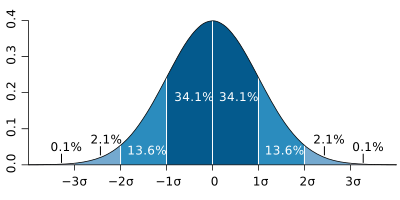
Continuous & discontinuous variables • Continuous variable e.g. protein, moisture, oil content,…
– Each kernel has a certain value – Normal distribution – Gauss
– 2 (-1 +1) sigma : 68 % – 4 (-2 +2) sigma : 95 % – 6 (-3 +3) sigma : 99 %
129
EXAMPLE : CONTINEOUS VARIABLES
20 samples tested for oilcontent
Average: 42.375
Standard dev. 1.12 • 68 % between 41.255 and 43.495 • 95 % between 40.135 and 44.615
42.5 42.3 43.6 43.7 41.8 42.6 42.8 42.4 40.3 42.4 40.8 41.4 43.8 42.9 43.7 40.4 44 41.1 42.6 42.4
-0.05
0
0.05
0.1
0.15
0.2
0.25
0.3
0.35
0.4
0 5 10 15 20
Chart2
| 0.0000000031 |
| 0.0000026967 |
| 0.0005106645 |
| 0.020910188 |
| 0.185139425 |
| 0.3544529532 |
| 0.1467361107 |
| 0.0131351224 |
| 0.0002542436 |
| 0.0000010641 |
Sheet1
| 10.3 | 0.0641033895 | 12.375 | mean |
| 10.4 | 0.0753216252 | 1.1205614194 | sdev |
| 10.8 | 0.1325828746 | ||
| 11.1 | 0.186357504 | ||
| 11.4 | 0.2438248879 | 0.0320308402 | |
| 11.8 | 0.3121028643 | ||
| 12.3 | 0.3552234603 | ||
| 12.4 | 0.3559314105 | ||
| 12.4 | 0.3559314105 | ||
| 12.4 | 0.3559314105 | ||
| 12.5 | 0.3538117814 | ||
| 12.6 | 0.3489149386 | ||
| 12.6 | 0.3489149386 | ||
| 12.8 | 0.3313126434 | ||
| 12.9 | 0.3190135877 | ||
| 13.6 | 0.1958681243 | ||
| 13.7 | 0.1769560155 | ||
| 13.7 | 0.1769560155 | ||
| 13.8 | 0.1586018308 | ||
| 14 | 0.1243992682 | ||
| 0.4 | 5.5467790262 | 0.0000000031 | |
| 0.5 | 6.9334737828 | 0.0000026967 | |
| 0.6 | 8.3201685393 | 0.0005106645 | |
| 0.7 | 9.7068632959 | 0.020910188 | |
| 0.8 | 11.0935580525 | 0.185139425 | |
| 0.9 | 12.480252809 | 0.3544529532 | |
| 1 | 13.8669475656 | 0.1467361107 | |
| 1.1 | 15.2536423221 | 0.0131351224 | |
| 1.2 | 16.6403370787 | 0.0002542436 | |
| 1.3 | 18.0270318352 | 0.0000010641 |
Sheet1
Sheet2
Sheet3
130
AN EXAMPLE
131
EXAMPLE : DISCONTINEOUS VARIABLES
• Discontinuous (discrete) variables – On/Off variables: e.g. damaged grains, GMO,… – Binomial distribution / Poisson distribution
132
AN EXAMPLE
1000 balls : 980 white + 20 black (= 2%) Sample 10 balls
– Chance to find 0 black balls: 81.71 % – 1 16.67 – 2 1.53
Sample 100 balls – Chance to find 0 black balls: 13.26 % – 1 27.06 – 2 27.34 – 3 18.22 – 4 9.02 – 5 3.53
0
0.05
0.1
0.15
0.2
0.25
0.3
0 1 2 3 4 5 6
Chart4
| 0.1326195559 |
| 0.2706521549 |
| 0.2734139116 |
| 0.182275941 |
| 0.0902079912 |
| 0.0353468047 |
| 0.0114215866 |
Sheet1
| 5901 20.31 20.22 20.27 0.78 |
| 5902 19.71 19.68 19.70 -0.99 |
| 5903 20.32 20.30 20.31 0.92 |
| 5904 20.42 20.52 20.47 1.42 |
| 5905 20.10 20.01 20.06 0.13 |
| 5906 19.90 19.87 19.89 -0.40 |
| 5907 19.97 19.77 19.87 -0.45 |
| 5908 20.57 20.58 20.58 1.74 |
| 5909 20.25 20.21 20.23 0.67 |
| 5910 19.57 19.44 19.51 -1.58 |
| 5911 20.42 20.50 20.46 1.39 |
| 5912 20.26 20.29 20.28 0.81 |
| 5913 19.96 19.95 19.96 -0.18 |
| 5914 20.08 20.08 20.08 0.21 |
| 5915 19.57 19.49 19.53 -1.50 |
| 5916 20.50 20.62 20.56 1.70 |
| 5917 19.61 19.66 19.64 -1.18 |
| 5918 19.96 19.96 19.96 -0.17 |
| 5919 19.40 19.47 19.44 -1.80 |
| 5920 20.44 20.41 20.43 1.28 |
| 5921 18.83 18.47 c 18.65 -4.24 |
| 5922 19.89 19.83 19.86 -0.48 |
| 5923 20.43 20.39 20.41 1.23 |
| 5924 20.03 20.15 20.09 0.24 |
| 5925 19.50 19.48 19.49 -1.63 |
| 5926 19.75 19.78 19.77 -0.77 |
| 5927 19.60 19.58 19.59 -1.32 |
| 5928 19.91 19.97 19.94 -0.23 |
| 5929 20.04 19.94 19.99 -0.07 |
| 5930 19.99 20.06 20.03 0.03 |
| 5931 19.80 19.90 19.85 -0.51 |
| 5932 19.46 19.49 19.48 -1.68 |
| 5933 19.95 19.98 19.97 -0.15 |
| 5934 19.38 19.44 19.41 -1.88 |
| 5935 19.96 19.92 19.94 -0.23 |
| 5937 20.03 20.04 20.04 0.07 |
| 5939 20.27 20.25 20.26 0.76 |
| 8 |
| 5940 20.32 20.28 20.30 0.89 |
| 5941 20.40 20.40 20.40 1.20 |
| 5942 19.39 19.35 19.37 -2.00 |
| 5943 20.29 20.25 20.27 0.80 |
| 5944 21.59 21.64 g 21.62 4.98 |
| 5945 19.97 19.90 19.94 -0.25 |
| 5946 20.48 20.56 20.52 1.57 |
| 5947 20.04 20.00 20.02 0.02 |
| 5948 20.09 19.76 c 19.93 -0.28 |
| 5949 19.98 19.90 19.94 -0.23 |
| 5950 23.22 23.30 g 23.26 10.09 |
| 5951 19.10 19.40 c 19.25 -2.37 |
| 5952 19.74 19.90 19.82 -0.60 |
| 5953 19.68 19.70 19.69 -1.01 |
| 5954 20.01 20.03 20.02 0.02 |
| 5955 19.82 19.84 19.83 -0.57 |
| 5956 20.42 20.26 20.34 1.01 |
| 5957 20.30 20.38 20.34 1.01 |
| 5958 19.88 20.01 19.95 -0.21 |
| 5959 19.70 19.76 19.73 -0.88 |
| 5960 20.16 20.26 20.21 0.61 |
| 5961 20.55 20.62 20.59 1.77 |
| 5962 21.48 21.54 g 21.51 4.65 |
| 5963 20.00 20.00 20.00 -0.04 |
| 5964 20.14 19.97 20.06 0.13 |
| 5965 19.89 19.95 19.92 -0.29 |
| 5966 20.15 20.08 20.12 0.31 |
| 5967 20.34 20.38 20.36 1.08 |
| 5968 19.82 19.89 19.86 -0.49 |
| 5969 18.57 18.97 c 18.77 -3.87 |
Sheet2
| 5901 20.31 20.22 20.27 0.78 |
| 5902 19.71 19.68 19.70 -0.99 |
| 5903 20.32 20.30 20.31 0.92 |
| 5904 20.42 20.52 20.47 1.42 |
| 5905 20.10 20.01 20.06 0.13 |
| 5906 19.90 19.87 19.89 -0.40 |
| 5907 19.97 19.77 19.87 -0.45 |
| 5908 20.57 20.58 20.58 1.74 |
| 5909 20.25 20.21 20.23 0.67 |
| 5910 19.57 19.44 19.51 -1.58 |
| 5911 20.42 20.50 20.46 1.39 |
| 5912 20.26 20.29 20.28 0.81 |
| 5913 19.96 19.95 19.96 -0.18 |
| 5914 20.08 20.08 20.08 0.21 |
| 5915 19.57 19.49 19.53 -1.50 |
| 5916 20.50 20.62 20.56 1.70 |
| 5917 19.61 19.66 19.64 -1.18 |
| 5918 19.96 19.96 19.96 -0.17 |
| 5919 19.40 19.47 19.44 -1.80 |
| 5920 20.44 20.41 20.43 1.28 |
| 5921 18.83 18.47 c 18.65 -4.24 |
| 5922 19.89 19.83 19.86 -0.48 |
| 5923 20.43 20.39 20.41 1.23 |
| 5924 20.03 20.15 20.09 0.24 |
| 5925 19.50 19.48 19.49 -1.63 |
| 5926 19.75 19.78 19.77 -0.77 |
| 5927 19.60 19.58 19.59 -1.32 |
| 5928 19.91 19.97 19.94 -0.23 |
| 5929 20.04 19.94 19.99 -0.07 |
| 5930 19.99 20.06 20.03 0.03 |
| 5931 19.80 19.90 19.85 -0.51 |
| 5932 19.46 19.49 19.48 -1.68 |
| 5933 19.95 19.98 19.97 -0.15 |
| 5934 19.38 19.44 19.41 -1.88 |
| 5935 19.96 19.92 19.94 -0.23 |
| 5937 20.03 20.04 20.04 0.07 |
| 5939 20.27 20.25 20.26 0.76 |
| 8 |
| 5940 20.32 20.28 20.30 0.89 |
| 5941 20.40 20.40 20.40 1.20 |
| 5942 19.39 19.35 19.37 -2.00 |
| 5943 20.29 20.25 20.27 0.80 |
| 5944 21.59 21.64 g 21.62 4.98 |
| 5945 19.97 19.90 19.94 -0.25 |
| 5946 20.48 20.56 20.52 1.57 |
| 5947 20.04 20.00 20.02 0.02 |
| 5948 20.09 19.76 c 19.93 -0.28 |
| 5949 19.98 19.90 19.94 -0.23 |
| 5950 23.22 23.30 g 23.26 10.09 |
| 5951 19.10 19.40 c 19.25 -2.37 |
| 5952 19.74 19.90 19.82 -0.60 |
| 5953 19.68 19.70 19.69 -1.01 |
| 5954 20.01 20.03 20.02 0.02 |
| 5955 19.82 19.84 19.83 -0.57 |
| 5956 20.42 20.26 20.34 1.01 |
| 5957 20.30 20.38 20.34 1.01 |
| 5958 19.88 20.01 19.95 -0.21 |
| 5959 19.70 19.76 19.73 -0.88 |
| 5960 20.16 20.26 20.21 0.61 |
| 5961 20.55 20.62 20.59 1.77 |
| 5962 21.48 21.54 g 21.51 4.65 |
| 5963 20.00 20.00 20.00 -0.04 |
| 5964 20.14 19.97 20.06 0.13 |
| 5965 19.89 19.95 19.92 -0.29 |
| 5966 20.15 20.08 20.12 0.31 |
| 5967 20.34 20.38 20.36 1.08 |
| 5968 19.82 19.89 19.86 -0.49 |
| 5969 18.57 18.97 c 18.77 -3.87 |
Sheet3
| 2027 | 20.27 | 12.66875 | ||||
| 1970 | 19.7 | 12.3125 | ||||
| 2031 | 20.31 | 12.69375 | ||||
| 2047 | 20.47 | 12.79375 | ||||
| 2006 | 20.06 | 12.5375 | ||||
| 1989 | 19.89 | 12.43125 | ||||
| 1987 | 19.87 | 12.41875 | ||||
| 2058 | 20.58 | 12.8625 | ||||
| 2023 | 20.23 | 12.64375 | ||||
| 1951 | 19.51 | 12.19375 | 0 | 0.1326195559 | ||
| 2046 | 20.46 | 12.7875 | 1 | 0.2706521549 | ||
| 2028 | 20.28 | 12.675 | 2 | 0.2734139116 | ||
| 1996 | 19.96 | 12.475 | 3 | 0.182275941 | ||
| 2008 | 20.08 | 12.55 | 4 | 0.0902079912 | ||
| 1953 | 19.53 | 12.20625 | 5 | 0.0353468047 | ||
| 2056 | 20.56 | 12.85 | 6 | 0.0114215866 | ||
| 1964 | 19.64 | 12.275 | ||||
| 1996 | 19.96 | 12.475 | ||||
| 1944 | 19.44 | 12.15 | ||||
| 2043 | 20.43 | 12.76875 | ||||
| 1865 | 18.65 | 11.65625 | ||||
| 1986 | 19.86 | 12.4125 | ||||
| 2041 | 20.41 | 12.75625 | ||||
| 2009 | 20.09 | 12.55625 | ||||
| 1949 | 19.49 | 12.18125 | ||||
| 1977 | 19.77 | 12.35625 | ||||
| 1959 | 19.59 | 12.24375 | ||||
| 1994 | 19.94 | 12.4625 | ||||
| 1999 | 19.99 | 12.49375 | ||||
| 2003 | 20.03 | 12.51875 | ||||
| 1985 | 19.85 | 12.40625 | ||||
| 1948 | 19.48 | 12.175 | ||||
| 1997 | 19.97 | 12.48125 | ||||
| 1941 | 19.41 | 12.13125 | ||||
| 1994 | 19.94 | 12.4625 | ||||
| 2004 | 20.04 | 12.525 | ||||
| 2026 | 20.26 | 12.6625 | ||||
| 2030 | 20.3 | 12.6875 | ||||
| 2040 | 20.4 | 12.75 | ||||
| 1937 | 19.37 | 12.10625 | ||||
| 2027 | 20.27 | 12.66875 | ||||
| 2162 | 21.62 | 13.5125 | ||||
| 1994 | 19.94 | 12.4625 | ||||
| 2052 | 20.52 | 12.825 | ||||
| 2002 | 20.02 | 12.5125 | ||||
| 1993 | 19.93 | 12.45625 | ||||
| 1994 | 19.94 | 12.4625 | ||||
| 2326 | 23.26 | 14.5375 | ||||
| 1925 | 19.25 | 12.03125 | ||||
| 1982 | 19.82 | 12.3875 | ||||
| 1969 | 19.69 | 12.30625 | ||||
| 2002 | 20.02 | 12.5125 | ||||
| 1983 | 19.83 | 12.39375 | ||||
| 2034 | 20.34 | 12.7125 | ||||
| 2034 | 20.34 | 12.7125 | ||||
| 1995 | 19.95 | 12.46875 | ||||
| 1973 | 19.73 | 12.33125 | ||||
| 2021 | 20.21 | 12.63125 | ||||
| 2059 | 20.59 | 12.86875 | ||||
| 2151 | 21.51 | 13.44375 | ||||
| 2000 | 20 | 12.5 | ||||
| 2006 | 20.06 | 12.5375 | ||||
| 1992 | 19.92 | 12.45 | ||||
| 2012 | 20.12 | 12.575 | ||||
| 2036 | 20.36 | 12.725 | ||||
| 1986 | 19.86 | 12.4125 | ||||
| 1877 | 18.77 | 11.73125 | ||||
| 20.0588059701 | ||||||
| 0.6183005114 |
Sheet3
133
SAMPLING FOR MYCOTOXINS
Non-uniform distribution Aflatoxine (ppb)
Aflatoxine avg. 10 ppb
0 0 0 0
0 0 0 0
0 0 0 0
0 200 0 0
0 0 0 0
134
IMPORTANT FACTS ABOUT SAMPLING
Lessons to learn
• Perform correct, representative sampling, with high amount of increments and use a boerner or riffle divider for sample division to make the composites.
• Don’t go for anything less than GAFTA rules ! • Lab portion for homogenization as high as practically possible,
should never be less than ca. 500 g, preferably 1 kg or more
135
SAMPLING & CERTIFICATES
GAFTA sampling
The superintendent shall ensure the samples are drawn and sealed as required by the Sampling rules 124.
Included in the certificate
Sampling: “Representative sampling of the cargo was performed at regular intervals throughout entire loading/discharging at the nearest practicable point of the vessel (as applicable) as per GAFTA 124 sampling rules. One composite sample of the total consignment proportionally mixed was submitted for analysis in a reputable laboratory and we report the average actual result as follows: XXX”
136
SAMPLING & CERTIFICATES
Sampling from a ship’s hold, pile in stock or a silo’s cell • Not representative sampling • Also for packed goods • GAFTA Sampling Rules : taken at the time and place of loading
GAFTA 123 WEIGHING RULES VERSION 2010
London 23/04/2019
Chris Ranschaert
SGS Group Management SA – Agriculture, Food & Life –
138
WEIGHING – WHY WEIGH ?
WEIGHING: THE OBJECTIVE • The value of a consignment in bulk is determined by its
grade and weight.
DETERMINATION OF COMMERCIAL WEIGHT • Payment of material costs depend directly on the results
obtained, • Weight is to be determined by weighing upon scales that
are known to be accurate within the limits of tolerance stated in scale specifications
• Weighing tolerances must be in accordance with the legal requirements for accuracy of commercial weigh scales.
• All weighing differences should be within acceptable tolerances.
139
WEIGHT CONTROL : ASCERTAINMENT OF WEIGHT
WEIGHING SCALES
Only scales that have been calibrated against a known national standard can be used. Owners of such scales are responsible for ensuring that periodical calibrations are performed by a competent person and they must be in possession of the stamped and signed calibration certificates. For simplicity:
Accuracy of the scale at time of static calibration must be <0.05%
Accuracy of the scale when in dynamic working condition must be <0.1%
Commercial scales should be calibrated at least every two years or when necessary as per local rules. Many country calibrations are valid for one year.
140
WEIGHT CONTROL
Any weighing – weighbridge or mechanical automatic hopper scales. • Prior to the commencement of loading and/or discharge, the
weighing equipment should be balanced and/or zeroed when empty .
Non-Automatic weighing machines • Weighbridge- Road vehicles • Weighbridge – Rail wagons
Automatic weighing equipment • Non-continuous automatic weighing.
– Within this classification are many bulk weighing machines which in turn are classified as either non-continuous weighing such as mechanical electronic hopper machines in Silos
• Continuous automatic weighing machines – Equipment which requires no human intervention., or continuous
weighing machines such as continuously totalizing conveyor weighers (Belt weighers)
141
WEIGHT CONTROL : GAFTA 123 WEIGHING RULES
GAFTA 123 WEIGHING RULES
Effective 01 September 2010
For all contracts incorporating the terms and conditions of the Grain & Feed Trade Association (GAFTA), unless mutually agreed otherwise.
142
WEIGHT CONTROL : GAFTA 123 WEIGHING RULES
GENERAL
Weighing to be done by
• Dock authorities • Public sworn weighers / superintendents • Recognized weighers by local public • Customs of the port
Full access All goods being loaded or discharged are to pass through the weighing
equipment in a secure route.
Calibration certificate to be available and valid
143
WEIGHT CONTROL : GAFTA 123 WEIGHING RULES
Weighing equipment : clean and empty
All sweepings and/or spillage to be uplifted and weighed, or an allowance mutually agreed
All printouts or tickets of any weighing shall be at the disposal
If any discrepancies • checks not be able to be made, or denied, • found to be at fault • parties to the contract are to mutually agree upon the loaded/discharged
weight. • arbitration
144
WEIGHT CONTROL : GAFTA 123 WEIGHING RULES
DISCONTINUOUS WEIGHERS (MECHANICAL OR AUTOMATIC HOPPER SCALES)
• Weighing equipment should be balanced and/or zeroed when empty • The right to secure the weighing equipment • Static checks, where appropriate, to be performed • Checking on a 2e scale with same commodity
145
WEIGHT CONTROL : GAFTA 123 WEIGHING RULES
146
WEIGHT CONTROL : GAFTA 123 WEIGHING RULES
147
WEIGHT CONTROL : GAFTA 123 WEIGHING RULES
Hopper scale Train unit
Load cells
148
WEIGHT CONTROL : GAFTA 123 WEIGHING RULES
CONTINUOUS TOTALISING AUTOMATIC WEIGHING INSTRUMENTS (BELT WEIGHERS)
Belt weighing is not considered a wholly accurate method of weighing. In the absence of other systems OK Weighing equipment can be test calibrated for accuracy Uninterrupted continuous flow. any effects of variation in the continuous flow can be accurately recorded. Method of weighing shall be stated on the weighing certificate.
149
WEIGHT CONTROL : GAFTA 123 WEIGHING RULES
150
WEIGHT CONTROL : GAFTA 123 WEIGHING RULES
DRAFT SURVEYS
Not wholly accurate methods of establishing weights
Not acceptable for contractual purposes, unless both parties to the contract explicitly accept this method in writing
151
WEIGHT CONTROL : GAFTA 123 WEIGHING RULES
DAMAGED GOODS
Weight shall be determined on the basis of an analysis made of the samples of the damaged and undamaged part of the goods.
Damage segregation
152
WEIGHT CONTROL : GAFTA 123 WEIGHING RULES
WEIGHBRIDGE - ROAD VEHICLES & RAIL WAGONS
Weighing equipment should be balanced and/or zeroed when empty
Checked during the operation Static checks, where appropriate, to be performed All road vehicles over a weighbridge should be
weighed gross and tare. Double axle and Tri-axle weighing will not be
accepted.
153
WEIGHT CONTROL : GAFTA 123 WEIGHING RULES
BAGS
154
WEIGHT CONTROL
Why Losses
We have studied two forms of loss that are particularly relevant in the case of bulk grain and or oil seed shipments .
1) Apparent Losses • These could be errors or inaccuracy of measurement during draft
surveys, on weighbridges, or in silo weightings.
2) Real Losses • These include loss due to spillage or dust, plus any loss of
moisture content in the cargo, which could be affected by delays in the voyage, high or low ambient air or sea temperature and differing relative humidity's..
• Loss of weight in bulk grains may occur by the simple process of evaporation or drying out and respiration This is due to the inherent nature of grain.
155
WEIGHT CONTROL
SUMMARY OF WEIGHT LOSSES
• 1. Normal "in service" inaccuracy of loading/discharging scales.
• 2. Natural loss of cargo due to variation of moisture, heat transfer, inherent nature of the cargo
• 3. Real losses of grain between silo and vessel at loading, and between vessel and silo scale at discharge, i.e.
sweepings/dockage, and -including "Shrinkage".
156
THE CUSTOMARY TRADE LOSS
Accuracy of measurement of bulk cargoes. • Must be accurate as practical within acceptable confidence limits. • Due to complexities in accurate measurement differences of
0.5% are regularly termed the “Customary Trade Loss” or ”Shrinkage Allowance” in grain as well other bulk cargoes.
Two forms of loss are particularly relevant in bulk cargoes. • Apparent Loss. Due inaccuracies in scales/draft survey • Real Losses. Due handling losses, spillage or dust,
moisture loss. • A third form of loss, not recognized, could include the
manipulation of scales, figures or calibrations.
All and any loss in bulk commoditiy shipments should be under the ”Customary Trade Loss’ of 0.5%
157
LOSS ?
158
WEIGHT SHORTAGES : POSSIBLE CONTRIBUTING FACTORS
SHORTAGES
Scale calibrationMethods
Lack of EquipmentPeople
Bad handling of transportation
Natural Losses and Real losses
Length of Chain
SecurityNon Ethical Players
Weather conditions
Improper calibration
Dynamic to static effects
‘Unknown’ technical issues
External factors
Frequency of calibration
Cost of security
Lack of focus on security
Lack of coordination with port authorities
Silo /Plant operation and lack of security in silo / plant areas
Weigh (filtered dust)
Non-standardization of D/S method or lack of implemenation
Scales to D/S differences
Absence of implementation of standardized working
procedures
Geography
Number of origins
Simultaneous loading
Laptop, hydrometer, water paste, tapes
External documents (barge, vessel data)
Cargo
Handling
Equipment
Moisture
Training Cost
Expertise
Corruption
Internal audits
Overtime
Leakage
Customary trade losses
Money
Frightened to loose a job
Compensate bonus losses
Client pressures
Commercial consideration
Maintain good relations
Doing the best for clients
Multiple handling
Theft
Lack of port security
159
© The Grain & Feed Trade Association
@Gaftaworld
Break
© The Grain & Feed Trade Association
@Gaftaworld
Sampling Exercise & Feedback
© The Grain & Feed Trade Association
@Gaftaworld
Evening networking Dinner venue
The Crypt, Ely Place, Holborn Time
17:30 – 21:00 Directions: Metropolitan/Circle Lines from Great Portland Street Station to Farringdon Station, then a 5 minute walk to Ely Place.
Central Line from Oxford Circus Station to Chancery Lane Station, then a 5 minute walk to Ely Place
© The Grain & Feed Trade Association
@Gaftaworld
Summary Jonathan Waters
LLB, LLM, MCIARB, CMC Registered Mediator, Barrister
General Counsel
Gafta
- Gafta GPD�Trade Foundation Course
- Welcome and introduction�
- Housekeeping
- Basic principles of contracting�
- English Contract Law
- Slide Number 6
- Slide Number 7
- Slide Number 8
- Contract Formation
- �Why Gafta Contracts?�
- Slide Number 11
- Slide Number 12
- Slide Number 13
- Slide Number 14
- Slide Number 15
- Slide Number 16
- Slide Number 17
- Slide Number 18
- Basic contractual obligations and contractual terms�
- Slide Number 20
- Slide Number 21
- Slide Number 22
- Slide Number 23
- Slide Number 24
- Slide Number 25
- Identifying a Condition or Warranty
- Slide Number 27
- Slide Number 28
- Intermediate Terms
- Slide Number 30
- Which Approach?
- Slide Number 32
- Sale of Goods Act 1979 (Refresher)
- Description – (S13)
- Satisfactory Quality
- Certificate Final (1)
- Certificate Final (2)
- Excluding the Sale of Goods Act
- Refreshments�
- Gafta Contracts: An introduction�
- Slide Number 41
- Slide Number 42
- Slide Number 43
- Slide Number 44
- Slide Number 45
- Slide Number 46
- Slide Number 47
- Slide Number 48
- Slide Number 49
- Lunch�
- Responsibility and risk� ��
- What do we mean by Risk and Responsibility?
- Categories of Risk
- What is a Contract?
- FOB
- FOB Buyer
- FOB Seller
- CIF
- FOB
- CIF
- Risk in the Goods
- Risk in the Goods
- Shipment Risks
- Shipment Risks
- Documentary Risks
- Documentary Risks
- Documentary Risks
- Legal & Political Risks
- Execution Risks
- Market Risks
- Instruction for Supervision
- �ISSUING INSTRUCTIONS : Ensuring clarity and best practice���
- RULES AND CODE OF CONDUCT FOR SUPERINTENDENTS
- RULES AND CODE OF CONDUCT FOR SUPERINTENDENTS
- RULES AND CODE OF CONDUCT FOR SUPERINTENDENTS
- RULES AND CODE OF CONDUCT FOR SUPERINTENDENTS
- ACCEPTING INSTRUCTIONS FROM THE CLIENT
- ACCEPTING INSTRUCTIONS FROM THE CLIENT�
- ACCEPTING INSTRUCTIONS FROM THE CLIENT
- ACCEPTING INSTRUCTIONS FROM THE CLIENT
- ACCEPTING INSTRUCTIONS FROM THE CLIENT
- SOME ISSUES
- Slide Number 83
- Slide Number 84
- CERTIFICATES : HOT TOPICS
- CERTIFICATES : HOT TOPICS
- Slide Number 87
- GAFTA CONTRACTS
- GAFTA CONTRACTS
- GAFTA
- GAFTA 124 SAMPLING RULES
- GAFTA SAMPLING
- GAFTA SAMPLING : 1 SCOPE
- GAFTA SAMPLING : 1 SCOPE
- GAFTA SAMPLING : 2 DEFINITIONS
- GAFTA SAMPLING : 3 GENERAL TERMS
- GAFTA SAMPLING : 4 METHOD OF DRAWING
- GAFTA SAMPLING : 4 METHOD OF DRAWING
- GAFTA SAMPLING : METHOD OF DRAWING
- EXAMPLE 12000 MT
- EXAMPLE 12000 MT
- Example 12000 MMT
- GAFTA SAMPLING : EXAMPLES
- GAFTA SAMPLING
- GAFTA SAMPLING
- GAFTA SAMPLING
- GAFTA SAMPLING
- GAFTA SAMPLING
- SAMPLING
- AUTOMATIC SAMPLER
- GAFTA SAMPLING : METHOD OF DRAWING
- DIVIDING
- Slide Number 113
- GAFTA SAMPLING
- GAFTA SAMPLING
- GAFTA SAMPLING – ROAD & RAIL
- GAFTA SAMPLING : 4 METHOD OF DRAWING
- GAFTA SAMPLING
- GAFTA SAMPLING
- GAFTA SAMPLING
- GAFTA SAMPLING SECTION 2 : ANALYSIS
- WHEAT
- WHEAT
- WHEAT
- UNCERTAINTY
- GAFTA SAMPLING DIFFICULTIES
- GAFTA SAMPLING RULES : 2018
- DIFFERENT KIND OF VARIABLES
- EXAMPLE : CONTINEOUS VARIABLES
- AN EXAMPLE
- EXAMPLE : DISCONTINEOUS VARIABLES
- AN EXAMPLE
- SAMPLING FOR MYCOTOXINS
- IMPORTANT FACTS ABOUT SAMPLING
- SAMPLING & CERTIFICATES
- SAMPLING & CERTIFICATES
- GAFTA 123 WEIGHING RULES
- WEIGHING – WHY WEIGH ?
- WEIGHT CONTROL : ASCERTAINMENT OF WEIGHT�
- �WEIGHT CONTROL�
- WEIGHT CONTROL : GAFTA 123 WEIGHING RULES
- WEIGHT CONTROL : GAFTA 123 WEIGHING RULES
- WEIGHT CONTROL : GAFTA 123 WEIGHING RULES
- WEIGHT CONTROL : GAFTA 123 WEIGHING RULES
- WEIGHT CONTROL : GAFTA 123 WEIGHING RULES
- WEIGHT CONTROL : GAFTA 123 WEIGHING RULES
- WEIGHT CONTROL : GAFTA 123 WEIGHING RULES
- WEIGHT CONTROL : GAFTA 123 WEIGHING RULES
- WEIGHT CONTROL : GAFTA 123 WEIGHING RULES
- WEIGHT CONTROL : GAFTA 123 WEIGHING RULES
- WEIGHT CONTROL : GAFTA 123 WEIGHING RULES
- WEIGHT CONTROL : GAFTA 123 WEIGHING RULES
- WEIGHT CONTROL : GAFTA 123 WEIGHING RULES
- WEIGHT CONTROL
- WEIGHT CONTROL
- THE CUSTOMARY TRADE LOSS�
- LOSS ?
- WEIGHT SHORTAGES : POSSIBLE CONTRIBUTING FACTORS
- Slide Number 159
- Break�
- Sampling Exercise & Feedback�
- Evening networking
- Summary�