chemical essay creativity portion
 Jichenyan
  Chapter4ACHEM101GenovaF20PostLesson.pptx
Chapters 3.3 and 4A (4.1-4.4): Chemical Reactions
CHEM 101
Fall 2020
Dr. Lauren Genova
1
2
Chapter 4
By the end of this chapter, you will be able to:
Balance chemical equations in molecular, total ionic, and net ionic formats
Distinguish between five basic types of chemical reactions (composition, decomposition, single replacement, double replacement and combustion)
Classify a compound as soluble or insoluble
Predict the products of a precipitation reaction
Identify common acids and bases
Balance an oxidation-reduction (redox) reaction
Chapter 4A: Learning Objectives
2
Chemical Reactions
Chemical changes:
A chemical change is one in which bonds are broken or formed
Atoms rearrange and the structures of molecules are changed
Since chemical bonds store energy, chemical reactions can consume or release energy
Indications of a chemical reaction:
Heat/light energy
Production of a gas
Color change
Formation of a precipitate
3
Chapter 4
4 Al(s) + 3 O2(g) → 2 Al2O3(s)
This equation means:
4 Al atoms + 3 O2 molecules react to yield (give) →
2 “molecules” (formula units) of Al2O3
OR
4 moles of Al + 3 moles of O2 react to yield (give) →
2 moles of Al2O3
4
Chemical Equations
Chapter 4
reactants
products
Aluminum will burn in oxygen with a brilliant white flame to form aluminum(III) oxide, Al2O3.
4
The standard format is:
Reactant particles → Product particles
(before) (after)
An arrow (→) is used to show the conversion from reactants (consumed) to products (produced)
Can be read as “yields” or “produces” or “forms” or “gives”
Note: we do NOT use the equals (=) sign!
For reactions involving heat, put a triangle over the arrow: →
For reversible reactions, a double arrow is used (⇌)
The amount of each particle is shown with a number in front of the particle, called a stoichiometric coefficient
Stoichiometric coefficients show the number of that type of particle, counted either as particles or moles
5
Conventions for Writing Chemical Equations
Chapter 4
Triangle = uppercase Greek letter delta
5
The letters s, l, g, and aq show the physical state of the substance
s indicates that the substance is a solid
l indicates that the substance is a liquid
g indicates that the substance is a gas
aq indicates that the substance is an aqueous solution (substance dissolved in water)
These letters are used if it is important to show the physical state of the substance when it undergoes the reaction
6
Physical States in Chemical Reactions
Chapter 4
Coefficients are used to balance chemical equations
There are several, equivalent meanings to a “balanced” equation:
1.) The number of each kind of atom in the reactants must be the same as the number of each kind of atom in the products.
2.) The total mass of all the reactants must equal the total mass of all the products.
Both of these statements are true because of the Law of Conservation of Mass
Mass and matter are conserved in chemical reactions; matter is neither created nor destroyed
7
Balanced Chemical Equations
Chapter 4
Tips for Balancing Equations
Balance the equation by using coefficients. Do NOT change the formulas of reactants or products by altering subscripts! Only change coefficients.
A coefficient of 1 is implied, so no need to write it out.
Balance atoms that appear only once on each side first.
Save H and O for last.
If polyatomic ion atoms “stay together,” balance together.
This is a trial and error approach; some reactions are easier to balance than others. Don’t be afraid to start over!
Try a coefficient of 2 if a 1 doesn’t work; try a 3 if a 2 doesn’t work, etc.
Check to see if there is a lowest common denominator once you’re finished with your balanced equation; reduce if possible.
Chapter 4
1.) Calcium oxide reacts with ammonium chloride to produce ammonia (NH3), water, and calcium chloride. Write the balanced equation for this reaction.
Tips:
Write and balance one formula at a time
If there is a metal, it is usually convenient to balance it first.
Balance all other nonmetal atoms next.
Leave H and O until last
Making a table to keep track of the number of atoms on each side of the equation can be useful!
Approach:
___CaO + ___NH4Cl → ___NH3 + ___H2O + ___CaCl2
___CaO + _2_NH4Cl → ___NH3 + ___H2O + ___CaCl2
___CaO + _2_NH4Cl → _2_NH3 + ___H2O + ___CaCl2
Balancing Equations Example
Chapter 4
Left Right
Ca 1 1
O 1 1
N 1 1
H 4 5
Cl 1 2
9
1.) Calcium oxide reacts with ammonium chloride to produce ammonia (NH3), water, and calcium chloride. Write the balanced equation for this reaction.
Approach:
___CaO + ___NH4Cl → ___NH3 + ___H2O + ___CaCl2
___CaO + _2_NH4Cl → ___NH3 + ___H2O + ___CaCl2
___CaO + _2_NH4Cl → _2_NH3 + ___H2O + ___CaCl2
Balancing Equations Example
Left Right
Ca 1 1
O 1 1
N 1 1
H 4 5
Cl 1 2
Original (unbalanced)
Left Right
Ca 1 1
O 1 1
N 2 2
H 8 8
Cl 2 2
Final (balanced)
Chapter 4
Equation is balanced! (same number of atoms of each element on each side.) We are finished! ✅
2.) Write a balanced equation for the reaction of propane, C3H8, with elemental oxygen to produce carbon dioxide and water.
Before we balance this equation, there are two very important things for you to know:
1.) This is a combustion reaction (a reaction in which a substance reacts with oxygen to produce carbon dioxide and water)
2.) Some substances form diatomic molecules. This is crucial to know when balancing an equation. The seven elements which form diatomic molecules are:
H2 O2 N2 Cl2 Br2 I2 F2 (HONClBrIF!)
11
Balancing Equations Practice: Combustion
Chapter 4
2.) Write a balanced equation for the reaction of propane, C3H8, with elemental oxygen to produce carbon dioxide and water. Let’s solve!
___C3H8 + ___O2 → ___CO2 + ___H2O
___C3H8 + ___O2 → _3_CO2 + ___H2O
___C3H8 + ___O2 → _3_CO2 + _4_H2O
___C3H8 + _5_O2 → _3_CO2 + _4_H2O
12
Balancing Equations Practice: Combustion
Left Right
C 3 1
H 8 2
O 2 3
Original (unbalanced)
Left Right
C 3 3
H 8 8
O 10 10
Final (balanced)
Chapter 4
Equation is balanced! We are finished! ✅
Balancing equations will take practice. You will get faster as you work through more examples. Some additional notes:
1.) You might end up with a fraction of a coefficient (common for O2 in combustion reactions). If this happens, just multiply each coefficient by the lowest whole number to obtain integer-only coefficients. Example: ___C2H6 + ___O2 → ___CO2 + ___H2O
___C2H6 + ___O2 → _2_CO2 + ___H2O
___C2H6 + ___O2 → _2_CO2 + _3_H2O
___C2H6 + 7/2 O2 → _2_CO2 + _3_H2O
2 ( ___C2H6 + 7/2 O2 → _2_CO2 + _3_H2O)
_2_C2H6 + _7_O2 → _4_CO2 + _6_H2O
2.) All free elements (uncombined) have zero charge. Examples:
Zn(s) + 2HCl(aq) → ZnCl2(aq) + H2(g) (Free zinc has zero charge: Zn0)
Ba(s) + 2H2O(l) → Ba(OH)2(aq) + H2(g) (Free barium has zero charge: Ba0)
Balancing Equations: Takeaways
Chapter 4
All chemical equations can be balanced unless there is an error in writing the formula for one of the reactants or products
Example #1:
HgCl2 + HNO3 → Au(NO3)2 + HCl
You can’t turn mercury into gold! Chemistry isn’t alchemy!
This reaction cannot be balanced.
Example #2:
Al(NO3) + H2S → Al2S3 + HNO3
Formula for aluminum nitrate is incorrect (should be Al(NO3)3 …remember the zero rule + cross rule!)
14
Errors in Written Equations
Chapter 4
5 Basic Types of Chemical Reactions
1.) Composition (also known as a Synthesis Reaction or Combination Reaction) – a reaction in which two or more substances combine to form a new compound
General equation: A + X → AX
Example: 2Mg + O2 → 2MgO
2.) Decomposition – a reaction in which a single compound breaks down to form two or more simpler substances
General equation: AX → A + X
Example: CaCO3 → CaO + CO2
15
Chapter 4
3.) Single Replacement – a reaction in which one element/radical takes the place of another, similar element/radical in a compound
General equation: A + BX → AX + B
Example: 2Al + 3Pb(NO3)2 → 3Pb + 2Al(NO3)3
4.) Double Replacement – a reaction in which the ions of two compounds exchange places in an aqueous solution to form two new compounds
General equation: AX + BY → AY + BX
Example: FeS + 2HCl → FeCl2 + H2S
16
5 Basic Types of Chemical Reactions
Chapter 4
5.) Combustion – a reaction in which a substance combines with oxygen, releasing a large amount of energy in the form of light and heat.
The two products of a combustion reaction are always CO2 and H2O
Example: C3H8 + 5O2 → 3CO2 + 4H2O
17
5 Basic Types of Chemical Reactions
Chapter 4
How would you classify the following reaction?
Li2CO3 → Li2O + CO2
A. Composition
B. Decomposition
C. Single Replacement
D. Double Replacement
E. Combustion
18
5 Basic Types of Chemical Reactions
Chapter 2
Chapter 2
Poll Question #1
How would you classify the following reaction?
Li2CO3 → Li2O + CO2
A. Composition
B. Decomposition
C. Single Replacement
D. Double Replacement
E. Combustion
19
5 Basic Types of Chemical Reactions
Chapter 2
Chapter 2
Poll Question #1
Decomposition – a reaction in which a single compound breaks down to form two or more simpler substances (General equation: AX → A + X)
Solubility
Solubility is the ability of a solute to dissolve in a certain solvent
We will discuss mostly aqueous solutions (where water is the solvent)
A substance that dissolves in a particular solvent is said to be soluble in that solvent.
If a substance is insoluble (unable to dissolve in a particular solvent), it will “crash” out as a solid precipitate.
20
Chapter 4
Electrolytes vs. Nonelectrolytes
Every water-soluble substance fits into one of the following two categories:
21
1.) Electrolyte: a substance that dissolves in water to yield a solution that conducts electricity
2.) Nonelectrolyte: a substance that dissolves in water to yield a solution that does NOT conduct electricity
Chapter 4
Electrolytes vs. Nonelectrolytes
Every water-soluble substance fits into one of the following two categories:
22
1.) Electrolyte: a substance that dissolves in water to yield a solution that conducts electricity
2.) Nonelectrolyte: a substance that dissolves in water to yield a solution that does NOT conduct electricity
What’s the difference between an aqueous solution that conducts electricity and one that does not?
The presence or absence of ions!
Chapter 4
Electrolytes – substances that form ions in solution
Strong electrolytes:
Nearly 100% dissociation (separation) of ions
Readily conduct current (electricity)
Recall: ions = charged particles!
Examples: NaCl (aq), Ca(NO3)2 (aq)
NaCl(s) Na+(aq) + Cl– (aq)
23
Electrolytes
Note: The reaction conditions (solvent, temperature, catalyst, etc.) are commonly listed above or below the reaction arrow.
Chapter 4
23
Electrolytes – substances that form ions in solution
Strong electrolytes:
Nearly 100% dissociation (separation) of ions
Readily conduct current (electricity)
Recall: ions = charged particles!
Examples: NaCl (aq), Ca(NO3)2 (aq)
NaCl(s) Na+(aq) + Cl– (aq)
How would you write the equation for the dissociation of calcium nitrate?
Ca(NO3)2(s) Ca2+(aq) + 2NO3– (aq)
24
Electrolytes
Chapter 4
24
0- Consider this salt cube in an aqueous environment.
1- How do the polar properties of water make it possible for ionic solids to dissolve in water?
2- The partially positive hydrogen side of water is attracted to the negative chloride ion of the solid salt; because of this attraction, the water molecules surround or hydrate the chloride ion.
3- This hydration process allows the chloride ion to be removed from the rest of the solid.
4- Similarly, the partially negative oxygen side of the water molecule is attracted to the sodium ion.
5- It is also removed.
6- A continuation of this process results in the dissolution of sodium chloride in water.
25
Scientist Spotlight Dr. Ace Santiago Senior Biochemist, Siemens Healthineers (Newark, DE) Topic: Electrolytes in aqueous solutions Advice: Chase your biggest dreams and do not be discouraged by hardships and failures along the way.
Email: [email protected]
Nonelectrolytes – substances that do not produce any ions in solution
Typically molecular (covalent) compounds, which contain covalent bonds that can’t be broken by dissolving
No ions = no charged particles; therefore, no conduction of electrical current
Examples: ethanol, sugar
C12H22O11(s) C12H22O11(aq)
(sucrose)
27
Nonelectrolytes
Chapter 4
27
1- Consider a glucose molecule in an aqueous environment.
2- What are the properties of this glucose molecule that allow it to dissolve in water?
3- Hydrogen bonding: The negative side of water is attracted to the hydrogen atoms on the glucose molecule, while the positive side of water is attracted to the negative oxygen of the glucose molecule.
4- Because the this glucose molecule has OH groups similar to water, it can be dissolved in water. This solvation process is sometimes referred to as “like dissolves like.” Glucose is dissolved in water because it has polar regions just like water.
28
29
How Can We Predict Whether a Compound Will Form Ions in Solution?
To decide if an ionic compound is soluble, use solubility rules or consult a solubility table (will be provided on exams)
Note: we will only be discussing solubility rules that apply to ionic compounds
Chapter 4
Soluble cations:
All Group I ions (alkali metals) and NH4+
Soluble anions:
NO3– , CH3COO– (acetate), ClO3- (chlorate)
Halides (Group 17): except with Ag+, Pb2+, Hg22+
Sulfates (SO42–): except with Pb2+, Hg22+, Ca2+, Ba2+, Sr2+
Other rules exist – full Table 4.1 on Page 183 (OpenStax); Table 4.2 on Pages 135-6 (Burdge)
No need to memorize; all solubility rules will be provided on exams
30
Solubility Rules
Chapter 4
30
31
Solubility Rules: Table
Chapter 4
NH4+
31
32
To decide if an ionic compound is soluble, use solubility rules or consult a solubility table (will be provided on exams)
Ions in solution can also be produced when a strong acid or base dissociates.
Strong acids: HCl, HBr, HI, HNO3, H2SO4, HClO3, HClO4
Strong bases: hydroxides (OH) of metals in Groups 1 & 2
How Can We Predict Whether a Compound Will Form Ions in Solution?
Chapter 4
33
5.) Decide if the given substance produces in ions in solution by using the guidelines covered on the last 3 slides.
If the ions act separately in solution, write the formulas and charges for these ions. The first two are done as an example.
| NaOH | Na+ OH− | KCl | |
| BaSO4 | insoluble | CaCO3 | |
| AgCl | PbCl2 | ||
| HCl | Al(OH)3 | ||
| KNO3 | NH4Cl |
How Can We Predict Whether a Compound Will Form Ions in Solution?: Practice
Chapter 4
Breakout rooms
33
34
| NaOH | Na+ OH− | KCl | K+ Cl− |
| BaSO4 | ------------ | CaCO3 | ------------ |
| AgCl | ------------ | PbCl2 | ------------ |
| HCl | H+ Cl− | Al(OH)3 | ------------ |
| KNO3 | K+ NO3− | NH4Cl | NH4+ Cl− |
5.) Decide if the given substance produces in ions in solution by using the guidelines covered on the last 3 slides.
If the ions act separately in solution, write the formulas and charges for these ions. The first two are done as an example.
How Can We Predict Whether a Compound Will Form Ions in Solution?: Practice
Chapter 4
What causes an ionic compound to be insoluble?
Electrostatic forces involved in holding the solid together “win” over forces wanting to dissociate ions in solution.
35
Insolubility
Chapter 4
Scientist Spotlight Ramya Sridharan
Graduate Research Assistant, Department of Pharmacology, Weill Cornell Medical School and Memorial Sloan Kettering Cancer Research Center (New York, NY) Topic: Solubility in medicine Favorite poem: “The Hangman” by Maurice Ogden
Email: [email protected]
37
Mixing Solutions
Many important solutions are mixtures of multiple compounds
Example: Ringer’s solution used in IV’s for rehydration is made by adding solid NaCl (saline), KCl, and CaCl2 to water to match body conditions
Na+, K+, Cl−, and Ca2+ are all very important electrolytes in the human body!
Chapter 4
Let’s consider a mixture of KBr (aq) + NaCl (aq)
38
A Closer Look at Mixing Solutions
Chapter 4
38
Let’s consider a mixture of KBr (aq) + NaCl (aq)
Are both of these compounds soluble?
A. Yes
B. No
39
A Closer Look at Mixing Solutions
Chapter 2
Chapter 2
Poll Question #2
39
Let’s consider a mixture of KBr (aq) + NaCl (aq)
Are both of these compounds soluble?
A. Yes
B. No
40
A Closer Look at Mixing Solutions
Chapter 2
Chapter 2
Poll Question #2
NH4+
40
Let’s consider a mixture of KBr (aq) + NaCl (aq)
Are both of these compounds soluble?
A. Yes
B. No
41
A Closer Look at Mixing Solutions
Chapter 2
Chapter 2
Poll Question #2
Solubility rules / solubility table: All Group I ions (alkali metals) and NH4+ are soluble.
41
Let’s consider a mixture of KBr (aq) + NaCl (aq)
Are both of these compounds soluble?
K+(aq) + Br –(aq) + Na+(aq) + Cl –(aq)
Has a reaction occurred?
42
A Closer Look at Mixing Solutions
Chapter 4
42
Has a reaction occurred here?
43
Chapter 4
A Closer Look at Mixing Solutions: Example 2
Let’s consider another example of mixing two ionic compounds in water: KI and Pb(NO3)2
44
Chapter 4
Precipitation Reactions
(strong ion-ion attraction between mixed reactants leading to the formation of a solid)
44
Precipitate (abbreviated as ppt):
Insoluble solid product formed from a reaction in solution
Pb(NO3)2 (aq) + 2 KI (aq) → 2 KNO3(aq) + PbI2(s)
Can predict formation of precipitates based on solubility rules
If both products are soluble (aq), no reaction is said to occur
45
Chapter 4
Precipitation Reactions
No reaction occurred
Ppt ∴ a reaction occurred
Insoluble solid product that separates from solution
45
46
Chapter 4
Describing Precipitation with Equations
Given the abundance of water on Earth, there are a great many chemical reactions that take place in aqueous media.
When ions are involved in these reactions, the chemical equations may be written with various levels of detail appropriate to their intended use.
We will differentiate between 3 types of equations:
1.) Molecular equations
2.) Total (complete) ionic equations
3.) Net ionic equations
Physical states are important to keep in mind here:
“aq” (aqueous) means a compound can be broken into ions when dissolved in water
“s” (solid) means a precipitate will form (no ions)
About 71% of the Earth is water-covered. Up to 60% of the human adult body is water.
46
Molecular equation: expresses compounds as molecules; does not explicitly represent the ionic species that are present in solution
Pb(NO3)2 (aq) + 2 KI (aq) → 2 KNO3(aq) + PbI2(s)
Total (complete) ionic equation: where all of the dissociated ions in a chemical reaction are explicitly written out. Be sure to balance!
Pb2+(aq) + 2(NO3)−(aq) + 2K+(aq) + 2I−(aq) → 2K+(aq) + 2(NO3)−(aq) + PbI2(s)
Net ionic equation: where ions that occur on both sides of the arrow are eliminated from the equation (because they essentially don’t participate in the reaction of interest)
Pb2+(aq) + 2(NO3)−(aq) + 2K+(aq) + 2I−(aq) → 2K+(aq) + 2(NO3)−(aq) + PbI2(s)
Pb2+(aq) + 2I−(aq) → PbI2(s)
Ions that are crossed out are called spectator ions
47
Chapter 4
Describing Precipitation with Equations: Example
47
A spectator ion is any ion that appears the same before and after mixing. These ions are not included in the net ionic equation.
The net ionic equation only shows ions that react with each other: Ag+ (aq) + Cl– (aq) → AgCl (s)
48
Chapter 4
Visualizing Spectator Ions
Let’s look at what happens when solutions of NaCl (aq) and AgNO3 (aq) are mixed
6.) Write the molecular equation, total ionic equation, and net ionic equation to describe Na2CO3 (aq) mixing with CaCl2 (aq).
Molecular equation:
Na2CO3(aq) + CaCl2(aq) → CaCO3(s) + 2NaCl(aq)
49
Chapter 4
Describing Precipitation with Equations: Practice
49
6.) Write the molecular equation, total ionic equation, and net ionic equation to describe Na2CO3 (aq) mixing with CaCl2 (aq).
Molecular equation:
Na2CO3(aq) + CaCl2(aq) → CaCO3(s) + 2NaCl(aq)
insoluble soluble
Total ionic equation:
2Na+(aq) + CO32– (aq) + Ca2+ (aq) + 2Cl–(aq) →
CaCO3(s) + 2Na+(aq) + 2Cl –(aq)
Net ionic equation:
Ca2+(aq) + CO32– (aq) → CaCO3(s)
50
Chapter 4
Describing Precipitation with Equations: Practice
50
51
Chapter 4
Precipitation Reaction Products
Chapter 2
Chapter 2
Poll Question #3
7a.) Predict the identity of the precipitate formed when aqueous solutions of potassium sulfate and barium nitrate are mixed. (Hint: writing out the molecular equation might help!)
A) KNO3 B) Ba(NO3)2
C) K2SO4 D) BaSO4
E) None of the above
51
52
Chapter 4
Precipitation Reaction Products
Chapter 2
Chapter 2
Poll Question #3
7a.) Predict the identity of the precipitate formed when aqueous solutions of potassium sulfate and barium nitrate are mixed. (Hint: writing out the molecular equation might help!)
KNO3
B) Ba(NO3)2
C) K2SO4
D) BaSO4
E) None of the above
NH4+
52
7a.) Predict the identity of the precipitate formed when aqueous solutions of potassium sulfate and barium nitrate are mixed. (Hint: writing out the molecular equation might help!)
A) KNO3 B) Ba(NO3)2
C) K2SO4 D) BaSO4
E) None of the above
Approach: determine the formulas, write out the molecular equation, and consult solubility rules! The precipitate = the insoluble product.
Ba(NO3)2 (aq) + K2SO4 (aq) → 2KNO3 (aq) + BaSO4 (s)
soluble insoluble
53
Chapter 4
Precipitation Reaction Products
Chapter 4
Chapter 2
Chapter 2
Poll Question #3
53
7a.) Predict the identity of the precipitate formed when aqueous solutions of potassium sulfate and barium nitrate are mixed. (Hint: writing out the molecular equation might help!)
A) KNO3 B) Ba(NO3)2
C) K2SO4 D) BaSO4
E) None of the above
Approach: determine the formulas, write out the molecular equation, and consult solubility rules! The precipitate = the insoluble product.
Ba(NO3)2 (aq) + K2SO4 (aq) → 2KNO3 (aq) + BaSO4 (s)
soluble insoluble
54
Chapter 4
Precipitation Reaction Products
Chapter 4
Chapter 2
Chapter 2
Poll Question #3
54
55
Chapter 4
Precipitation Reaction Products
Chapter 2
Chapter 2
Poll Question #4
7b.) What are the spectator ions here? (disregard coefficients)
(Hint: writing out the total ionic equation might help!)
Ba(NO3)2 (aq) + K2SO4 (aq) → 2KNO3 (aq) + BaSO4 (s)
soluble insoluble
A) Ba2+ and NO3– B) K+ and SO42–
C) K+ and NO3– D) Ba2+ and SO42–
E) None of the above
55
56
Chapter 4
Precipitation Reaction Products
Chapter 2
Chapter 2
Poll Question #4
7b.) What are the spectator ions here? (disregard coefficients)
(Hint: writing out the total ionic equation might help!)
Ba(NO3)2 (aq) + K2SO4 (aq) → 2KNO3 (aq) + BaSO4 (s)
soluble insoluble
Total ionic equation:
Ba2+(aq) + 2NO3– (aq) + 2K+ (aq) + SO42–(aq) →
2K+(aq) + 2NO3– (aq) + BaSO4(s)
Spectator ions: K+ and NO3–
56
57
Chapter 4
Precipitation Reaction Products
Chapter 4
Chapter 2
Chapter 2
Poll Question #4
Net ionic equation: Ba2+ (aq) + SO42– (aq) → BaSO4 (s)
7b.) What are the spectator ions here? (disregard coefficients)
(Hint: writing out the total ionic equation might help!)
Ba(NO3)2 (aq) + K2SO4 (aq) → 2KNO3 (aq) + BaSO4 (s)
soluble insoluble
A) Ba2+ and NO3– B) K+ and SO42–
C) K+ and NO3– D) Ba2+ and SO42–
E) None of the above
57
58
Chapter 4
Acid-Base Reactions
(H+ transfer between reactants)
58
There are multiple ways to define acid-base behavior. The Arrhenius definition of acids and bases is the most limited because they are restricted to the behavior of compounds in aqueous solutions only (i.e., in water).
Arrhenius Acid: Any substance which, when dissolved in water, increases the concentration of H+ (H3O+, hydronium ion)
HCl (aq) → H+ (aq) + Cl– (aq)
or
HCl (aq) + H2O (aq) → H3O+ (aq) + Cl– (aq)
Arrhenius Base: Any substance which, when dissolved in water, increases the concentration of OH– (hydroxide ion).
NaOH (aq) → Na+ (aq) + OH– (aq)
59
Chapter 4
Acid-Base Reactions: Arrhenius Definition
HCl is an acid, as defined by Arrhenius, because it dissociates in water to increase the concentration of H+ (H3O+) ions.
NaOH is an base, as defined by Arrhenius, because it dissociates in water to increase the concentration of OH- ions.
59
Hydronium = acid: A hydrogen ion, H+, which is just a single proton, doesn’t exist freely as a lone ion in water. This is often written as a hydronium ion, H3O+.
For the most part, H+ and H3O+ are interchangeable
Hydroxide = base. Hydroxide is OH–.
Note that these ions are both related to water. The simplest acid-base reaction is that of an acid, H+ or H3O+, with a base, OH–. This can be expressed two ways:
H+ (aq) + OH– (aq) ⇌ H2O (l)
H3O+ (aq) + OH– (aq) ⇌ 2 H2O (l)
60
Chapter 4
Hydronium vs. Hydroxide Ions
acid
base
The double arrow here means that each reaction is reversible.
Acids may be fully or partially ionized (dissociated) in water.
A strong acid is one that is fully ionized in water (strong electrolyte; dissociates 100%)
Common strong acids that you must learn are:
1. Hydrochloric acid, HCl
2. Hydrobromic acid, HBr
3. Hydroiodic acid, HI
4. Nitric acid, HNO3
5. Sulfuric acid, H2SO4
6. Perchloric acid, HClO4
61
Chapter 4
Strong Acids
“Fully ionized” or “full dissociation” means that in aqueous solution, the acid breaks apart completely:
HA → H+ + A–
(example: HCl → H+ + Cl–)
When the reaction is complete, NONE of the HA (original acid – e.g., HCl) remains
*** Important practical lab information: a strong acid is not necessarily more dangerous than a weak acid ***
A concentrated weak acid can also be very harmful!
We will cover weak acids in more detail in a later chapter
62
Chapter 4
Ionization of Strong Acids
Strong bases are substances which contain “-OH” in their formula and dissociate completely in aqueous solution
Most metal oxides and hydroxides are insoluble and can have complex chemistries
Any Group I or II hydroxide (that is soluble) is a strong base
Examples: The hydroxides of Na and K are soluble and strong bases. Ba(OH)2 is also soluble and a strong base:
NaOH (s) → Na+ (aq) + OH– (aq)
KOH (s) → K+ (aq) + OH– (aq)
Ba(OH)2 (s) → Ba2+ (aq) + 2OH– (aq)
63
Chapter 4
Strong Bases
One common weak base is ammonia, NH3
Since ammonia reacts only to a small extent to form ions when it is dissolved in water, it is a weak electrolyte and a weak base.
How can ammonia be an Arrhenius base when it doesn’t have an OH– ion?
Definition of Arrhenius Base: Any substance which, when dissolved in water, increases the concentration of OH–
Ammonia reacts with water to increase the [OH–] in aqueous solution.
64
Chapter 4
Weak Bases
Although the Arrhenius definition of acids and bases are useful, they are restricted to the behavior of compounds in aqueous solution.
Brønsted-Lowry definition of acids and bases = more inclusive.
They are NOT restricted to species in aqueous solution
They classify a substance solely based on its ability to donate or to accept a proton (H+)
Brønsted-Lowry Acid: a proton donor; any substance which donates a proton (H+) to another substance
Brønsted-Lowry Base: a proton acceptor; any substance which accepts a proton (H+) from another substance
Acid-base reaction = a proton transfer reaction
65
Chapter 4
Brønsted-Lowry Definition of Acids + Bases
HNO3(aq) + H2O(l) → H3O+(aq) + NO3−(aq)
HNO3 donates a proton (in green) to water, thereby acting as the acid (Brønsted-Lowry acid = proton donor)
H2O accepts the proton from HNO3 to form H3O+, thereby acting as the base (Brønsted-Lowry base = proton acceptor)
66
Chapter 4
Brønsted-Lowry Acids + Bases: Example
Identify the Brønsted-Lowry acid and base in this reaction:
HNO3(aq) + H2O(l) → H3O+(aq) + NO3−(aq)
acid
base
NH3(aq) + H2O(l) ⇌ NH4+ (aq) + OH−(aq)
H2O donates a proton (in green) to NH3, thereby acting as the acid (Brønsted-Lowry acid = proton donor)
NH3 accepts the proton from H2O to form NH4+, thereby acting as the base (Brønsted-Lowry base = proton acceptor)
67
Chapter 4
Brønsted-Lowry Acids + Bases: Practice
9.) Identify the Brønsted-Lowry acid and base in this reaction:
NH3(aq) + H2O(l) ⇌ NH4+(aq) + OH−(aq)
acid
base
Note: in the two previous reactions, we see water behaving both as a Brønsted-Lowry base—in the reaction with nitric acid—and as a Brønsted-Lowry acid—in the reaction with ammonia. Because of its ability to both accept and donate protons, water is known as an amphoteric or amphiprotic substance, meaning that it can act as either a Brønsted-Lowry acid or a Brønsted-Lowry base.
67
Reaction of a strong acid with a strong base is called a neutralization reaction because the resulting solution is neither acidic nor basic.
The two products of an acid-base neutralization reaction are a salt and water
acid + base → salt + water
example: HCl (aq) + NaOH (aq) → NaCl (aq) + H2O (l)
acid base salt water
A salt = cation from base + anion from acid (NaCl)
The net ionic equation for a neutralization reaction excludes the salt, as both the cation and anion are spectator ions.
68
Chapter 4
Neutralization Reactions
Molecular equation:
HNO3 (aq) + NaOH (aq) → NaNO3 (aq) + H2O (l)
acid base salt water
Total ionic equation: (note: we only dissociate strong acids and bases when writing ionic equations)
H+(aq) + NO3–(aq) + Na+(aq) + OH–(aq) →
Na+(aq) + NO3–(aq) + H2O(l)
Net ionic equation:
H+(aq) + OH–(aq) → H2O(l)
Note the identities of the two spectator ions which we’ve eliminated: NO3– and Na+ (both of which form the salt)
69
Chapter 4
Net Ionic Equation for Neutralization
69
70
Chapter 4
Redox Reactions
(electron transfer between reactants)
70
Redox Reactions
Oxidation-reduction (redox) reactions are electron transfer reactions.
One or more e− is transferred from one species to another.
Results in the generation of an electrical current.
71
Chapter 4
*** This is a CHEM 102 topic, so you will NOT be tested on redox reactions! ***
Redox reactions are easily identified – look for changes in charge (oxidation number)
Recall: oxidation state/number is the hypothetical charge an atom would have if all bonds were treated as ionic
Purpose: to keep track of each atom’s electrons in a compound, whether ionic or molecular
Change in oxidation state results from a gain or loss of electrons
2Mg (s) + O2 (g) → 2MgO (s)
0
0
2+
2-
72
Chapter 4
Redox Reactions
LEO says GER
Lose Electrons = Oxidation
Gain Electrons = Reduction
OR
OIL RIG
Oxidation is Loss (of electrons)
Reduction is Gain (of electrons)
73
Chapter 4
Remembering Redox
MrLittleScience.com
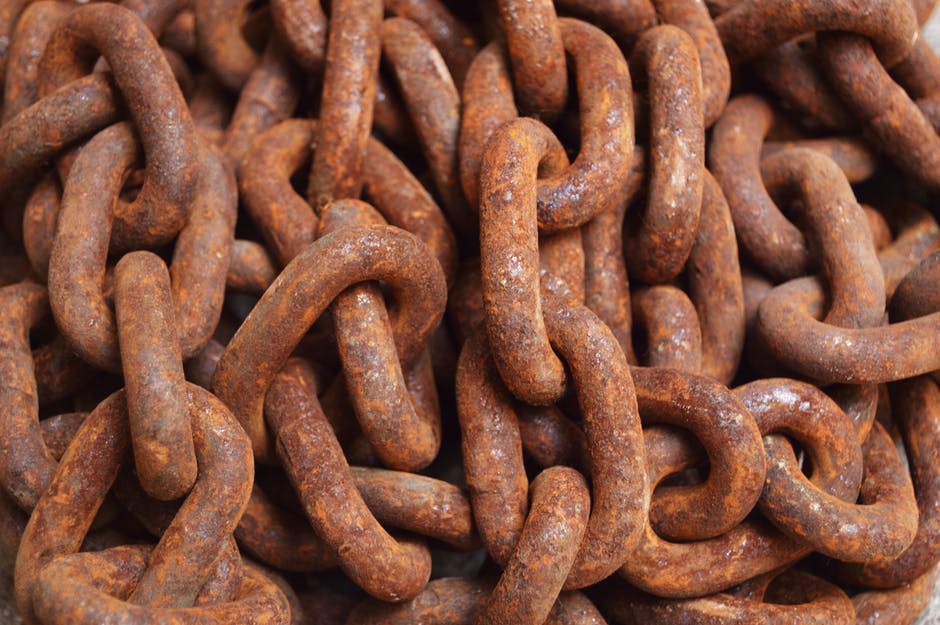
Rust = Iron Oxidation!
Rust is essentially Fe2O3
74
Chapter 4
Redox in your Everyday Life
4Fe(s) + 3O2(g) 2Fe2O3(s)
H2O
0
0
3+
LEO: loss of electrons (oxidation)
GER: gain of electrons (reduction)
2–
https://pediaa.com/wp-content/uploads/2017/12/Difference-Between-Corrosion-and-Rusting-2.jpeg
(iron (III) oxide)
Rust – a form of corrosion, but it specifically refers to the oxidation of iron or its alloys (such as steel).
74
Scientist Spotlight Dr. Margaret Frey
Vincent V.C. Woo Professor in Fiber Science & Apparel Design, College of Human Ecology, Cornell University (Ithaca, NY)
Topic: Oxidation-reduction (redox) reactions
Email: [email protected]
2
HO
¾¾®