Homer’s Iliad
 AA14NS
 Ch3p6.pdf
10/3/2020 GRLContent
https://colorstate.grlcontent.com/westerncivpremodern/page/ch3pg5 1/6
C h a p te r s ( h tt p s : //co l o r s t a te .g r l co n te n t .co m /we s te r n c i v p re m o d e r n /pa g e /c h a p te r s ) C h a p te r 3 : A rc h a i c a n d C l a s s i c a l G re e ce ( h tt p s : //co l o r s t a te .g r l co n te n t .co m /we s te r n c i v p re m o d e r n /pa g e /c h 3 ) C h a p te r 3 : T h e Pe l o p o n n e s i a n Wa r ( h tt p s : //co l o r s t a te .g r l co n te n t .co m /we s te r n c i v p re m o d e r n /pa g e /c h 3 p g 5 )
The Peloponnesian War
As the major sources for this war are from Athens, the con�ict between Sparta and Athens came to be called the Peloponnesian War—
after the peninsula on which Sparta and her allies are located. The war was on-again, off-again struggle lasting twenty-seven years, which
is longer than any previous war in ancient Greece. The end result would ultimately lead to the decline of the autonomy of Ancient Greek
poleis.
Athens was predominantly a naval power, having secured ships and money from members in the Delian League. Sparta, on the other hand,
was a superior land force due to their militaristic society. As such, when Sparta invaded Athenian territory, the Athenian leader, Pericles,
developed a two-fold strategy: �rst, use their ships to raid Spartan lands, and second, to avoid as many land battles as was possible.
In order to avoid land battles in Attica, the Athenians build a series of “long walls” between the center of the polis and their port, the
Piraeus. This strategy seemed to be working, until Athens was struck by a devastating plague in 430 BC. It ravaged the population of
Athens for four years and killed thousands, including Pericles. His successor, Cleon, pursued a more aggressive and offensive strategy.
Indeed, Cleon’s tactic was working, and he defeated the Spartan forces led by Brasidas. When both commanders were killed in 422 BC,
Athens and Sparta sued for peace.
MENU
10/3/2020 GRLContent
https://colorstate.grlcontent.com/westerncivpremodern/page/ch3pg5 2/6
Lon g Walls in Ath ens—Peloponn esian War.
The peace did not last long, and �ghting resumed in 416 BC under the Athenian commander, Alcibiades. After a few small successes,
Alcibiades had signi�cant in�uence over the Athenian assembly. The turning point in the war came when Alcibiades convinced the
Athenian people to launch the most expensive (and most problematic) expeditions yet—in 415 BC, Athens invades Sicily. Sparta had many
allies there, but the aim of the invasion rests in capturing the rich land that Sicily held. It was a catastrophic defeat. The captured Athenians
were stuffed into quarries and tortured with no toilets, and little food or water. Athens was at the mercy of Sparta.
Following the Athenian surrender, Sparta installed an antidemocratic regime in Athens called the Thirty Tyrants. They were pro-Spartan
and willing to assist the victors in pushing their own agenda in Athens. Between 404 and 403 BC these oligarchs reigned brutally, killing all
those who opposed them. Outraged, the citizens of Athens banded together and fought off the Tyrants. Luckily, Sparta was distracted
with internal political issues and democracy was restored in Athens.
The Peloponnesian War was as long as it was brutal. Both sides suffered large casualties to their armies and their population. By the
beginning of the fourth century BC (400 BC), Athenian control of Greece had been destroyed. However, Sparta was not strong enough to
take control, and a power vacuum was left in Greece, to be �lled with the most unlikely of candidates—Macedonia.
Culture in Classical Athens History The systematic study of past events, the discipline of History, was an innovation of the Greeks. The term “history” comes from the Greek
word, historia, and is mentioned in the �rst lines of Herodotus. Herodotus of Halicarnassus wrote his History of the Persian Wars in the mid-
�fth century BC and is considered the “father of Western History.” He tells us in the opening lines of his account of the Persian Wars,
This is the display of the inquiry (historia) of Herodotus of Halicarnassus, so that things done by
man not be forgotten in time, and that great and marvelous deeds, some displayed by the Hellenes,
10/3/2020 GRLContent
https://colorstate.grlcontent.com/westerncivpremodern/page/ch3pg5 3/6
dotus: orian
der s: //www.youtube.com/watch?
TXXcr2GEtc)
Read f rom the works of Aristophanes. (http: //classics.mit.edu /Browse/browse- Aristophanes.html)
some by the barbarians, not lose their glory, including among others what was the cause of their
waging war on each other (Herodotus, Histories 1.1).
Herodotus’ account of the con�ict between the Greeks and Persians is the �rst account of con�ict presented as a history. The main
themes of East vs West, and Freedom vs Slavery is an important source for the history of the Persian Wars and other aspects of Greek
culture. Modern readers must be aware that he includes several fantastical stories, and presents myths and legends with little comment
on their truth value, such as gold-digging ants in Africa.
Thucydides does not tend to include stories of interventionist gods and myths, but rather political and social motivations for occurrences.
In this sense, Thucydides’ approach to history is closer to our own than Herodotus,
The absence of romance in my history will, I fear, detract somewhat f rom its interest; but if it be
judged useful by those inquirers who desire an exact knowledge of the past as an aid to the
interpretation of the future, which in the course of human things must resemble if it does not reflect
it, I shall be content. In f ine, I have written my work, not as an essay which is to win the applause of
the moment, but as a possession for all time. (Thucydides, History of the Peloponnesian War 1.22.4).
His History of the Peloponnesian War picks up where Herodotus’ narrative leaves off and is a crucial source of information regarding the
struggle between Athens and Sparta. He is an eye-witness to many events he recounts, and had participated in the war himself. These two
men, Herodotus and Thucydides, were pioneers of the historical discipline.
Drama Drama, theater, and comedy, as modern culture understands it, were created by the Greeks. This social convention was used to greater
ends than mere entertainment—the theater was used to educate, persuade, and convince the populous at Athens. As a whole, the
production of Greek plays was consistent over time. Men would be the actors (even in women’s roles), there would be scenery, and a
chorus who narrated the story and emphasized important details to the audience.
Greek tragedy dealt with universal themes such as love, nature of good and evil, the relationship with men and the divine realm, and the
human condition. Often, but not always, a tragedy would end in disaster and would usually be presented in a trilogy series. Several
playwrights’ works have come down to us—Aeschylus, Sophocles, and Euripides are the most famous.
In addition to tragedy, the Greeks also developed Comedy. Here, a more lighthearted genre would be
depicted with grotesque masks, obscene jokes, and over-the-top themes to entertain the audience.
Many times these plays would satirize the political and social climate, while making reference to actual
people and events. The most famous of the Comic playwrights is Aristophanes (Ar-is-STAH-fu-neez).
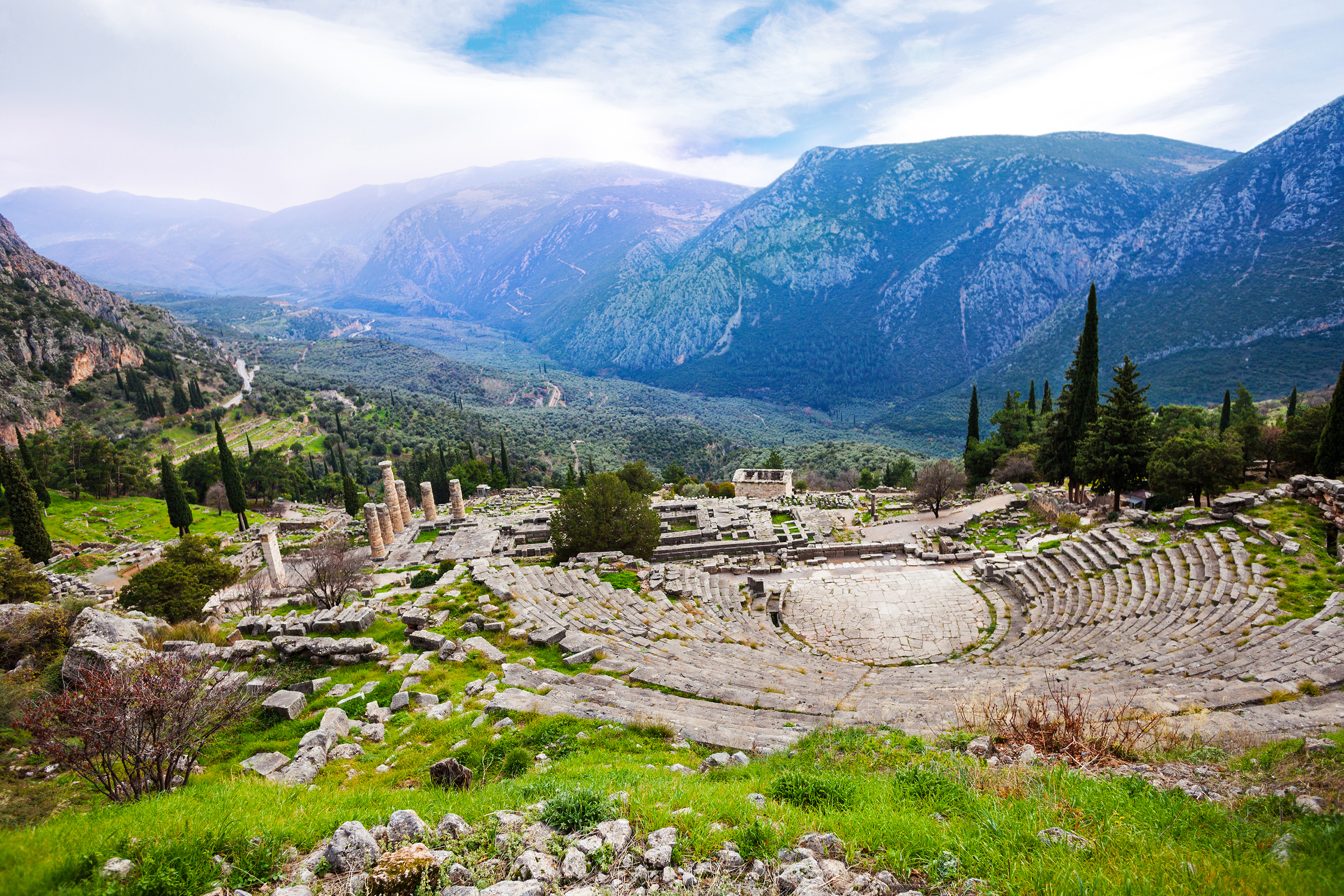
Th eater at Delphi.
(http://s3.amazonaws.com/edelta.greatrivertech.net/images/145855/shutterstock_310278887.jpg)(http://s3.amazonaws.com
Philosophy
10/3/2020 GRLContent
https://colorstate.grlcontent.com/westerncivpremodern/page/ch3pg5 4/6
The term philosophy comes from the Greek words, philos- (meaning love) and -sophia, (meaning wisdom) and literally means “the love of
wisdom.” Here, Greek culture gives another legacy to Western Civilization, the notion of rational thought. Of particular interest in
rational thought in regards to the nature of existence and the universe, as well as humanity’s place within the cosmos, and the relationship
between men and gods.
The Pre-Socratic philosophers (those philosophers who taught before Socrates) focus on the unifying, original principle of the universe.
For example, some early Greek philosophers thought the primary substance of the cosmos was �re, others water, air, and even atoms.
Democritus proposed the notion that the world is made from tiny, indivisible particles which he called atoms—a theory that was picked up
later by Western society in modern times. The signi�cance of these early thinkers is that they removed the role of the gods in
understanding the universe, meteorological phenomena, and the human condition.
The Sophists rejected the notion of the Pre-Socratics and denied the possibility for humans to understand the nature of the universe in
rational terms. It was more important for individuals to prove themselves in arête, and so the human condition was the only subject
worthy of study. These Sophists were teachers who wandered around Greece, charging students a fee for their scholarly services. They
particularly stressed the discipline of rhetoric—the art of persuasive speech—which was so integral to democratic Athens.
A stark opponent of the Sophists, and one of the most famous philosophers from ancient Greece, is Socrates. Most of what we know of
Socrates’ philosophical teachings comes from his pupil, Plato, who himself is a famous philosopher. Socrates did not write any of his own
works down, but he taught several students the fundamentals of his doctrine—for free. One of his main points was to emphasize reasoning
in order to uphold individual ethics and universal standards. Once a universal standard of just behavior is achieved, people can then �nd
happiness by choosing good over evil.
Socrates’ method of instruction was the Socratic Method. Through his method of teaching, Socrates often upset the people of Athens, as it
left them feeling ignorant. Indeed, his teachings ended up getting him in trouble. Particularly, because Socrates was accused of corrupting
the youth of Athens and not worshipping the civic gods, he was condemned to death in 399 BC.
Socrates’ pupil, Plato, is considered by many to be the greatest philosopher in Western civilization. It is to him that we owe most of our
knowledge of his teacher, Socrates. Luckily, Plato did write his own ideas down. Of particular interest to Plato was the area of philosophy
called epistemology—how do we know what is real? To him, there existed pure, unchanging ideas which he called Forms that are the
ultimate reality. Our existence is simply a shadowy re�ection of these Forms. Only through philosophical contemplation can an individual
uncover the true nature of existence and the Forms.
Likewise, Plato discusses his ideal form of government in his Republic—one of the greatest treatises written in the Ancient Greek language.
Plato demonstrates his distaste for democracy (since it was democratic Athens that condemned his friend and teacher to death), and
suggests that the ideal state should be ruled by the elite “philosopher-kings” rather than the masses.
In Athens, Plato created a learning institution called the Academy. Here, in a lush grove in Athens, people would come to learn and teach
philosophy to like-minded learners. Aristotle studied here for years before founding his own philosophical school.
Aristotle was the pupil of Plato, continuing a philosophical pedigree which began with Socrates (and will end with Aristotle’s pupil,
Alexander the Great). Aristotle rejected Plato’s idea of the true Forms and suggested, rather, that by examining objects and their
similarities, humanity can come to some understanding of universal principles. As such, Aristotle spent much of his time analyzing and
categorizing things. Through this approach, Aristotle became fascinated with animals and their lifecycle. By examining them in detail,
Aristotle laid the foundation for taxonomy, zoology, and biology.
Like his predecessor, Aristotle also wrote treatises on politics and government. He compiled details of many existing governments, such as
Athens and Sparta, to �nd the best form through rational examination, rather than the ideal which Plato espoused. He noted that a
monarchy can easily turn into a despot, aristocracy will degrade into oligarchy, and democracy will turn to anarchy. His support lies with a
constitutional government.
Religion
10/3/2020 GRLContent
https://colorstate.grlcontent.com/westerncivpremodern/page/ch3pg5 5/6
Ruins of th e great temple of Apollo at Delphi. Image © Shutterstock, Inc.
The Greeks practiced a polytheistic religion, comprised of many gods. The
religious tradition which they maintained was comprised of civic and
private sacri�ces. Indeed, sacri�ce was the central aspect of Greek
religious observances. Sacri�ces—in the form of an animal, liquid libation,
votive gift, or incense—were dedicated to the gods in order to establish
and maintain good relations with the divine realm. To each god were
dedicated different festivals, rituals, and proper forms of worship. Many of
the
, as they appear in Mythology, are
familiar to Western culture. Zeus, Hera, Poseidon, Hermes, Athena, and Aphrodite are all thought to control their own spheres of
in�uence. Poleis or individuals were appeal to a particular god for assistance in a speci�c area, for example, Poseidon as the god of the sea,
would be sacri�ced to in order for a safe sea journey.
Review Question
READ MORE GREEK RELIGION (/WESTERNCIVPREMODERN/PAGE/C
G r e e k g o d s
( h t t p s : //c o l o r s t a t e . g r l c o n t e n t . c o m / w e s t e r n c i v p r e m o d e r n /p a g e /c h 3 p g 3 # g r e e k p a n t h e o n )
What was the fundamental difference between Socrates and the Sophists?
SAVE VIEW CORRECT ANSWER
TIME TABLE Age/Event Date
Minoan Crete c. 2000–1450 BC
Mycenaean Civilization c. 1600–1100 BC
Greek Dark Ages c. 1000–750 BC
Early revival of trade and population c. 900–800 BC
First Olympic Games 776 BC
Homeric poetry recorded c.750 BC
Greek Colonization c. 750–550 BC
Sparta conquers Messenia c.730–710 BC
Democracy instituted in Athens 508 BC
First Persian Invasion 499–479 BC
Battle of Marathon 490 BC
Xerxes’ Invasion of Greece 480–479 BC
Battle of Salamis 480 BC
10/3/2020 GRLContent
https://colorstate.grlcontent.com/westerncivpremodern/page/ch3pg5 6/6
PREVIOUS (HTTPS: //COLORSTATE.GRLCONTENT.COM/ WEBCOM-VIEW-PAGE/532/6138/6135?PAGE-ID=332438) NEXT (HTTPS: //COLORSTATE.GRLCONTENT.COM/ WEBCOM-VIEW-PAGE/532/6138/6135?PAGE-ID=332440)
Age/Event Date
Golden Age of Athens: 480–430 BC
Sophocles’ Antigone 441 BC
Peloponnesian War 431–404 BC
Socrates executed 399 BC
For questions or
concerns regarding
this online
publication, please
contact
w e b s u p p o r t ( h t t p s : //c o l o r s t a t e . g r l c o n t e n t . c o m /e f o r m /s u b m i t /s u p p o r t - f o r m )
.
Having troubles
viewing something
on the page, make
sure you have the
correct
p l u g - i n s ( h t t p s : //c o l o r s t a t e . g r l c o n t e n t . c o m /s y s t e m R e q u i r e m e n t s )
.
GRLContent™ is a
trademark of Great
River Learning. All
rights reserved. ©
2002-2020.
View the Great River Learning P r i v a c y S t a t e m e n t ( h t t p s : //c o l o r s t a t e . g r l c o n t e n t . c o m /s h o w P r i v a c y P o l i c y ) | Te r m s a n d C o n d i t i o n s ( h t t p s : //c o l o r s t a t e . g r l c o n t e n t . c o m / t e r m s O f U s e P a g e ) .