OE7 due in 18 hours
 yk1993
 Businessandbeyondbook_303-end.pdf
Chapter 13: Trends in Information Systems
Learning Objectives
Upon successful completion of this chapter, you will be
able to:
• describe current trends in information systems.
• know how to think about the impacts of changes in
technology on society and culture.
Introduction
Information systems have evolved at a rapid pace ever since their
introduction in the 1950s. Today devices you can hold in one hand
are more powerful than the computers used to land a man on the
moon in 1969. The Internet has made the entire world accessible to
you, allowing you to communicate and collaborate like never before.
This chapter examines current trends and looks ahead to what is
coming next. As you read about technology trends in this chapter,
think how you might gain competitive advantage in a future career
through implementation of some of these devices.
Chapter 13: Trends in Information Systems | 291
Global
The first trend to note is the continuing expansion of globalization.
The use of the Internet is growing all over the world, and with
it the use of digital devices. Penetration rates, the percent of the
population using the Internet, remains high in the developed world,
but other continents are gaining.1
Internet Users by Continent (Source: Internet World Stats)
In addition to worldwide growth in Internet penetration, the
number of mobile phones in use continues to increase. At the end
of 2017 the world population of people over the age 10 years (those
old enough to possibly have their own mobile phone) was about
5.7 billion with an estimated 4.77 billion mobile phone users. This
1. Internet World Stats
292 | Information Systems for Business and Beyond (2019)
equates to over 80% of people in the world having a mobile phone. 2
World wide mobile phone users (Source: Statista)
Social
Social media growth is another trend that continues at a firm
growth rate. As of April 2018 there were about 2.18 billion Facebook
users, a 14% increase from April 2017.3
2. Statistica Forecast of Mobile Phone Users Worldwide
3. Zephoria Top 15 Valuable Facebook Statistics
Chapter 13: Trends in Information Systems | 293
Facebook users world wide in June 2017 (Source: Internet World
Stats)
In 2018, of the 2.2 billion users who regularly use Facebook, only half
them spoke English and only 10% were from the US.4
Besides Facebook, other social media sites are also seeing
tremendous growth. Over 83% of YouTube’s users are outside the
US, with the UK, India, Germany, Canada, France, South Korea, and
Russia leading the way.5 Pinterest gets over 57% of its users from
outside the US, with over 9% residing in India. 6 Twitter now has
over 330 million active users. 7 Social media sites not based in the
US are also growing. China’s WeChat multipurpose messaging and
social media app is the fifth most-visited site in the world.8
4. https://blog.hootsuite.com/facebook-statistics
5. Omnicore Agency Facebook Statistics
6. Omnicore Agency Pinterest Statistics
7. Omnicore Agency Twitter Statistics
8. Statista
294 | Information Systems for Business and Beyond (2019)
Mary Meeker making her Internet Trends presentation
Personal
Ever since the advent of Web 2.0 and e-commerce, users of
information systems have expected to be able to modify their
experiences to meet their personal tastes. From custom
backgrounds on computer desktops to unique ringtones on mobile
phones, makers of digital devices provide the ability to personalize
how we use them. More recently, companies such as Netflix have
begun assisting their users with personalizations by viewing
suggestions. In the future, we will begin seeing devices perfectly
matched to our personal preferences, based upon information
collected about us.
Sidebar: Mary Meeker and Internet Trends
Chapters such as this are
difficult to maintain because
the future is a moving target.
The same goes for businesses
looking to figure out where to
develop new products and
make investments. Enter Mary
Meeker, up until 2018 a partner
at the notable venture capital
firm Kleiner Perkins Caufield &
Byers and now forming her own investment group, Bond Capital. For
the past several years, Ms. Meeker has presented the “Internet
Trends” report at the Code Conference every May. The
presentation consists of rapid-fire summaries of data that provides
insights into all of the latest trends in digital technologies and their
Chapter 13: Trends in Information Systems | 295
impact on economies, culture, and investing. For those wanting to
keep up with technology, there is no better way than to unpack her
annual presentation by watching a video of the presentation and
reviewing the associated slide deck.
Here are the last few years of videos of her presentation: 2019
2018 2017
You can view her slide decks from previous years by going to the
Bond Capital archive.
Mobile
Perhaps the most impactful trend in digital technologies in the last
decade has been the advent of mobile technologies. Beginning with
the simple cellphone in the 1990s and evolving into the smartphones
of today, the growth of mobile has been overwhelming. Here are
some key indicators of this trend:
• Mobile vs. Desktop. Minutes spent each day on a mobile device are 2.5 times the number of minutes spent on a desktop
computer.
• Daytime vs. Evening. Desktop use dominates in the daytime hours, but mobile devices are dominant in the evening, with
peak usage around 8:00 pm.
• Device usage. Smartphones are used more than any other technology. Laptops are in second place, followed by tablets
holding a slight edge over desktops. 9
• Smartphone sales decline. According to Gartner Group, world
9. Smart Insights
296 | Information Systems for Business and Beyond (2019)
wide smartphone sales declined in the fourth quarter of 2017
by 4.7% compared with the fourth quarter of 2016. This is the
first decline in global smartphone sales since Gartner began
tracking mobile phone sales in 2004. 10
• The rise and fall of tablets. In 2012 the iPad sold more than three times as many units in its first twelve months as the
iPhone did in its first twelve months. However, tablet sales
dropped 20% from the fourth quarter 2015 to fourth quarter
2016. 11
The decline in tablet sales continued into 2017 when first
quarter sales dropped 8.5% to their lowest total since the third
quarter of 2012, the year they were introduced. 12 In
comparison, PC sales dropped only 1.7% in 2017 compared with
tablet sales being down 10%. 13
As discussed in chapter 5, the advent of 5G connection technologies
will accelerate an “always-connected” state for a majority of people
around the world.
Wearable
The average smartphone user looks at his or her smartphone 150
times a day for functions such as messaging (23 times), phone calls
(22), listening to music (13), and social media (9).Many of these
functions would be much better served if the technology was worn
10. Gartner.com
11. Techcrunch
12. Business Insider
13. Telegraph
Chapter 13: Trends in Information Systems | 297
Wearable Devices Actual and Forecast (Source: Gartner Group, August 2017)
on, or even physically integrated into, our bodies. This technology is
known as a “wearable.”
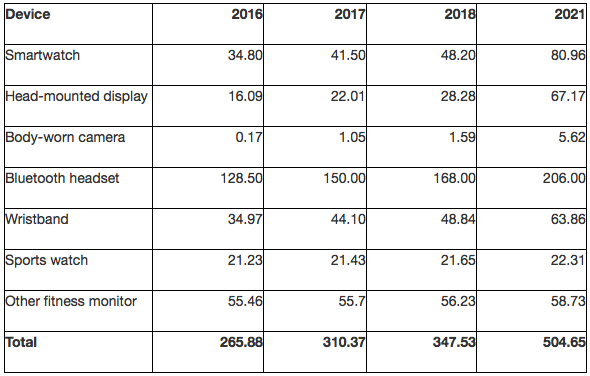
Wearables have been around for a long time, with technologies
such as hearing aids and, later, bluetooth earpieces. Now the
product lines have expanded to include the Smartwatch, body
cameras, sports watch, and various fitness monitors. The following
table from the Gartner Group reports both historical and predicted
sales.
Wearable Devices Worldwide (millions of units)
Notice the strong growth predicted by 2021. Total wearable
devices are projected to increase by about 45% from 2018 to 2021.
298 | Information Systems for Business and Beyond (2019)
Waze Screen Shot (Click to enlarge)
Collaborative
As more people use
smartphones and wearables, it
will be simpler than ever to
share data with each other for
mutual benefit. Some of this
sharing can be done passively,
such as reporting your location
in order to update traffic
statistics. Other data can be
reported actively, such as
adding your rating of a
restaurant to a review site.
The smartphone app Waze is
a community-based tool that
keeps track of the route you are
traveling and how fast you are
making your way to your
destination. In return for
providing your data, you can benefit from the data being sent from
all of the other users of the app. Waze directs you around traffic and
accidents based upon real-time reports from other users.
Yelp! allows consumers to post ratings and reviews of local
businesses into a database, and then it provides that data back to
consumers via its website or mobile phone app. By compiling ratings
of restaurants, shopping centers, and services, and then allowing
consumers to search through its directory, Yelp! has become a huge
source of business for many companies. Unlike data collected
passively however, Yelp! relies on its users to take the time to
provide honest ratings and reviews.
Chapter 13: Trends in Information Systems | 299
Printable
One of the most amazing innovations to be developed recently is
the 3-D printer. A 3-D printer allows you to print virtually any 3-D
object based on a model of that object designed on a computer.
3-D printers work by creating layer upon layer of the model using
malleable materials, such as different types of glass, metals, or even
wax.
3-D printing is quite useful for prototyping the designs of
products to determine their feasibility and marketability. 3-D
printing has also been used to create working prosthetic legs and
an ear that can hear beyond the range of normal hearing. The US
military now uses 3-D printed parts on aircraft such as the F-18.14
Here are more amazing productions from 3D printers.
• Buildings. Researchers at MIT in 2017 unveiled a 3D printing robot that can construct a building. It has a large arm and small
arm. The large arm moves around the perimeter of the building
while the small arm sprays a variety of materials including
concrete and insulation. Total time to construct a dome-
shaped building is just 14 hours.
• Musical Instruments. Flutes, fiddles, and acoustic guitars are being produced with 3D printing using both metal and plastic.
You can click here for an example of making a violin.
• Medical Models. Medical models are being used to help doctors train in the areas of orthopedics, transplant surgery,
and oncology. Using a 3D printed brain model similar to the
one shown here, surgeons were able to save a patient from a
cerebral aneurysm.
• Clothing. How would you like clothes that fit perfectly? Special
14. The Economist. (2013, September 13). 3-D Printing Scales
Up.
300 | Information Systems for Business and Beyond (2019)
software is used to measure a person, then 3D printing
produces the clothing to the exact measurements. The result is
well-fitting clothes that consume less raw materials. Initially
the challenge was to find materials that would not break. You
can read more about 3D printing of clothes and shoes. 15
3-D printing is one of many technologies embraced by the
“maker” movement. Chris Anderson, editor of Wired magazine, puts it this way16:
In a nutshell, the term “Maker” refers to a new category of
builders who are using open-source methods and the latest
technology to bring manufacturing out of its traditional
factory context, and into the realm of the personal desktop
computer. Until recently, the ability to manufacture was
reserved for those who owned factories. What’s happened
over the last five years is that we’ve brought the Web’s
democratizing power to manufacturing. Today, you can
manufacture with the push of a button.
15. Bosavage, J. (2017, September 5). Unbelievable Creations
from 3-D Printers.
16. Anderson, C. (2012). Makers: The New Industrial
Revolution.. Crown Business.
Chapter 13: Trends in Information Systems | 301
Findable
The “Internet of Things” (IoT) refers to devices that have been
embedded into a variety of objects including appliances, lamps,
vehicles, lightbulbs, toys, thermostats, jet engines, etc. and then
connecting them via Wi-Fi, BlueTooth, or LTE to the Internet.
Principally three factors have come together to give us IoT:
inexpensive processors, wireless connectivity, and a new standard
for addresses on the Internet known as IPv6. The result is these
small, embedded objects (things) are capable of sending and
receiving data. Lights can be turned on or off remotely. Thermostats
can be reset with anyone being present. And, perhaps on the
downside, how you drive your car can be monitored and evaluated
by your insurance company.
Processors have become both smaller and cheaper in recent
years, leading to their being embedded in more devices. Consider
technological advancements in your vehicles. Your car can now
collect data about how fast you drive, where you go, radio stations
you listen to, and your driving performance such as acceleration
and braking. Insurance companies are offering discounts for the
right to monitor your driving behavior. On the positive side, imagine
302 | Information Systems for Business and Beyond (2019)
the benefit of being informed instantly of anticipated traffic delays
each time you adjust your route to work in the morning.
Think of IoT as devices that you wouldn’t normally consider being
connected to the Internet. And, the connection is independent of
human intervention. So a PC is not an IoT, but a fitness band could
be. One keyword for IoT would be “independent”, not relying
directly or constantly on human action.
Another keyword would be “interconnected”, in the sense that
IoTs are connected to other IoTs and data collection points or data
servers. This interconnectedness or uploading of data is virtually
automatic.
“Ubiqutous” is also a good descriptor of IoTs. And so is
“embeddedness.” It is reasonable to expect that devices through
IoTs are reporting data about conditions and events that are not
foremost in our thinking, at least not on a continuous basis. Today
there are IoTs for monitoring traffic, air quality, soil moisture, bridge
conditions, consumer electronics, autonomous vehicles, and the list
seemingly never stops. The question that might come to mind is
“How many IoTs are there today?”
The Gartner Group released a study in January 2017 which
attempted to identify where IoTs exist. They reported that over half
of all IoTs are installed in devices used by consumers. They also
noted that growth in IoTs increased by over 30% from 2016 to the
projected levels for 2017.17
Benefits from IoTs are virtually everywhere. Here is a quick list.
• Optimization of Processes. IoTs in manufacturing monitor a variety of conditions that impact production including
temperature, humidity, barometric pressure – all factors which
17. Ranger, S. (2018, January 19). What is the IoT? Everything
You Wanted to Know about The Internet of Things Right
Now. ZDNet.
Chapter 13: Trends in Information Systems | 303
require adjustment in application of manufacturing formulas.
• Component Monitoring. IoTs are added to components in the manufacturing process, then monitored to see how each
component is performing.
• Home Security Systems. IoTs make the challenge of monitoring activity inside and outside your home are now
easier.
• Smart Thermostats. Remote control of home thermostats through the use of IoTs allows the homeowner to be more
efficient in consumption of utilities.
• Residential Lighting. IoTs provide remote control of lighting, both interior and exterior, and at any time of day.18
Security issues need to be acknowledged and resolved, preferably
before IoTs in the form of remote lighting, thermostats, and security
systems are installed in a residence. Here are some security
concerns that need monitoring.
• Eavesdropping. Smart speaker systems in residences have been hacked, allowing others to eavesdrop on conversations
within the home.
• Internet-connected Smart Watches. These devices are sometimes used to monitor the location of children in the
family. Unfortunately, hackers have been able to breakin and
again, eavesdrop as well as learn where children are located.
• Lax Use by Owners. Devices such as smart thermometers, security systems, etc. come with a default password. Many
owners fail to change the password, thereby allowing easy
access by a hacker.
18. Ranger, S. (2018, January 19). What is the IoT? Everything
You Wanted to Know about The Internet of Things Right
Now. ZDNet.
304 | Information Systems for Business and Beyond (2019)
Autonomous
Another trend that is emerging is an extension of the Internet of
Things: autonomous robots and vehicles. By combining software,
sensors, and location technologies, devices that can operate
themselves to perform specific functions are being developed.
These take the form of creations such as medical nanotechnology
robots (nanobots), self-driving cars, or unmanned aerial vehicles
(UAVs).
A nanobot is a robot whose components are on the scale of about
a nanometer, which is one-billionth of a meter. While still an
emerging field, it is showing promise for applications in the medical
field. For example, a set of nanobots could be introduced into the
human body to combat cancer or a specific disease.
In March of 2012, Google introduced the world to their driverless
car by releasing a video on YouTube showing a blind man driving
the car around the San Francisco area. The car combines several
technologies, including a laser radar system, worth about $150,000.
While the car is not available commercially yet, three US states
(Nevada, Florida, and California) have already passed legislation
making driverless cars legal.
A UAV, often referred to as a “drone,” is a small airplane or
helicopter that can fly without a pilot. Instead of a pilot, they are
either run autonomously by computers in the vehicle or operated
by a person using a remote control. While most drones today are
used for military or civil applications, there is a growing market
for personal drones. For around $300, a consumer can purchase a
drone for personal use.
Secure
As digital technologies drive relentlessly forward, so does the
Chapter 13: Trends in Information Systems | 305
demand for increased security. One of the most important
innovations in security is the use of encryption, which we covered
in chapter 6.
Summary
As the world of information technology moves forward, we will
be constantly challenged by new capabilities and innovations that
will both amaze and disgust us. As we learned in chapter 12, many
times the new capabilities and powers that come with these new
technologies will test us and require a new way of thinking about
the world. Businesses and individuals alike need to be aware of these
coming changes and prepare for them.
Study Questions
1. Which countries are the biggest users of the Internet? Social
media? Mobile?
2. Which country had the largest Internet growth (in %) in the
last five years?
3. How will most people connect to the Internet in the future?
4. What are two different applications of wearable technologies?
5. What are two different applications of collaborative
technologies?
6. What capabilities do printable technologies have?
7. How will advances in wireless technologies and sensors make
objects “findable”?
8. What is enhanced situational awareness?
9. What is a nanobot?
10. What is a UAV?
306 | Information Systems for Business and Beyond (2019)
Exercises
1. If you were going to start a new technology business, which of
the emerging trends do you think would be the biggest
opportunity? Do some original research to estimate the market
size.
2. What privacy concerns could be raised by collaborative
technologies such as Waze?
3. Do some research about the first handgun printed using a 3-D
printer and report on some of the concerns raised.
4. Write up an example of how IoT might provide a business with
a competitive advantage.
5. How do you think wearable technologies could improve overall
healthcare?
6. What potential problems do you see with a rise in the number
of autonomous cars? Do some independent research and write
a two-page paper that describes where autonomous cars are
legal and what problems may occur.
7. Seek out the latest presentation by Mary Meeker on “Internet
Trends” (if you cannot find it, the video from 2018 is available
at Mary Meeker). Write a one-page paper describing what the
top three trends are, in your opinion.
8. Select a business enterprise of interest to you, one that you
may pursue following graduation. Select one or more of the
technologies listed in this chapter, then write a one or two
page paper about how you might use that technology to gain a
competitive advantage.
Chapter 13: Trends in Information Systems | 307
Index
Below are listed terms that can be found in this text. The terms are
indexed by chapter and page. For example, “12-254” indicates that
the term can be found in chapter 12 on page 254. Please also note
that page numbers may vary based upon how you are reading this
text!
Acceptable User Policy, 12-254
Access control, 6-127
Agile methodologies, 10-205
Altair 8800, 1-20
Apple II, 1-20
Application software, 1-16, 3-57
ARPA Net, 1-225-104
Assembly language, 10-210
Authentication, 6-125
Autonomous devices, 13-289
Availability, 6-125
Backups, 6-131
Berners-Lee, Tim, 1-22
Big Data, 4-91, 4-93
Binary, 2-33, -34
Binary prefixes, 2-36
Biometrics, 6-126
Bit, 2-33
Bitcoin, 11-245
Blockchain, 11-244
Bluetooth, 2-43, 5-114
Brynjolfson, Eric, 7-146
Build v. buy, 10-218
Bus, 2-39
Business Analytics, 4-98
Business Intelligence, 4-98
Index | 309
Business process, 8-163
Business Process Management (BPM), 7-153, 8-168
Business process re-engineering, 8-170
Byte, 2-33</p>
Cambridge Analytica, 12-251
Career paths, 9-189
Carr, Nicholas, 1-12, 2-26, 7-147
CASE tools, 10-215
Castells, Manuel, 11-233
Cellphone abroad, 5-114
Central Processing Unit (CPU), 2-36, video 2-37, multi-core 2-45
Certifications, 9-190
Change management, 10-223
Chief Information Officer (CIO), 9-186
Client-server, 1-21, 5-116
Cloud computing, 1-25, 3-68, 5-118
Collaborative systems, 7-155, 13-283
Code of ethics, 12-252
Commoditization, 2-50
Competitive advantage, 1-13, 2-26, 7-147, 7-153, 7-158
Compiled v. interpreted, 10-213
Components, 1-14
Computer engineer, 9-183
Computer operator, 9-185
Confidentiality, 6-124
Copyright, 12-256
Creative Commons, 12-261
Cross platform development, 10-221
Customer Relationship Management (CRM), 3-65
Data dictionary, 4-93
Data-Information-Knowledge-Wisdom, 4-77
Data integrity, 4-86
Data mining, 4-96, sidebar, 4-97
Data privacy, 12-251
Data types, 4-83
310 | Information Systems for Business and Beyond (2019)
Data warehouse, 4-93, benefits, 4-95
Database, 4-78
Database administrator, 9-185
Database, enterprise, 4-91
Database spreadsheet sidebar, 4-85
Database Management System (DBMS), 4-90
Database, Relational, 4-78
Decimal numbering system, 2-34
Decision Support Systems (DSS), 7-156
Developer, 9-183
Digital devices, 2-33
Digital divide, 11-240
Digital Millennium Copyright Act, 12-260
Disintermediation, 1-23
Domain name, 5-107
DNS, 5-107
Do Not Track, 12-273
Dot-comm bubble, 1-235, 5-109
Double Data Rate (DDR), 2-40
Eclipse IDE, 3-61
Electronic Data Interchange (EDI), 7-154
Email, 5-110
Encryption, 6-128
End-user computing, 10-220
Enterprise Resource Planning (ERP), 1-21, 3-64, 8-166
Eras, business computing, 1-25
Ethics, 12-250
Extranet, 5-117
Facebook, 11-251, 13-280
Fair use, 12-258
Family Educational Rights and Privacy Act, 12-271
Fernandes, Benjamin, 11-245
Findable, 13-286
Firewalls, 6-132
First sale doctrine, 12-257
Index | 311
Ford, Henry, 12-250
Friedman, Thomas, 11-234
Gantt chart, 9-188
General Data Protection Regulation, 12-272
Global firm, 11-236
Globalization, 11-232
Ghemawat, Pankaj, 11-236
Hammer, Michael, 8-170
Hard disk, 2-41
Hardware, 1-15, 2-32
Health Insurance Portability and Accountability Act, 12-271
Huang’s Law, 2-38
Implementation Methodologies, 10-222
Information security triad, 6-124
Information systems, 1-14
Information systems employment, 9-180
Integrity, 6-124
Intellectual property, 12-255
Internet speed, 11-239
Internet usage statistics, 11-233
Intrusion Detection System (IDS), 6-133
IBM-PC, 1-20
Integrated circuits, 2-45
Internet, 1-22, internet and www, 5-111, high speed, 5-111
Internet of Things (IoT), 2-49, 13-286, install, 13-287
IP address, 5-106
Integrated Development Environment (IDE), 10-214
Internet user worldwide, 5-108
Intranet, 5-116
Isabel, 7-157
ISO certification, 8-174
IT doesn’t matter, 7-147
Key-Value database, 4-89
Kim, Paul, 11-243
Knowledge Management (KM), 4-98
312 | Information Systems for Business and Beyond (2019)
Laptop, 1-12
Lean methodologies, 10-207
Linux, 3-56
Local Area Network (LAN), 1-21
Machine code, 10-209
Mainframe, 1-18
Manufacturing Resource Planning (MRP), 1-19
Metadata, 4-92
Metcaffe’s Law, 5-119
Microsoft Excel, 3-57
Mobile applications, 3-67, building, 10-221, cross platform, 10-221
Mobile phone users worldwide, 13-280
Mobile networking, 5-113
Mobile security, 6-136
Mobile technology trends, 13-282
Motherboard, 2-39
Moore’s Law, 2-37
Nanobot, 13-289
Network Interface Card (NIC), 2-44
Nielsen, Jakob, 11-241
Non-obvious relationship awareness, 12-269
Normalization, 4-82
NoSQL, 4-89
Office application suites, 3-60
Open source software, 3-71
Openoffice, 3-72
Operating systems, 1-15, 3-55
Outsourcing, 9-193
Ownership of software, 3-63
Packet, 5-106
Password security, 6-130
Patent, 12-263
Patent troll, 12-265
PC, 1-12
Personal information security, 6-138
Index | 313
Personally identifiable information, 12-268
Physical security, 6-134
Powerpoint, 3-62
Portable computer, 2-47
Porter’s five forces, 7-150
Post PC world, 1-24
Primary key, 4-80
Printable, 13-284
Privacy, data, 4-97, 12-267
Procedural v. object-oriented, 10-213
Productivity paradox, 7-146
Productivity software, 3-58
Project manager, 9-188
Programming language spectrum, 10-212
Protocol, 5-108
Public key encryption, 6-129
Quality triangle, 10-208
Random Access Memory (RAM), 2-40
Rapid Application Development (RAD), 10-203
Retail Link, Walmart, 1-27
Router, 5-106
RSA SecurID token, 6-126
Security policies, 6-135
Sharepoint, 5-118
Smartphone, 1-12, 2-47
Software, 1-15
Solid State Drive (SSD), 2-41
Stop Think Connect, 6-139
Structured Query Language (SQL) 4-86
Student Clubs database, 4-81
Supply Chain Management, 1-27, 3-66
Support analyst, 9-185
Switch, 5-106
Systems analyst, 9-181
Systems Development Life Cycle (SDLC), 10-200
314 | Information Systems for Business and Beyond (2019)
Tableau, 3-62
Tablet, 2-48, decline, 13-282
TCP/IP, 5-105
Ted talk fibre optic, 1-23
Time-sharing, 1-19
Trademark, 12-265
Universal Serial Bus (USB), 2-42
Unmanned Aerial Vehicle, 13-290
Usability, 6-138
Users, adoption types, 9-194
Value chain, 7-148
Virtual Machine (VM), 3-70
Virtual Private Network (VPN), 6-133
Virtualization, 3-70
Voice Over IP (VOIP), 5-115
Walmart, 1-26, 4-91
Wearable, 13-282
Web 2.0, 1-23, 5-109
Web services, 10-219
Website, build, 10-216
Wi-fi, 5-112
Windows operating system, 1-20
Word size, 2-34
World 3.0, 11-236
World is flat, 11-234
World Wide Web (WWW), 1-22
Index | 315
- Information Systems for Business and Beyond (2019)
- Information Systems for Business and Beyond (2019)
- Title Page
- Copyright
- Book Contributors
- Changes from Previous Edition
- How you can help
- Introduction
- Part I: What is an information system?
- Chapter 1: What Is an Information System?
- Chapter 2: Hardware
- Chapter 3: Software
- Chapter 4: Data and Databases
- Chapter 5: Networking and Communication
- Chapter 6: Information Systems Security
- Part II: Information Systems for Strategic Advantage
- Chapter 7: Does IT Matter?
- Chapter 8: Business Processes
- Chapter 9: The People in Information Systems
- Chapter 10: Information Systems Development
- Part III: Information Systems Beyond the Organization
- Chapter 11: Globalization and the Digital Divide
- Chapter 12: The Ethical and Legal Implications of Information Systems
- Chapter 13: Trends in Information Systems
- Index