OE6 Due in 36 hours
 yk1993
 Businessandbeyondbook_257-302.pdf
Chapter 11: Globalization and the Digital Divide
Learning Objectives
Upon successful completion of this chapter, you will be
able to:
• explain the concept of globalization;
• describe the role of information technology in
globalization;
• identify the issues experienced by firms as they
face a global economy; and
• define the digital divide and explain Nielsen’s three
stages of the digital divide.
Introduction
The Internet has wired the world. Today it is just as simple to
communicate with someone on the other side of the world as it
is to talk to someone next door. But keep in mind that many
businesses attempted to outsource different needs in technology,
only to discover that near-sourcing (outsourcing to countries to
Chapter 11: Globalization and the Digital Divide | 245
Internet Statistics by Continent. Source: https://www .internetworl dstats.com/ stats.htm. (Click to enlarge)
which your country is physically connected) had greater advantage.
This chapter looks at the implications of globalization and the
impact it is having on the world.
What Is Globalization?
Globalization refers to the integration of goods, services, and
culture among the nations of the world. Globalization is not
necessarily a new phenomenon. In many ways globalization has
existed since the days of European colonization. Further advances
in telecommunication and transportation technologies accelerated
globalization. The advent of the the worldwide Internet has made all
nations virtual next door neighbors.
The Internet is truly a worldwide phenomenon. As of December
2017 the Internet was being used by over 4.1 billion people world
wide. 1 From its initial beginnings in the United States in the 1970s to
the development of the World Wide Web in the 1990s to the social
networks and e-commerce of today, the Internet has continued to
increase the integration between countries, making globalization a
fact of life for citizens all over the world.
1. [1]
246 | Information Systems for Business and Beyond (2019)
The Network Society
In 1996 social-sciences researcher Manuel Castells published The
Rise of the Network Society, in which he identified new ways
economic activity was being organized around the networks that
the new telecommunication technologies had provided. This new,
global economic activity was different from the past, because “it
is an economy with the capacity to work as a unit in real time on
a planetary scale.” 2 Having a world connected via the Internet has
some massive implications.
The World Is Flat
Thomas Friedman’s 2005 book The World Is Flat uses anecdotal
evidence to present the impact the personal computer, the Internet,
and communication software have had on business, specifically the
impact on globalization. Three eras of globalization are defined at
the beginning of the book. 3
:
• “Globalization 1.0″ occurred from 1492 until about 1800. In this
era globalization was centered around countries. It was about
how much horsepower, wind power, and steam power a
country had and how creatively it was deployed. The world
shrank from size “large” to size “medium.”
• “Globalization 2.0″ occurred from about 1800 until 2000,
interrupted only by the two World Wars. In this era, the
dynamic force driving change was multinational companies.
The world shrank from size “medium” to size “small.”
2. [2]
3. [3]
Chapter 11: Globalization and the Digital Divide | 247
• “Globalization 3.0″ is our current era, beginning in the year
2000. The convergence of the personal computer, fiber-optic
Internet connections, and software has created a “flat-world
platform” that allows small groups and even individuals to go
global. The world has shrunk from size “small” to size “tiny.”
According to Friedman, this third era of globalization was brought
about, in many respects, by information technology. Some of the
specific technologies include:
• Graphical user interface for the personal computer popularized in the late 1980s. Before the graphical user interface, using a computer was relatively difficult, requiring
users to type commands rather than click a mouse. By making
the personal computer something that anyone could use, the
computer became a tool of virtually every person, not just
those intrigued by technology. Friedman says the personal
computer made people more productive and, as the Internet
evolved, made it simpler to communicate information
worldwide.
• Build-out of the Internet infrastructure during the dot-com boom during the late-1990s. During the late 1990s, telecommunications companies laid thousands of miles of fiber
optic cable all over the world, turning network
communications into a commodity. At the same time, the
Internet protocols, such as SMTP (e-mail), HTML (web pages),
and TCP/IP (network communications) became standards that
were available for free and used by everyone through their
email programs and web browsers.
• Introduction of software to automate and integrate business processes. As the Internet continued to grow and become the dominant form of communication, it became essential to build
on the standards developed earlier so that the websites and
applications running on the Internet would work well together.
Friedman calls this “workflow software,” by which he means
248 | Information Systems for Business and Beyond (2019)
software that allows people to work together more easily, and
allows different software and databases to integrate with each
other more easily. Examples include payment processing
systems and shipping calculators.
These three technologies came together in the late 1990s to
create a “platform for global collaboration.” Once these technologies
were in place, they continued to evolve. Friedman also points out
a couple more technologies that have contributed to the flat-world
platform, namely the open source movement discussed in Chapter
10 and the advent of mobile technologies.
Economist Pankaj Ghemawat authored the book World 3.0 in 2011
in an attempt to provide a more moderate and research-based
analysis of globalization. While Friedman talked with individuals and
produced an anecdotally-based book, Ghemawat’s approach was to
research economic data, then draw conclusions about globalization.
His research found the following:
• Mailed letters that cross international borders = 1%
• Telephone calling minutes that are international = 2%
• Internet traffic that is routed across international borders =
18%
• National, as opposed to international, TV news sources = 95%
• First generation immigrants as portion of world’s population =
3%
• People who at sometime in their lives will cross an
international border = 10%
• Global exports as portion of the value of all goods produced in
the world = 20% 4
According to Ghemawat, while the Internet has had an impact on
4. [4]
Chapter 11: Globalization and the Digital Divide | 249
the world’s economy, it may well be that domestic economies can be
expected to continue to be the main focus in most countries. You
can watch Ghemawat’s Ted Talk here. Current and future trends will
be discussed in Chapter 13.
The Global Firm
The new era of globalization allows virtually any business to become
international. By accessing this new platform of technologies,
Castells’s vision of working as a unit in real time on a planetary scale
can be a reality. Some of the advantages include:
• Ability to locate expertise and labor around the world. Instead of drawing employees from their local area,
organizations can now hire people from the global labor pool.
This also allows organizations to pay a lower labor cost for the
same work based on the prevailing wage in different countries.
• Ability to operate 24 hours a day. With employees in different time zones all around the world, an organization can literally
operate around the clock, handing off work on projects from
one part of the world to another as the normal business day
ends in one region and begins in another. A few years ago
three people decided to open a web hosting company. They
strategically relocated to three places in the world which were
eight hours apart, giving their business 24 hour coverage while
allowing each to work during the normal business day.
Operating expenses were minimized and the business provided
24/7 support to customers world wide.
• Larger market for their products. Once a product is being sold online, it is available for purchase from a worldwide
customer base. Even if a company’s products do not appeal
beyond its own country’s borders, being online has made the
product more visible to consumers within that country.
250 | Information Systems for Business and Beyond (2019)
In order to fully take advantage of these new capabilities,
companies need to understand that there are also challenges in
dealing with employees and customers from different cultures.
Some of these challenges include:
• Infrastructure differences. Each country has its own infrastructure with varying levels of quality and bandwidth. A
business cannot expect every country it deals with to have the
same Internet speeds. See the sidebar titled “How Does My
Internet Speed Compare?”
• Labor laws and regulations. Different countries (even different states in the United States) have different laws and regulations.
A company that wants to hire employees from other countries
must understand the different regulations and concerns.
• Legal restrictions. Many countries have restrictions on what can be sold or how a product can be advertised. It is important
for a business to understand what is allowed. For example, in
Germany, it is illegal to sell anything Nazi related.
• Language, customs, and preferences. Every country has its own unique culture which a business must consider when
trying to market a product there. Additionally, different
countries have different preferences. For example, in many
parts of Europe people prefer to eat their french fries with
mayonnaise instead of ketchup. In South Africa a hamburger
comes delivered to your table with gravy on top.
• International shipping. Shipping products between countries in a timely manner can be challenging. Inconsistent address
formats, dishonest customs agents, and prohibitive shipping
costs are all factors that must be considered when trying to
deliver products internationally.
Because of these challenges, many businesses choose not to
expand globally, either for labor or for customers. Whether a
business has its own website or relies on a third-party, such as
Chapter 11: Globalization and the Digital Divide | 251
Comparison of top world Internet speeds in 2019. Source: https://www .statista.com /chart/ 7246/ the-countrie s-with-the-f astest-intern et/ (Click to enlarge)
Amazon or eBay, the question of whether or not to globalize must
be carefully considered.
Sidebar: How Does My Internet Speed Compare?
How does your Internet speed compare with others in the world?
The following chart shows how Internet speeds compare
in different countries. You can find the full list of countries by going
to this article . You can also compare the evolution of Internet
speeds among countries by using this tool .
So how does your own Internet speed compare? There are many
online tools you can use to determine the speed at which you are
connected. One of the most trusted sites is speedtest.net, where
you can test both your download and upload speeds.
252 | Information Systems for Business and Beyond (2019)
The Digital Divide
As the Internet continues to make inroads across the world, it is also
creating a separation between those who have access to this global
network and those who do not. This separation is called the “digital
divide” and is of great concern. An article in Crossroads puts it this
way:
Adopted by the ACM Council in 1992, the ACM Code of
Ethics and Professional Conduct focuses on issues involving
the Digital Divide that could prevent certain categories of
people — those from low-income households, senior
citizens, single-parent children, the undereducated,
minorities, and residents of rural areas — from receiving
adequate access to the wide variety of resources offered
by computer technology. This Code of Ethics positions the
use of computers as a fundamental ethical consideration: “In
a fair society, all individuals would have equal opportunity
to participate in, or benefit from, the use of computer
resources regardless of race, sex, religion, age, disability,
national origin, or other similar factors.” This article
summarizes the digital divide in its various forms, and
analyzes reasons for the growing inequality in people’s
access to Internet services. It also describes how society
can bridge the digital divide: the serious social gap between
information “haves” and “have-nots.” 5
The digital divide can occur between countries, regions, or even
neighborhoods. In many US cities, there are pockets with little or no
5. [5]
Chapter 11: Globalization and the Digital Divide | 253
Internet access, while just a few miles away high-speed broadband
is common.
Solutions to the digital divide have had mixed success over the
years. Many times just providing Internet access and/or computing
devices is not enough to bring true Internet access to a country,
region, or neighborhood.
A New Understanding of the Digital Divide
In 2006, web-usability consultant Jakob Nielsen wrote an article
that got to the heart of our understanding of this problem. In his
article he breaks the digital divide up into three stages: the
economic divide, the usability divide, and the empowerment
divide 6
.
• Economic divide. This is what many call the digital divide. The economic divide is the idea that some people can afford to
have a computer and Internet access while others cannot.
Because of Moore’s Law (see Chapter 2), the price of hardware
has continued to drop and, at this point, we can now access
digital technologies, such as smartphones, for very little.
Nielsen asserts that for all intents and purposes, the economic
divide is a moot point and we should not focus our resources
on solving it.
• Usability divide. Usability is concerned with the fact that “technology remains so complicated that many people couldn’t
use a computer even if they got one for free.” And even for
those who can use a computer, accessing all the benefits of
having one is beyond their understanding. Included in this
group are those with low literacy and seniors. According to
6. [6]
254 | Information Systems for Business and Beyond (2019)
Nielsen, we know how to help these users, but we are not
doing it because there is little profit in doing so.
• Empowerment divide. Empowerment is the most difficult to solve. It is concerned with how we use technology to empower
ourselves. Very few users truly understand the power that
digital technologies can give them. In his article, Nielsen
explains that his and others’ research has shown that very few
users contribute content to the Internet, use advanced search,
or can even distinguish paid search ads from organic search
results. Many people will limit what they can do online by
accepting the basic, default settings of their computer and not
work to understand how they can truly be empowered.
Understanding the digital divide using these three stages provides
a more nuanced view of how we can work to alleviate it. More work
needs to be done to address the second and third stages of the
digital divide for a more holistic solution.
Refining the Digital Divide
The Miniwatts Marketing Group, host of Internet World Stats, has
sought in 2018 to further clarify the meaning of digital divide by
acknowledging that the divide is more than just who does or does
not have access to the Internet. In addition to Nielsen’s economic,
usability, and empowerment divides, this group sees the following
concerns.
• Social mobility. Lack of computer education works to the disadvantage of children with lower socioeconomic status.
• Democracy. Greater use of the Internet can lead to healthier democracies especially in participation in elections.
• Economic growth. Greater use of the Internet in developing countries could provide a shortcut to economic advancement.
Chapter 11: Globalization and the Digital Divide | 255
Using the latest technology could give companies in these
countries a competitive advantage.
The focus on the continuing digital divide has led the European
Union to create an initiative known as The European 2020 Strategy.
Five major areas are being targeted: a) research and development,
b) climate/energy, c) education, d) social inclusion, and e) poverty
reduction. 7
Sidebar: Using Gaming to Bridge the Digital Divide
Paul Kim, the Assistant Dean and Chief Technology Officer of the
Stanford Graduate School of Education, designed a project to
address the digital divide for children in developing countries. 8
In their project the researchers wanted to learn if children can
adopt and teach themselves mobile learning technology, without
help from teachers or other adults, and the processes and factors
involved in this phenomenon. The researchers developed a mobile
device called TeacherMate, which contained a game designed to
help children learn math. The unique part of this research was
that the researchers interacted directly with the children. They
did not channel the mobile devices through the teachers or the
schools. There was another important factor to consider. In order
to understand the context of the children’s educational
environment, the researchers began the project by working with
7. [7]
8. [8]
256 | Information Systems for Business and Beyond (2019)
parents and local nonprofits six months before their visit. While the
results of this research are too detailed to go into here, it can be
said that the researchers found that children can, indeed, adopt and
teach themselves mobile learning technologies.
What makes this research so interesting when thinking about
the digital divide is that the researchers found that, in order to be
effective, they had to customize their technology and tailor their
implementation to the specific group they were trying to reach. One
of their conclusions stated the following:
Considering the rapid advancement of technology today,
mobile learning options for future projects will only
increase. Consequently, researchers must continue to
investigate their impact. We believe there is a specific need
for more in-depth studies on ICT [Information and
Communication Technology] design variations to meet
different challenges of different localities.
To read more about Dr. Kim’s project, locate the paper referenced
here.
Summary
Information technology has driven change on a global scale.
Technology has given us the ability to integrate with people all over
the world using digital tools. These tools have allowed businesses to
broaden their labor pools, their markets, and even their operating
hours. But they have also brought many new complications for
businesses, which now must understand regulations, preferences,
and cultures from many different nations. This new globalization
has also exacerbated the digital divide. Nielsen has suggested that
the digital divide consists of three stages (economic, usability, and
empowerment), of which the economic stage is virtually solved.
Chapter 11: Globalization and the Digital Divide | 257
Study Questions
1. What does the term globalization mean?
2. How does Friedman define the three eras of globalization?
3. Which technologies have had the biggest effect on
globalization?
4. What are some of the advantages brought about by
globalization?
5. What are the challenges of globalization?
6. What perspective does Ghemawat provide regarding
globalization in his book World 3.0?
7. What does the term digital divide mean?
8. What are Jakob Nielsen’s three stages of the digital divide?
9. What was one of the key points of The Rise of the Network
Society?
10. Which country has the highest average Internet speed? How
does your country compare?
Exercises
1. Compare the concept of Friedman’s “Globalization 3.0″ with
Nielsen empowerment stage of the digital divide.
2. Do some original research to determine some of the
regulations that a US company may have to consider before
doing business in one of the following countries: China,
Germany, Saudi Arabia, Turkey.
3. Give one example of the digital divide and describe what you
would do to address it.
4. How did the research conducted by Paul Kim address the three
258 | Information Systems for Business and Beyond (2019)
levels of the digital divide?
Lab
1. Go to speedtest.net to determine your Internet speed.
Compare your speed at home to the Internet speed at two
other locations, such as your school, place of employment, or
local coffee shop. Write a one-page summary that compares
these locations.
1. Internet World Stats. (n.d.). World Internet Users and 2018
Population Stats. Retrieved from
http://internetworldstats.com/↵
2. Castells, M. (2000). The Rise of the Network Society (2nd ed.).
Cambridge, MA: Blackwell Publishers, Inc.↵
3. Friedman, T. L. (2005). The world is flat: A brief history of the
twenty-first century. New York: Farrar, Straus and Giroux.↵
4. Ghemawat, P. (2011). World 3.0: Global Prosperity and How to
Achieve It. Boston: Harvard Business School Publishing.↵
5. Kim, K. (2005, December). Challenges in HCI: digital divide.
Crossroads 12, 2. DOI=10.1145/1144375.1144377. Retrieved from
http://doi.acm.org/10.1145/1144375.1144377↵
6. Nielsen, J. (2006).Digital Divide: The 3 Stages. Nielsen Norman
Group. Retrieved from http://www.nngroup.com/articles/
digital-divide-the-three-stages/↵
7. Miniwatts Marketing Group. (2018, May 23). The Digital Divide,
ICT, and Broadband Internet. Retrieved from
https://www.internetworldstats.com/links10.htm↵
8. Kim, P., Buckner, E., Makany, T., and Kim, H. (2011). A
comparative analysis of a game-based mobile learning model in
Chapter 11: Globalization and the Digital Divide | 259
low-socioeconomic communities of India. International Journal
of Educational Development. Retrieved from https//doi:10.1016/
j.ijedudev.2011.05.008.↵
260 | Information Systems for Business and Beyond (2019)
Chapter 12: The Ethical and Legal Implications of Information Systems
Learning Objectives
Upon successful completion of this chapter, you will be
able to:
• describe what the term information systems ethics
means;
• explain what a code of ethics is and describe the
advantages and disadvantages;
• define the term intellectual property and explain
the protections provided by copyright, patent, and
trademark; and
• describe the challenges that information
technology brings to individual privacy.
Introduction
Information systems have had an impact far beyond the world of
Chapter 12: The Ethical and Legal Implications of Information
business. New technologies create new situations that have never
had to be confronted before. One issue is how to handle the new
capabilities that these devices provide to users. What new laws are
going to be needed for protection from misuse of new technologies.
This chapter begins with a discussion of the impact of information
systems has on user behavior or ethics. This will be followed with
the new legal structures being put in place with a focus on
intellectual property and privacy.
Information Systems Ethics
The term ethics means “a set of moral principles” or “the principles
of conduct governing an individual or a group.” 1 Since the dawn
of civilization, the study of ethics and their impact has fascinated
mankind. But what do ethics have to do with information systems?
The introduction of new technology can have a profound effect
on human behavior. New technologies give us capabilities that we
did not have before, which in turn create environments and
situations that have not been specifically addressed in an ethical
context. Those who master new technologies gain new power while
those who cannot or do not master them may lose power. In 1913
Henry Ford implemented the first moving assembly line to create
his Model T cars. While this was a great step forward technologically
and economically, the assembly line reduced the value of human
beings in the production process. The development of the atomic
bomb concentrated unimaginable power in the hands of one
government, who then had to wrestle with the decision to use
it. Today’s digital technologies have created new categories of
ethical dilemmas.
1. [1]
262 | Information Systems for Business and Beyond (2019)
Facebook logo
For example, the ability to anonymously make perfect copies of
digital music has tempted many music fans to download
copyrighted music for their own use without making payment to the
music’s owner. Many of those who would never have walked into a
music store and stolen a CD find themselves with dozens of illegally
downloaded albums.
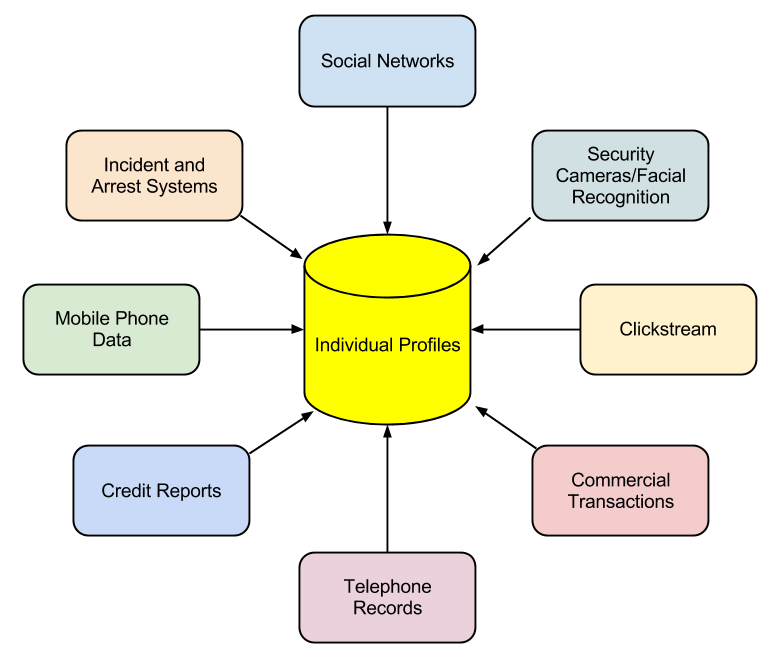
Digital technologies have given us the ability to aggregate
information from multiple sources to create profiles of people.
What would have taken weeks of work in the past can now be
done in seconds, allowing private organizations and governments
to know more about individuals than at any time in history. This
information has value, but also chips away at the privacy of
consumers and citizens.
Sidebar: Data Privacy, Facebook, and Cambridge Analytica
In early 2018 Facebook acknowledged a
data breach affecting 87 million users. The
app “thisisyourdigitallife”, created by Global
Science Research, informed users that they
could participate in a psychological research
study. About 270,000 people decided to
participate in the research, but the app failed
to tell users that the data of all of their
friends on Facebook would be automatically
captured as well. All of this data theft took place prior to 2014, but it
did not become public until four years later.
In 2015 Facebook learned about Global Science Research’s
collection of data on millions of friends of the users in the research.
Global Science Research agreed to delete the data, but it had already
Chapter 12: The Ethical and Legal Implications of Information Systems | 263
been sold to Cambridge Analytica who used it in the 2016
presidential primary campaign. The ensuing firestorm resulted in
Mark Zuckerberg, CEO of Facebook, testifying before the U.S.
Congress in 2018 on what happened and what Facebook would
do in the future to protect users’ data. Congress is working on
legislation to protect user data in the future, a prime example of
technology advancing faster than the laws needed to protect users.
More information about this case of data privacy can be found at
Facebook and Cambridge Analytica. 2
Code of Ethics
A code of ethics is one method for navigating new ethical waters.
A code of ethics outlines a set of acceptable behaviors for a
professional or social group. Generally, it is agreed to by all
members of the group. The document details different actions that
are considered appropriate and inappropriate.
A good example of a code of ethics is the Code of Ethics and
Professional Conduct of the Association for Computing Machinery, 3
an organization of computing professionals that includes
academics, researchers, and practitioners. Here is a quote from the
preamble:
Commitment to ethical professional conduct is expected of
every member (voting members, associate members, and
student members) of the Association for Computing
Machinery (ACM).
2. [2]
3. [3]
264 | Information Systems for Business and Beyond (2019)
This Code, consisting of 24 imperatives formulated as
statements of personal responsibility, identifies the
elements of such a commitment. It contains many, but not
all, issues professionals are likely to face. Section 1 outlines
fundamental ethical considerations, while Section
2 addresses additional, more specific considerations of
professional conduct. Statements in Section 3 pertain more
specifically to individuals who have a leadership role,
whether in the workplace or in a volunteer capacity such
as with organizations like ACM. Principles involving
compliance with this Code are given in Section 4.
In the ACM’s code you will find many straightforward ethical
instructions such as the admonition to be honest and trustworthy.
But because this is also an organization of professionals that focuses
on computing, there are more specific admonitions that relate
directly to information technology:
• No one should enter or use another’s computer system,
software, or data files without permission. One must always
have appropriate approval before using system resources,
including communication ports, file space, other system
peripherals, and computer time.
• Designing or implementing systems that deliberately or
inadvertently demean individuals or groups is ethically
unacceptable.
• Organizational leaders are responsible for ensuring that
computer systems enhance, not degrade, the quality of
working life. When implementing a computer system,
organizations must consider the personal and professional
development, physical safety, and human dignity of all workers.
Appropriate human-computer ergonomic standards should be
considered in system design and in the workplace.
One of the major advantages of creating a code of ethics is that
it clarifies the acceptable standards of behavior for a professional
Chapter 12: The Ethical and Legal Implications of Information Systems | 265
group. The varied backgrounds and experiences of the members
of a group lead to a variety of ideas regarding what is acceptable
behavior. While the guidelines may seem obvious, having these
items detailed provides clarity and consistency. Explicitly stating
standards communicates the common guidelines to everyone in a
clear manner.
A code of ethics can also have some drawbacks. First, a code of
ethics does not have legal authority. Breaking a code of ethics is
not a crime in itself. What happens if someone violates one of the
guidelines? Many codes of ethics include a section that describes
how such situations will be handled. In many cases repeated
violations of the code result in expulsion from the group.
In the case of ACM: “Adherence of professionals to a code of
ethics is largely a voluntary matter. However, if a member does
not follow this code by engaging in gross misconduct, membership
in ACM may be terminated.” Expulsion from ACM may not have
much of an impact on many individuals since membership in ACM is
usually not a requirement for employment. However, expulsion from
other organizations, such as a state bar organization or medical
board, could carry a huge impact.
Another possible disadvantage of a code of ethics is that there
is always a chance that important issues will arise that are not
specifically addressed in the code. Technology is quickly changing
and a code of ethics might not be updated often enough to keep up
with all of the changes. A good code of ethics, however, is written
in a broad enough fashion that it can address the ethical issues of
potential changes to technology while the organization behind the
code makes revisions.
Finally, a code of ethics could also be a disadvantage in that it
may not entirely reflect the ethics or morals of every member of the
group. Organizations with a diverse membership may have internal
conflicts as to what is acceptable behavior. For example, there may
be a difference of opinion on the consumption of alcoholic
beverages at company events. In such cases the organization must
266 | Information Systems for Business and Beyond (2019)
make a choice about the importance of addressing a specific
behavior in the code.
Sidebar: Acceptable Use Policies
Many organizations that provide technology services to a group
of constituents or the public require agreement to an Acceptable
Use Policy (AUP) before those services can be accessed. Similar to
a code of ethics, this policy outlines what is allowed and what is
not allowed while someone is using the organization’s services. An
everyday example of this is the terms of service that must be agreed
to before using the public Wi-Fi at Starbucks, McDonald’s, or even
a university. Here is an example of an acceptable use policy from
Virginia Tech.
Just as with a code of ethics, these acceptable use policies specify
what is allowed and what is not allowed. Again, while some of the
items listed are obvious to most, others are not so obvious:
• “Borrowing” someone else’s login ID and password is
prohibited.
• Using the provided access for commercial purposes, such as
hosting your own business website, is not allowed.
• Sending out unsolicited email to a large group of people is
prohibited.
As with codes of ethics, violations of these policies have various
consequences. In most cases, such as with Wi-Fi, violating the
acceptable use policy will mean that you will lose your access to
the resource. While losing access to Wi-Fi at Starbucks may not
have a lasting impact, a university student getting banned from the
Chapter 12: The Ethical and Legal Implications of Information Systems | 267
university’s Wi-Fi (or possibly all network resources) could have a
large impact.
Intellectual Property
One of the domains that has been deeply impacted by digital
technologies is intellectual property. Digital technologies have
driven a rise in new intellectual property claims and made it much
more difficult to defend intellectual property.
Intellectual property is defined as “property (as an idea, invention,
or process) that derives from the work of the mind or intellect.” 4
This could include creations such as song lyrics, a computer
program, a new type of toaster, or even a sculpture.
Practically speaking, it is very difficult to protect an idea. Instead,
intellectual property laws are written to protect the tangible results
of an idea. In other words, just coming up with a song in your head
is not protected, but if you write it down it can be protected.
Protection of intellectual property is important because it gives
people an incentive to be creative. Innovators with great ideas will
be more likely to pursue those ideas if they have a clear
understanding of how they will benefit. In the US Constitution,
Article 8, Section 8, the authors saw fit to recognize the importance
of protecting creative works:
Congress shall have the power . . . To promote the Progress
of Science and useful Arts, by securing for limited Times to
Authors and Inventors the exclusive Right to their respective
Writings and Discoveries.
4. [4]
268 | Information Systems for Business and Beyond (2019)
An important point to note here is the “limited time” qualification.
While protecting intellectual property is important because of the
incentives it provides, it is also necessary to limit the amount of
benefit that can be received and allow the results of ideas to become
part of the public domain.
Outside of the US, intellectual property protections vary. You can
find out more about a specific country’s intellectual property laws
by visiting the World Intellectual Property Organization.
The following sections address three of the best known
intellectual property protections: copyright, patent, and trademark.
Copyright
Copyright is the protection given to songs, computer programs,
books, and other creative works. Any work that has an “author” can
be copyrighted. Under the terms of copyright, the author of a work
controls what can be done with the work, including:
• Who can make copies of the work.
• Who can make derivative works from the original work.
• Who can perform the work publicly.
• Who can display the work publicly.
• Who can distribute the work.
Many times a work is not owned by an individual but is instead
owned by a publisher with whom the original author has an
agreement. In return for the rights to the work, the publisher will
market and distribute the work and then pay the original author a
portion of the proceeds.
Copyright protection lasts for the life of the original author plus
seventy years. In the case of a copyrighted work owned by a
publisher or another third party, the protection lasts for ninety-
five years from the original creation date. For works created before
Chapter 12: The Ethical and Legal Implications of Information Systems | 269
1978, the protections vary slightly. You can see the full details on
copyright protections by reviewing the Copyright Basics document
available at the US Copyright Office’s website.
Obtaining Copyright Protection
In the United States a copyright is obtained by the simple act of
creating the original work. In other words, when an author writes
down a song, makes a film, or develops a computer program, the
author has the copyright. However, for a work that will be used
commercially, it is advisable to register for a copyright with the
US Copyright Office. A registered copyright is needed in order to
bring legal action against someone who has used a work without
permission.
First Sale Doctrine
If an artist creates a painting and sells it to a collector who then,
for whatever reason, proceeds to destroy it, does the original artist
have any recourse? What if the collector, instead of destroying it,
begins making copies of it and sells them? Is this allowed? The first
sale doctrine is a part of copyright law that addresses this, as shown
below 5 :
The first sale doctrine, codified at 17 U.S.C. § 109, provides
that an individual who knowingly purchases a copy of a
copyrighted work from the copyright holder receives the
5. [5]
270 | Information Systems for Business and Beyond (2019)
right to sell, display or otherwise dispose of that particular
copy, notwithstanding the interests of the copyright owner.
Therefor, in our examples the copyright owner has no recourse if
the collector destroys the artwork. But the collector does not have
the right to make copies of the artwork.
Fair Use
Another important provision within copyright law is that of fair use.
Fair use is a limitation on copyright law that allows for the use
of protected works without prior authorization in specific cases.
For example, if a teacher wanted to discuss a current event in
class, copies of the copyrighted new story could be handed out in
class without first getting permission. Fair use is also what allows a
student to quote a small portion of a copyrighted work in a research
paper.
Unfortunately, the specific guidelines for what is considered fair
use and what constitutes copyright violation are not well defined.
Fair use is a well-known and respected concept and will only be
challenged when copyright holders feel that the integrity or market
value of their work is being threatened. The following four factors
are considered when determining if something constitutes fair
use: 6
1. The purpose and character of the use, including whether such
use is of commercial nature or is for nonprofit educational
purposes;
2. The nature of the copyrighted work;
3. The amount and substantiality of the portion used in relation
6. [6]
Chapter 12: The Ethical and Legal Implications of Information Systems | 271
to the copyrighted work as a whole;
4. The effect of the use upon the potential market for, or value of,
the copyrighted work.
If you are ever considering using a copyrighted work as part of
something you are creating, you may be able to do so under fair
use. However, it is always best to check with the copyright owner to
be sure you are staying within your rights and not infringing upon
theirs.
Sidebar: The History of Copyright Law
As noted above, current copyright law grants copyright protection
for seventy years after the author’s death, or ninety-five years from
the date of creation for a work created for hire. But it was not always
this way.
The first US copyright law, which only protected books, maps, and
charts, provided protection for only 14 years with a renewable term
of 14 years. Over time copyright law was revised to grant protections
to other forms of creative expression, such as photography and
motion pictures. Congress also saw fit to extend the length of the
protections, as shown in the following chart. Today, copyright has
become big business with many businesses relying on the income
from copyright protected works for their income.
Many now think that the protections last too long. The Sonny
Bono Copyright Term Extension Act has been nicknamed the
“Mickey Mouse Protection Act,” as it was enacted just in time to
protect the copyright on the Walt Disney Company’s Mickey Mouse
character. Because of this term extension, many works from the
1920s and 1930s that would have been available now in the public
domain are still restricted.
272 | Information Systems for Business and Beyond (2019)
Evolution of copyright
The Digital Millennium Copyright Act
As digital technologies have changed what it means to create, copy,
and distribute media, a policy vacuum has been created. In 1998, the
US Congress passed the Digital Millennium Copyright Act (DMCA),
which extended copyright law to take into consideration digital
technologies. Two of the best-known provisions from the DMCA are
the anti-circumvention provision and the “safe harbor” provision.
• The anti-circumvention provision makes it illegal to create
technology to circumvent technology that has been put in
place to protect a copyrighted work. This provision includes
not just the creation of the technology but also the publishing
of information that describes how to do it. While this provision
does allow for some exceptions, it has become quite
controversial and has led to a movement to have it modified.
• The “safe harbor” provision limits the liability of online service
providers when someone using their services commits
copyright infringement. This is the provision that allows
YouTube, for example, not to be held liable when someone
posts a clip from a copyrighted movie. The provision does
Chapter 12: The Ethical and Legal Implications of Information Systems | 273
require the online service provider to take action when they
are notified of the violation (a “takedown” notice). For an
example of how takedown works, here’s how YouTube handles
these requests: YouTube Copyright Infringement Notification.
Many think that the DMCA goes too far and ends up limiting our
freedom of speech. The Electronic Frontier Foundation (EFF) is at
the forefront of this battle. In discussing the anti-circumvention
provision, the EFF states:
Yet the DMCA has become a serious threat that jeopardizes
fair use, impedes competition and innovation, chills free
expression and scientific research, and interferes with
computer intrusion laws. If you circumvent DRM [digital
rights management] locks for non-infringing fair uses or
create the tools to do so you might be on the receiving end
of a lawsuit.
Sidebar: Creative Commons
Chapter 2 introduced the topic of open-source software. Open-
source software has few or no copyright restrictions. The creators
of the software publish their code and make their software available
for others to use and distribute for free. This is great for software,
but what about other forms of copyrighted works? If an artist or
writer wants to make their works available, how can they go about
doing so while still protecting the integrity of their work? Creative
Commons is the solution to this problem.
Creative Commons is a nonprofit organization that provides legal
tools for artists and authors. The tools offered make it simple to
license artistic or literary work for others to use or distribute in a
274 | Information Systems for Business and Beyond (2019)
manner consistent with the author’s intentions. Creative Commons
licenses are indicated with the symbol . It is important to note
that Creative Commons and public domain are not the same. When
something is in the public domain, it has absolutely no restrictions
on its use or distribution. Works whose copyrights have expired are
in the public domain.
By using a Creative Commons license, authors can control the use
of their work while still making it widely accessible. By attaching a
Creative Commons license to their work, a legally binding license is
created. Here are some examples of these licenses:
• CC-BY. This is the least restrictive license. It lets others distribute and build upon the work, even commercially, as long
as they give the author credit for the original work.
• CC-BY-SA. This license restricts the distribution of the work via the “share-alike” clause. This means that others can freely
distribute and build upon the work, but they must give credit
to the original author and they must share using the same
Creative Commons license.
• CC-BY-NC. This license is the same as CC-BY but adds the restriction that no one can make money with this work. NC
stands for “non-commercial.”
• CC-BY-NC-ND. This license is the same as CC-BY-NC but also adds the ND restriction, which means that no derivative works
may be made from the original.
These are a few of the more common licenses that can be created
using the tools that Creative Commons makes available. For a full
listing of the licenses and to learn much more about Creative
Commons, visit their web site.
Chapter 12: The Ethical and Legal Implications of Information Systems | 275
Patent
Patents are another important form of intellectual property
protection. A patent creates protection for someone who invents a
new product or process. The definition of invention is quite broad
and covers many different fields. Here are some examples of items
receiving patents:
• circuit designs in semiconductors;
• prescription drug formulas;
• firearms;
• locks;
• plumbing;
• engines;
• coating processes; and
• business processes.
Once a patent is granted it provides the inventor with protection
from others infringing on his or her patent. A patent holder has the
right to “exclude others from making, using, offering for sale, or
selling the invention throughout the United States or importing the
invention into the United States for a limited time in exchange for
public disclosure of the invention when the patent is granted.” 7
As with copyright, patent protection lasts for a limited period of
time before the invention or process enters the public domain. In
the US, a patent lasts twenty years. This is why generic drugs are
available to replace brand-name drugs after twenty years.
7. [7]
276 | Information Systems for Business and Beyond (2019)
Obtaining Patent Protection
Unlike copyright, a patent is not automatically granted when
someone has an interesting idea and writes it down. In most
countries a patent application must be submitted to a government
patent office. A patent will only be granted if the invention or
process being submitted meets certain conditions.
• Must be original. The invention being submitted must not have been submitted before.
• Must be non-obvious. You cannot patent something that anyone could think of. For example, you could not put a pencil
on a chair and try to get a patent for a pencil-holding chair.
• Must be useful. The invention being submitted must serve some purpose or have some use that would be desired.
The job of the patent office is to review patent applications to
ensure that the item being submitted meets these requirements.
This is not an easy job. In 2017 the US Patent Office granted 318,849
patents, an increase of 5.2% over 2016. 8
The current backlog for a
patent approval is 15.6 months. Information Technology firms have
apply for a significant number of patents each year. Here are the
top five I.T. firms in terms of patent applications filed since 2009.
The percents indicate the percent of total I.T. patents filed since
2009. Notice that over half of patent filings come from just these
five corporations.
• International Business Machines (IBM) 21.6%
• Microsoft Corporation 14.2%
• AT & T, Inc. 7.1%
• Alphabet (Google), Inc. 5.0%
8. [8]
Chapter 12: The Ethical and Legal Implications of Information Systems | 277
• Sony Corporation 4.7%
You might have noticed that Apple is not in the top five listing.
Microsoft holds the lead in Artificial Intelligence (AI) patents. 9
Sidebar: What Is a Patent Troll?
The advent of digital technologies has led to a large increase in
patent filings and therefore a large number of patents being
granted. Once a patent is granted, it is up to the owner of the patent
to enforce it. If someone is found to be using the invention without
permission, the patent holder has the right to sue to force that
person to stop and to collect damages.
The rise in patents has led to a new form of profiteering called
patent trolling. A patent troll is a person or organization who gains
the rights to a patent but does not actually make the invention that
the patent protects. Instead, the patent troll searches for those who
are illegally using the invention in some way and sues them. In many
cases the infringement being alleged is questionable at best. For
example, companies have been sued for using Wi-Fi or for scanning
documents, technologies that have been on the market for many
years.
Recently, the U.S. government has begun taking action against
patent trolls. Several pieces of legislation are working their way
through the U.S. Congress that will, if enacted, limit the ability of
patent trolls to threaten innovation. You can learn a lot more about
9. [9]
278 | Information Systems for Business and Beyond (2019)
Apple logo
patent trolls by listening to a detailed investigation conducted by
the radio program This American Life, by clicking this link.
Trademark
A trademark is a word, phrase, logo,
shape or sound that identifies a
source of goods or services. For
example, the Nike “Swoosh,” the
Facebook “f”, and Apple’s apple (with a
bite taken out of it) are all
trademarked. The concept behind
trademarks is to protect the
consumer. Imagine going to the local
shopping center to purchase a
specific item from a specific store and
finding that there are several stores all with the same name!
Two types of trademarks exist – a common law trademark and
a registered trademark. As with copyright, an organization will
automatically receive a trademark if a word, phrase, or logo is being
used in the normal course of business (subject to some restrictions,
discussed below). A common law trademark is designated by placing
“TM” next to the trademark. A registered trademark is one that has
been examined, approved, and registered with the trademark office,
such as the Patent and Trademark Office in the US. A registered
trademark has the circle-R (®) placed next to the trademark.
While most any word, phrase, logo, shape, or sound can be
trademarked, there are a few limitations. A trademark will not hold
up legally if it meets one or more of the following conditions:
• The trademark is likely to cause confusion with a mark in a
registration or prior application.
Chapter 12: The Ethical and Legal Implications of Information Systems | 279
• The trademark is merely descriptive for the goods/services.
For example, trying to register the trademark “blue” for a blue
product you are selling will not pass muster.
• The trademark is a geographic term.
• The trademark is a surname. You will not be allowed to
trademark “Smith’s Bookstore.”
• The trademark is ornamental as applied to the goods. For
example, a repeating flower pattern that is a design on a plate
cannot be trademarked.
As long as an organization uses its trademark and defends it
against infringement, the protection afforded by it does not expire.
Because of this, many organizations defend their trademark against
other companies whose branding even only slightly copies their
trademark. For example, Chick-fil-A has trademarked the phrase
“Eat Mor Chikin” and has vigorously defended it against a small
business using the slogan “Eat More Kale.” Coca-Cola has
trademarked the contour shape of its bottle and will bring legal
action against any company using a bottle design similar to
theirs. Examples of trademarks that have been diluted and have
now lost their protection in the US include: “aspirin” (originally
trademarked by Bayer), “escalator” (originally trademarked by Otis),
and “yo-yo” (originally trademarked by Duncan).
Information Systems and Intellectual Property
The rise of information systems has resulted in rethinking how
to deal with intellectual property. From the increase in patent
applications swamping the government’s patent office to the new
laws that must be put in place to enforce copyright protection,
digital technologies have impacted our behavior.
280 | Information Systems for Business and Beyond (2019)
Privacy
The term privacy has many definitions, but for purposes here,
privacy will mean the ability to control information about oneself.
The ability to maintain our privacy has eroded substantially in the
past decades, due to information systems.
Personally Identifiable Information
Information about a person that can be used to uniquely establish
that person’s identify is called personally identifiable information, or
PII. This is a broad category that includes information such as:
• Name;
• Social Security Number;
• Date of birth;
• Place of birth;
• Mother‘s maiden name;
• Biometric records (fingerprint, face, etc.);
• Medical records;
• Educational records;
• Financial information; and
• Employment information.
Organizations that collect PII are responsible to protect it. The
Department of Commerce recommends that “organizations
minimize the use, collection, and retention of PII to what is strictly
necessary to accomplish their business purpose and mission.” They
go on to state that “the likelihood of harm caused by a breach
involving PII is greatly reduced if an organization minimizes the
Chapter 12: The Ethical and Legal Implications of Information Systems | 281
amount of PII it uses, collects, and stores.” 10
Organizations that do
not protect PII can face penalties, lawsuits, and loss of business. In
the US, most states now have laws in place requiring organizations
that have had security breaches related to PII to notify potential
victims, as does the European Union.
Just because companies are required to protect your information
does not mean they are restricted from sharing it. In the US,
companies can share your information without your explicit
consent (see the following sidebar), though not all do so. Companies
that collect PII are urged by the FTC to create a privacy policy and
post it on their website. The State of California requires a privacy
policy for any website that does business with a resident of the state
(see http://www.privacy.ca.gov/lawenforcement/laws.htm).
While the privacy laws in the US seek to balance consumer
protection with promoting commerce, privacy in the European
Union is considered a fundamental right that outweighs the
interests of commerce. This has led to much stricter privacy
protection in the EU, but also makes commerce more difficult
between the US and the EU.
Non-Obvious Relationship Awareness
Digital technologies have given people many new capabilities that
simplify and expedite the collection of personal information. Every
time a person comes into contact with digital technologies,
information about that person is being made available. From
location to web-surfing habits, your criminal record to your credit
report, you are constantly being monitored. This information can
then be aggregated to create profiles of each person. While much
of the information collected was available in the past, collecting it
10. [10]
282 | Information Systems for Business and Beyond (2019)
Non-obvious relationship awareness (NORA)
and combining it took time and effort. Today, detailed information
about a person is available for purchase from different companies.
Even information not categorized as PII can be aggregated in such a
way that an individual can be identified.
This process of collecting large quantities of a variety of
information and then combining it to create profiles of individuals
is known as Non-Obvious Relationship Awareness, or NORA. First
commercialized by big casinos looking to find cheaters, NORA is
used by both government agencies and private organizations, and it
is big business.
In some settings NORA can bring many benefits such as in law
enforcement. By being able to identify potential criminals more
quickly, crimes can be solved sooner or even prevented before they
happen. But these advantages come at a price, namely, our privacy.
Chapter 12: The Ethical and Legal Implications of Information Systems | 283
Restrictions on Data Collecting
In the United State the government has strict guidelines on how
much information can be collected about its citizens. Certain
classes of information have been restricted by laws over time and
the advent of digital tools has made these restrictions more
important than ever.
Children’s Online Privacy Protection Act
Websites that collect information from children under the age of
thirteen are required to comply with the Children’s Online Privacy
Protection Act (COPPA), which is enforced by the Federal Trade
Commission (FTC). To comply with COPPA, organizations must
make a good-faith effort to determine the age of those accessing
their websites and, if users are under thirteen years old, must obtain
parental consent before collecting any information.
Family Educational Rights and Privacy Act
The Family Educational Rights and Privacy Act (FERPA) is a US law
that protects the privacy of student education records. In brief, this
law specifies that parents have a right to their child’s educational
information until the child reaches either the age of eighteen or
begins attending school beyond the high school level. At that point
control of the information is given to the child. While this law is
not specifically about the digital collection of information on the
Internet, the educational institutions that are collecting student
information are at a higher risk for disclosing it improperly because
of digital technologies.
284 | Information Systems for Business and Beyond (2019)
GDPR Logo
Health Insurance Portability and Accountability Act
The Health Insurance Portability and Accountability Act of 1996
(HIPAA) singles out records related to health care as a special class
of personally identifiable information. This law gives patients
specific rights to control their medical records, requires health care
providers and others who maintain this information to get specific
permission in order to share it, and imposes penalties on the
institutions that breach this trust. Since much of this information is
now shared via electronic medical records, the protection of those
systems becomes paramount.
General Data Protection Regulation
The European Union, in an effort to
help people take control over their
personal data, passed the General Data
Protection Regulation (GDPR) in May
2016. While this protection applies to
the countries in the EU, it is having an
impact of U.S. companies using the
Internet as well. The regulation went
into effect May 25, 2018.
EU and non-EU countries have
different approaches to protecting the data of individuals. The focus
in the U.S. has been on protecting data privacy so that it does not
impact commercial interests.
In the EU the individual’s data privacy rights supercede those
of business. Under GDPR data cannot be transferred to countries
that do not have adequate data protection for individuals. Currently,
those countries include, but are not limited to, the United States,
Korea, and Japan. While the GDPR applies to countries in the EU,
it is having an impact around the world as businesses in other
Chapter 12: The Ethical and Legal Implications of Information Systems | 285
countries seek to comply with this regulation.IEEE Spectrum.
Retrieved from https://spectrum.ieee.org/telecom/internet/your-
guide-to-the-gdpr.” 11
One week prior to the effective date of May 25, 2018, only 60%
of companies surveyed reported they would be ready by the
deadline.Information Management. Retrieved from
https://www.information-management.com/opinion/playing-
catch-up-with-the-general-data-protection-regulation.” 12
Clearly, the message of GDPR has gone out around the world. It is
likely that greater data protection regulations will forthcoming from
the U.S. Congress as well.
Sidebar: Do Not Track
When it comes to getting permission to share personal information,
the US and the EU have different approaches. In the US, the “opt-
out” model is prevalent. In this model the default agreement states
that you have agreed to share your information with the
organization and must explicitly tell them that you do not want your
information shared. There are no laws prohibiting the sharing of
your data, beyond some specific categories of data such as medical
records. In the European Union the “opt-in” model is required to
be the default. In this case you must give your explicit permission
before an organization can share your information.
11. [11]
12. [12]
286 | Information Systems for Business and Beyond (2019)
To combat this sharing of information, the Do Not Track initiative
was created. As its creators explain 13
:
Do Not Track is a technology and policy proposal that
enables users to opt out of tracking by websites they do
not visit, including analytics services, advertising networks,
and social platforms. At present few of these third parties
offer a reliable tracking opt out and tools for blocking them
are neither user-friendly nor comprehensive. Much like the
popular Do Not Call registry, Do Not Track provides users
with a single, simple, persistent choice to opt out of third-
party web tracking.
Summary
The rapid changes in information technology in the past few
decades have brought a broad array of new capabilities and powers
to governments, organizations, and individuals alike. These new
capabilities have required thoughtful analysis and the creation of
new norms, regulations, and laws. This chapter has covered the
areas of intellectual property and privacy regarding how these
domains have been affected by new information systems
capabilities and how the regulatory environment has been changed
to address them.
13. [13]
Chapter 12: The Ethical and Legal Implications of Information Systems | 287
Study Questions
1. What does the term information systems ethics mean?
2. What is a code of ethics? What is one advantage and one
disadvantage of a code of ethics?
3. What does the term intellectual property mean? Give an
example.
4. What protections are provided by a copyright? How do you
obtain one?
5. What is fair use?
6. What protections are provided by a patent? How do you obtain
one?
7. What does a trademark protect? How do you obtain one?
8. What does the term personally identifiable information mean?
9. What protections are provided by HIPAA, COPPA, and FERPA?
10. How would you explain the concept of NORA?
11. What is GDPR and what was the motivation behind this
regulation?
Exercises
1. Provide one example of how information technology has
created an ethical dilemma that would not have existed before
the advent of I.T.
2. Find an example of a code of ethics or acceptable use policy
related to information technology and highlight five points
that you think are important.
3. Do some original research on the effort to combat patent
trolls. Write a two-page paper that discusses this legislation.
4. Give an example of how NORA could be used to identify an
individual.
5. How are intellectual property protections different across the
288 | Information Systems for Business and Beyond (2019)
world? Pick two countries and do some original research, then
compare the patent and copyright protections offered in those
countries to those in the US. Write a two- to three-page paper
describing the differences.
6. Knowing that GDPR had a deadline of May 25, 2018, provide an
update on the status of compliance by firms in non-European
countries.
Labs
1. Contact someone who has created a mobile device app,
composed music, written a book, or created some other type
of intellectual property. Ask them about the amount of effort
required to produce their work and how they feel about being
able to protect that work. Write a one or two page paper on
your findings.
2. Research the intellectual property portion of the End User
License Agreement (EULA) on a favorite computer program of
yours. Explain what the EULA is saying about protection of this
work.
1. Merriam-Webster Dictionary. (n.d.). Ethics. Retrieved from
http://www.merriam-webster.com/dictionary/ethics↵
2. Grigonis, H. (2018, April 5). Nine Things to Know About
Facebook and Cambridge Analytica. Digital Trends. Retrieved
from https://www.digitaltrends.com/social-media/what-
facebook-users-should-know-about-cambridge-analytica-
and-privacy/
3. Association for Computing Machinery (1992, October 16) ACM
Code of Ethics and Professional Conduct.↵
Chapter 12: The Ethical and Legal Implications of Information Systems | 289
4. Merriam-Webster Dictionary. (n.d.). Intellectual Property.
Retrieved from http://www.merriam-webster.com/
dictionary/intellectual%20property↵
5. United States Department of Justice. (n.d.). Copyright
Infringement – First Sale Doctrine. Retrieved from
http://www.justice.gov/usao/eousa/foia_reading_room/
usam/title9/crm01854.htm↵
6. United States Copyright Office. (n.d.). Fair Use Index. Retrieved
from http://www.copyright.gov/fls/fl102.html↵
7. United States Patent and Trademark Office (n.d.). What Is A
Patent? Retrieved from http://www.uspto.gov/patents/↵
8. United States Patent and Trademark Office (n.d.). Visualization
Center. Retrieved from http://www.uspto.gov/patents/↵
9. Bachmann, S. (2016, December 22). America’s Big 5 Tech
companies increase patent filings, Microsoft holds lead in AI
technologies. IP Watchdog. Retrieved from
http://www.ipwatchdog.com/2016/12/22/big-tech-
companies-increase-patent/id=76019/↵
10. McAllister, E., Grance, T., and Scarfone, K. (2010, April). Guide
to Protecting the Confidentiality of Personally Identifiable
Information (PII). National Institute of Standards and
Technology. Retrieved from http://csrc.nist.gov/publications/
nistpubs/800-122/sp800-122.pdf↵
11. Sanz, R. M. G. (2018, April 30). Your Guide to the GDPR. IEEE
Spectrum. Retrieved from
https://spectrum.ieee.org/telecom/internet/your-guide-to-
the-gdpr↵
12. Zafrin, W. (2018, May 25). Playing Catch-up with the General
Data Protection Regulation. Information Management.
Retrieved from
https://www.information-management.com/opinion/playing-
catch-up-with-the-general-data-protection-regulation↵
13. Electronic Frontier Foundation. (n.d.). Do Not Track. Retrieved
from http://donottrack.us/↵
290 | Information Systems for Business and Beyond (2019)
- Information Systems for Business and Beyond (2019)
- Information Systems for Business and Beyond (2019)
- Title Page
- Copyright
- Book Contributors
- Changes from Previous Edition
- How you can help
- Introduction
- Part I: What is an information system?
- Chapter 1: What Is an Information System?
- Chapter 2: Hardware
- Chapter 3: Software
- Chapter 4: Data and Databases
- Chapter 5: Networking and Communication
- Chapter 6: Information Systems Security
- Part II: Information Systems for Strategic Advantage
- Chapter 7: Does IT Matter?
- Chapter 8: Business Processes
- Chapter 9: The People in Information Systems
- Chapter 10: Information Systems Development
- Part III: Information Systems Beyond the Organization
- Chapter 11: Globalization and the Digital Divide
- Chapter 12: The Ethical and Legal Implications of Information Systems
- Chapter 13: Trends in Information Systems
- Index