Data Visualization for Business With Tableau
 Daraja
 ANL201StudyUnit1ver20200108.pdf
Visualisation for Business
ANL 201
Overview of Business Performance Measurement
Study Unit 1
January 2020
2
Assessment Overview Assignment 1 2% Pre-Course Quiz 01
20–31 Jan 2020 1200hrs
2% Pre-Class Quiz 01 3–10 Feb 2020 1200hrs
2% Pre-Class Quiz 02 17–24 Feb 2020 1200hrs
Assignment 2 38% Group-Based Assignment (GBA) — comprising
of 2-3 students per group Due 26 Feb 2020 2355hrs
Participation 6% Contribution to the class learning experience
Examination 50% End-of-Course Assignment (ECA) Due 12 Mar 2020 1200hrs
3
Important Dates
4
Installation of Tableau Desktop and Prep For January 2020 semester, Tableau Desktop 2019.4 will be used for teaching,
assessments, and exam
1. To download Tableau, visit the Tableau for Teaching landing page at
https://www.tableau.com/tft/activation
2. Click on “Download Tableau Desktop”
3. Fill in your SUSS email address in the “Business E-mail” field, and click on
“Download Free Trial”
4. Go back to the landing page, and click on “Download Tableau Prep”
5. Activate with this product key: TCZZ-FDAB-CD00-56E5-7616
Business Performance
Measurement Concepts
6
Business Performance Measurement The big idea – Concepts
‣ Business performance measurement is the process of establishing parameters within which resources, programmes, investments and acquisitions should be in
order to achieve desired business results
‣ Through this process, an organisation establishes criteria to determine the quality of their activities, their efficiency, and their effectiveness in conducting
their business operations
7
Business Performance Measurement Benefits
‣ Understand an organisation’s inherent strengths and weaknesses ‣ Encourage the organisation to focus on customers’ real needs ‣ Provide relevant training and upgrading skills to employees ‣ Understand an organisation’s past and current financial health ‣ Predict future shortcomings that may arise if not addressed ‣ Improve and control critical processes ‣ Enhance product and service quality ‣ Motivate correct behaviours ‣ Align improvement activities to organisational strategies
8
Business Performance Measurement Pointers for Effective Measurement
1. Do not confuse business objectives with business performance. Good
objectives are the result of organisation exhibiting high business performance
2. Relevant measures are those that measure activities that can impact strategic
objectives
3. Business processes are often made up of activities that involve many different
business functions or departments. Therefore, measuring business process
performance reflects more on the organisation’s business performance than
individual activities within a business function or department
9
Business Performance Measurement Pointers for Effective Measurement
4. Measurements should relate to customer’s perspective of good business
performance rather than to internal manager’s perspective
5. The measuring method is as important as the selection of measures.
Furthermore, measuring method is subjective and complex in nature
6. Measures should be used as a basis for improving business processes rather
than finding faults
10
Business Performance Measurement Pointers for Effective Measurement
7. Measures shape employee behaviour, and therein lies the danger that
employees seeking to improve a particular measure in a specific area which
may have adverse consequences in other areas
8. Define measures precisely and execute measurements accurately within the
context of justifiable costs and feasibility
The Balanced Scorecard
12
The Balanced Scorecard What is Strategy?
‣ A business strategy is a set of guiding principles that, when communicated and adopted in the organization, generates a desired pattern of decision making
‣ A strategy is therefore about how people throughout the organization should make decisions and allocate resources in order accomplish key objectives
‣ A good strategy provides a clear roadmap, consisting of a set of guiding principles or rules, that defines the actions people in the business should take
(and not take) and the things they should prioritize (and not prioritize) to achieve
desired goals Demystifying Strategy: The What, Who, How, and Why Michael D. Watkins, Harvard Business Review, 10 Sep 2007
13
The Balanced Scorecard Principles of Strategy Focused Organisations
‣ Ensure that measurement considerations are always appropriate for the organisation’s current strategy (which will change over time)
‣ Manage both tangible and intangible assets
‣ Go beyond traditional, slow reacting, and tactical management control systems (e.g., budgeting) which may be inadequate for today’s dynamic, rapidly changing
business environment
14
The Balanced Scorecard Concepts of the Balanced Scorecard (BSC) Model
‣ The BSC is meant to provide a holistic view of an organisation’s overall performance that incorporates both financial and non-financial measures
‣ Without a BSC approach, organisations tend to be judged only by short-term financial results, and this may hide serious problems
‣ The BSC enables organisations to clarify their visions and strategies, put them into action, and provide feedback around both internal business processes as
well as external objectives to continuously improve strategic performance and
results
15
The Balanced Scorecard The Four Balanced Scorecard Perspectives
Financial
How should we appear to
stakeholders?
Learning & Growth
How could we continue to
improve and create value?
Internal Business
Processes
What business processes
must we excel at?
Customer
How should we appear to
our customers? Vision & Strategy
16
The Balanced Scorecard The Customer Perspective
‣ Under the Customer Perspective, an organisation needs to determine what the customers require and think are important in terms of the products and services
that the organisation provides them
‣ Organisations have to establish goals for each key requirement
‣ Measures are then selected to gauge the organisation’s success in achieving these goals
17
The Balanced Scorecard The Internal Business Processes Perspective
‣ Measures based upon internal processes perspective allow managers to know how well their business is running, and whether their products and services meet
customer requirements
‣ Organisations must identify key business processes that need to be excelled in terms of organisation’s operations
‣ Measures are then established to monitor the performance of these key business processes
18
The Balanced Scorecard The Learning and Growth Perspective
‣ This perspective includes employee training and corporate cultural attitudes related to both the individual and corporate self-improvement, product and
service innovation, and organisational development
‣ Organisations have to establish goals that relate to innovation, growth and development
‣ Measures are then selected so that they can gauge the organisation’s success in achieving these goals
19
The Balanced Scorecard The Financial Perspective
‣ Although the concept of the BSC is to take performance in many non-financial areas into consideration, the measures in the financial perspective must
eventually show gains in order for the organisation to conclude that its overall
performance has indeed improved
‣ The measures for the other three perspectives that relate to customer, internal business process and people must be appropriately selected in order (for
financial performance) to yield results
20
The Balanced Scorecard An illustration — Bank
Source: http://image.slidesharecdn.com/presentation1cc-140220094550-phpapp01/95/the-balance-scorecard-44-638.jpg?cb=1392889762
The Strategy Map
22
The Strategy Map Four Elements of a Strategic Framework
1. Mission is about what will be achieved
2. The Value Network is about with whom value will be created and captured
3. Strategy is about how resources should be allocated to accomplish the mission
in the context of the value network
4. Vision and Incentives are about why people in the organization should feel
motivated to perform at a high level
Demystifying Strategy: The What, Who, How, and Why
Michael D. Watkins, Harvard Business Review, 10 Sep 2007
23
The Strategy Map The need for a Strategic Framework
‣ Mission is about what will be achieved; the value network is about with whom value will be created and captured; strategy is about how resources should be
allocated to accomplish the mission in the context of the value network; and
vision and incentives are about why people in the organization should feel
motivated to perform at a high level
‣ Together, the mission, network, strategy, and vision define the strategic direction for a business. They provide the what, who, how, and why necessary to
powerfully align action in complex organizations Demystifying Strategy: The What, Who, How, and Why
Michael D. Watkins, Harvard Business Review, 10 Sep 2007
24
The Strategy Map The need for Strategic Objectives (Goals)
‣ Performance management begins with Strategic Objectives
‣ Strategic Objectives focus limited resources on things that matter most
‣ In the absence of Strategic Objectives, financial and human resources would be wasted on activities that contribute little towards organisational success
25
The Strategy Map Cause and Effect Relationships within the Strategy Map
‣ In a strategy map, individual Strategic Objectives are positioned systematically to demonstrate the relationships between them, and reveal the logic under each
Strategic Theme
‣ Each Strategic Objective is related and linked to other Strategic Objectives on the strategy map using lines that represent cause-and-effect relationships. Such
linkages logically reflect the natural value chain and culture. The strategy map
also illustrates how the achievement of one objective enables the achievement of
another, and captures the underlying hypotheses for the strategy
26
The Strategy Map Example of a Strategy Map
27
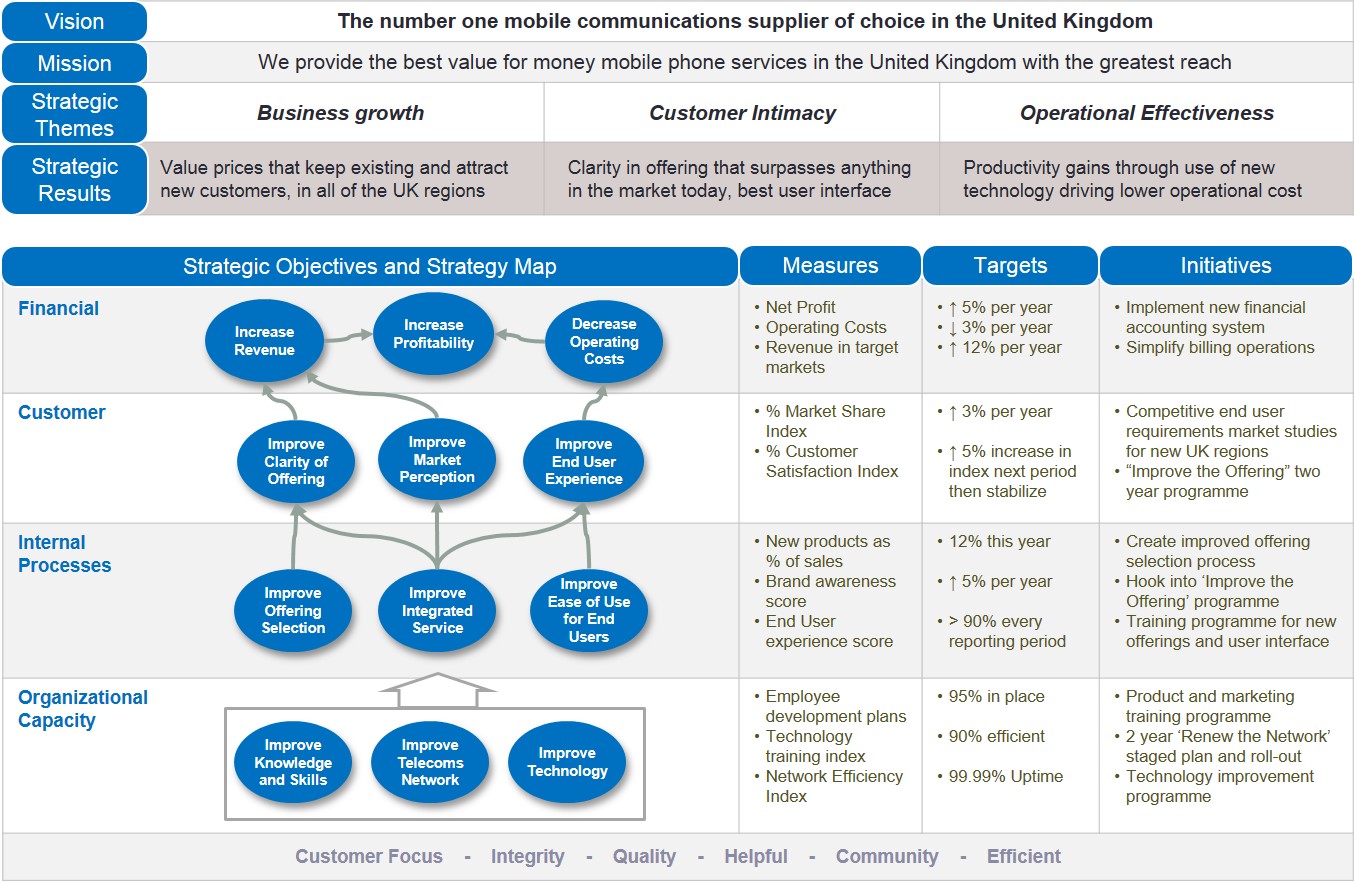
Strategic Initiatives An illustration — Mobile Network
Provider
Strategic Initiatives are specific
projects, programmes or
planned activities directed at
key processes for the purpose
of enhancing output
performance, and to meet or
exceed the established targets
Source: https://www.intrafocus.com/wp-content/uploads/2015/03/Integrated-Strategy-Map.jpg
28
Discussion
Develop a strategy map
• In groups of 3-4, describe and develop a strategy map for an organization (of
your choice). It could be a company that you have worked in. Make use of the
Balanced Scorecard and other concepts to illustrate the strategy map.
Internalisation of Business Performance Measurement
30
Internalisation of Business Performance Measurement Selecting what to Measure
‣ Considerations when deciding what to measure,
1. Whether the measure has an impact on a strategic objective,
2. Whether the measure is measurable,
3. Whether the data is easily available and accessible, and
4. The measurement frequency.
31
Internalisation of Business Performance Measurement Linking Organisational Strategy to Business Performance Measures
‣ Business Performance Measures are intended to provide objective information on the effectiveness and efficiency of a particular process or activity. This will
lead to the accomplishment of goals
‣ Linking a performance measure to a strategic objective provides relevance for the measurement. It also helps drive the organisation’s activities towards
achieving the organisation’s strategy
32
Internalisation of Business Performance Measurement Constructing Appropriate Measures
‣ Lagging measures focus on results at the end of a time period. Based on historical performance
‣ Leading measures drive or lead to the performance of lagging measures. They measure intermediate process and activities
‣ The Balanced Scorecard should contain a mix of leading and lagging indicators
‣ Proxy measures are an alternative choice of measurement when a direct measure is unavailable
33
Internalisation of Business Performance Measurement Setting Appropriate Targets
‣ A systematic approach towards setting up targets can start by specifying the target for each strategic objective, and subsequently to each measure
‣ Business Performance Targets can be short-term (achieve within one year), mid- term (achieve within three years), or long term (achieve within five years). They
usually correspond to an organisation’s Strategic Objectives in terms of being
incremental objectives, stretch objectives and visionary objectives respectively
‣ Targets should be (1) easily understood and communicated, (2) clear in establishing expectations, and (3) encouragements given to stretch performance
34
Internalisation of Business Performance Measurement An effective and sustainable
Business Performance
Measurement should be
balanced by placing an
appropriate balanced focus on
the number of measures in all
four BSC perspectives. There
must be cause-and-effect
relationships amongst
Strategies, Strategic
Objectives, Measures, and
Targets. Source: https://bizperfblog.files.wordpress.com/2010/12/strategymapalignedtobscsmall.png
35
Internalisation of Business Performance Measurement Obstacles in Implementing and Sustaining Business Performance
Measurement Systems
1. Lack of senior management support
2. Too few individuals involved
3. Too little consensus on measures
4. Consensus sought only from the top
management and not the others
5. Keeping scorecard only at the top
management
6. Prolonged development of the
scorecard
7. Scorecard that is alienated from
organisation strategy
8. Treat the Balanced Scorecard as a
system project
9. Hire inexperienced Business
Performance Management
consultants
36
Internalisation of Business Performance Measurement Success Factors for Implementing and Sustaining Business Performance
Measurement Systems
1. Top management support
2. Project champion
3. Adequate resources
4. Employee participation
5. Concise reporting
6. Linkage amongst Strategy, Strategic Themes, Strategic Objectives, Business
Performance Measures, Business Performance Targets, and Strategic
Initiatives
Tableau (Class Activity)
Tableau (Class Activity)
1. Follow your instructor for the followings exercises:
- Import Excel data: global_superstore_2016.xlsx
(orders)
- Build a simple worksheet
Tableau (Class Activity)
Tableau (Class Activity)
Tableau File Extension
File Type File Extension Purpose
Tableau Workbook .twb It contains information on each sheet and dashboard that is present in a workbook. It has the details of the fields which are used in each view and the formula applied to the aggregation of the measures. It also has the formatting and styles applied. It also contains the data source connection information and any metadata information created for that connection.
Tableau Packaged Workbook .twbx This file format contains the details of workbook as well as the local data that is used in the analysis. Its purpose is to be share with other Tableau desktop or Tableau reader users assuming it does not need data from the server.
Tableau Data source .tds The details of the connection used to create the tableau report are stored in this file. In the connection details it stores the source type(excel/relational/sap etc.) as well as the data types of the columns.
Tableau Packaged Data source .tdsx This file is similar to the .tds file with the addition of data along with the connection details.
Tableau Data Extract .tde This file contains the data used in a .twb file in a highly compressed columnar data format. This helps in storage optimization. It also saves the aggregated calculations that are applied in the analysis. This file should be refreshed to get the updated data form the source.
suss.edu.sg
Course Homepage https://canvas.suss.edu.sg/courses/21575
Study Guide https://ibookstore.suss.edu.sg/
Tableau Desktop https://www.tableau.com/products/trial
Tableau Tutorials https://www.tableau.com/learn/get-started/creator
Academic Calendar https://www.suss.edu.sg/docs/default-
source/contentdoc/cel/ft-2020acadcalendar.pdf