


M4 Discussion 10: World War II
 jvalcin1
 American-Yawp-World-War-II.html.zip
Module-4/American-Yawp-World-War-II.html
The American Yawp: World War II
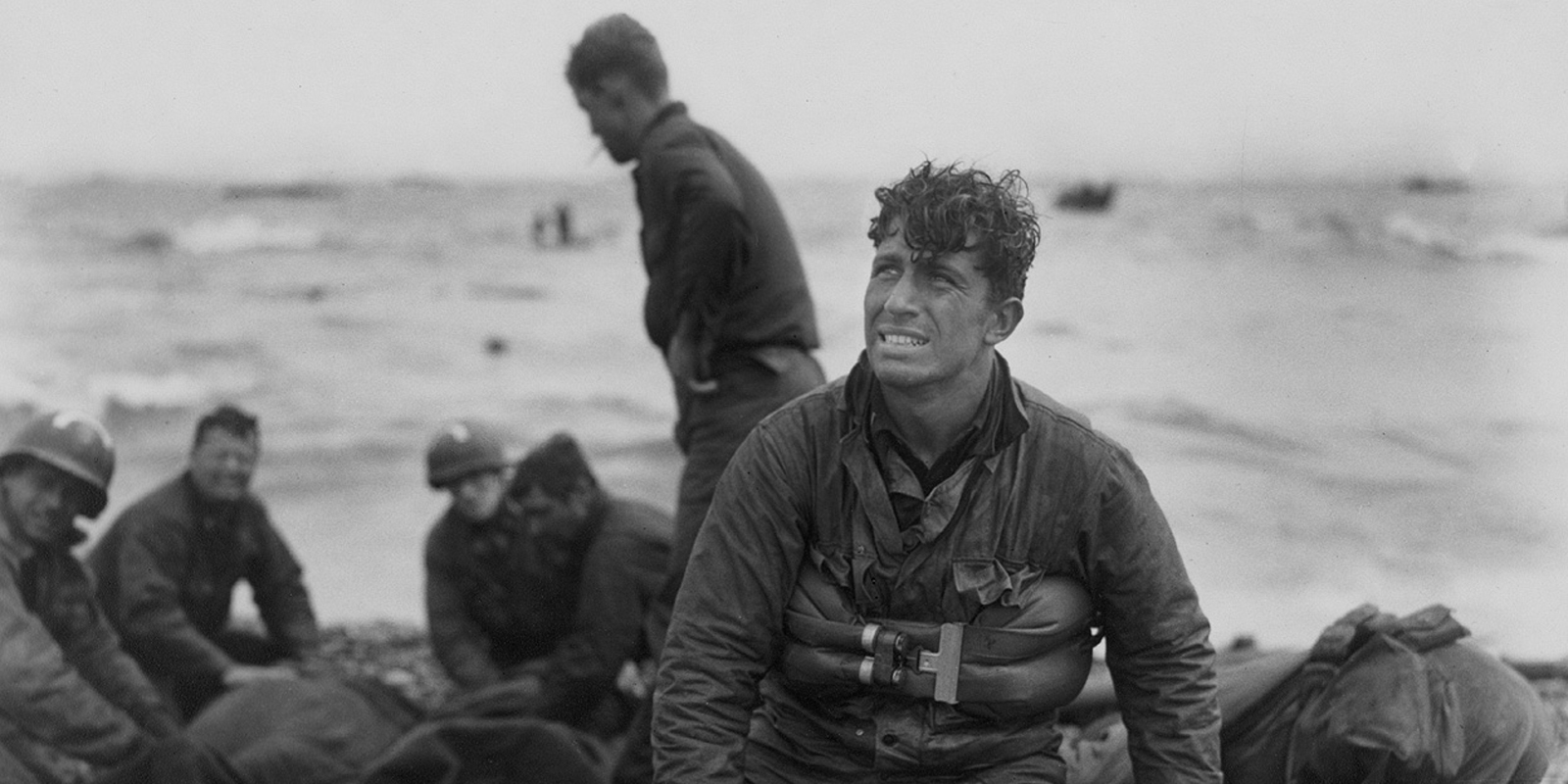
American soldiers recover the dead on Omaha Beach in 1944. [Public domain via Library of Congress]
I. The Origins of the Pacific War
Although the United States joined the war in 1941, two years after Europe exploded into conflict in 1939, the path to the Japanese bombing of Pearl Harbor, the surprise attack that threw the United States headlong into war, began much earlier. For the Empire of Japan, the war had begun a decade before Pearl Harbor.
On September 18, 1931, a small explosion tore up railroad tracks controlled by the Japanese-owned South Manchuria Railway near the city of Shenyang (Mukden) in the Chinese province of Manchuria. The railway company condemned the bombing as the work of anti-Japanese Chinese dissidents. Evidence, though, suggests that the initial explosion was neither an act of Chinese anti-Japanese sentiment nor an accident but an elaborate ruse planned by the Japanese to provide a basis for invasion. In response, the privately operated Japanese Guandong (Kwangtung) army began shelling the Shenyang garrison the next day, and the garrison fell before nightfall. Hungry for Chinese territory and witnessing the weakness and disorganization of Chinese forces, but under the pretense of protecting Japanese citizens and investments, the Japanese Imperial Army ordered a full-scale invasion of Manchuria. The invasion was swift. Without a centralized Chinese army, the Japanese quickly defeated isolated Chinese warlords and by the end of February 1932, all of Manchuria was firmly under Japanese control. Japan established the nation of Manchukuo out of the former province of Manchuria. 1
This seemingly small skirmish—known by the Chinese as the September 18 Incident and the Japanese as the Manchurian Incident—sparked a war that would last thirteen years and claim the lives of over thirty-five million people. Comprehending Japanese motivations for attacking China and the grueling stalemate of the ensuing war are crucial for understanding Japan’s seemingly unprovoked attack on Pearl Harbor, Hawaii, on December 7, 1941, and, therefore, for understanding the involvement of the United States in World War II as well.
Despite their rapid advance into Manchuria, the Japanese put off the invasion of China for nearly three years. Japan occupied a precarious domestic and international position after the September 18 Incident. At home, Japan was riven by political factionalism due to its stagnating economy. Leaders were torn as to whether to address modernization and lack of natural resources through unilateral expansion (the conquest of resource-rich areas such as Manchuria to export raw materials to domestic Japanese industrial bases such as Hiroshima and Nagasaki) or international cooperation (a philosophy of pan-Asianism in an anti-Western coalition that would push the colonial powers out of Asia). Ultimately, after a series of political crises and assassinations enflamed tensions, pro-war elements within the Japanese military triumphed over the more moderate civilian government. Japan committed itself to aggressive military expansion.
Chinese leaders Chiang Kai-shek and Zhang Xueliang appealed to the League of Nations for assistance against Japan. The United States supported the Chinese protest, proclaiming the Stimson Doctrine in January 1932, which refused to recognize any state established as a result of Japanese aggression. Meanwhile, the League of Nations sent Englishman Victor Bulwer-Lytton to investigate the September 18 Incident. After a six-month investigation, Bulwer-Lytton found the Japanese guilty of inciting the September 18 incident and demanded the return of Manchuria to China. The Japanese withdrew from the League of Nations in March 1933.
Japan isolated itself from the world. Its diplomatic isolation empowered radical military leaders who could point to Japanese military success in Manchuria and compare it to the diplomatic failures of the civilian government. The military took over Japanese policy. And in the military’s eyes, the conquest of China would not only provide for Japan’s industrial needs, it would secure Japanese supremacy in East Asia.
The Japanese launched a full-scale invasion of China. It assaulted the Marco Polo Bridge on July 7, 1937, and routed the forces of the Chinese National Revolutionary Army led by Chiang Kai-shek. The broken Chinese army gave up Beiping (Beijing) to the Japanese on August 8, Shanghai on November 26, and the capital, Nanjing (Nanking), on December 13. Between 250,000 and 300,000 people were killed, and tens of thousands of women were raped, when the Japanese besieged and then sacked Nanjing. The Western press labeled it the Rape of Nanjing. To halt the invading enemy, Chiang Kai-shek adopted a scorched-earth strategy of “trading space for time.” His Nationalist government retreated inland, burning villages and destroying dams, and established a new capital at the Yangtze River port of Chongqing (Chungking). Although the Nationalists’ scorched-earth policy hurt the Japanese military effort, it alienated scores of dislocated Chinese civilians and became a potent propaganda tool of the emerging Chinese Communist Party (CCP).2
Americans read about the brutal fighting in China, but the United States lacked both the will and the military power to oppose the Japanese invasion. After the gut-wrenching carnage of World War I, many Americans retreated toward isolationism by opposing any involvement in the conflagrations burning in Europe and Asia. And even if Americans wished to intervene, their military was lacking. The Japanese army was a technologically advanced force consisting of 4,100,000 men and 900,000 Chinese collaborators—and that was in China alone. The Japanese military was armed with modern rifles, artillery, armor, and aircraft. By 1940, the Japanese navy was the third-largest and among the most technologically advanced in the world.
Still, Chinese Nationalists lobbied Washington for aid. Chiang Kai-shek’s wife, Soong May-ling—known to the American public as Madame Chiang—led the effort. Born into a wealthy Chinese merchant family in 1898, Madame Chiang spent much of her childhood in the United States and graduated from Wellesley College in 1917 with a major in English literature. In contrast to her gruff husband, Madame Chiang was charming and able to use her knowledge of American culture and values to garner support for her husband and his government. But while the United States denounced Japanese aggression, it took no action.
As Chinese Nationalists fought for survival, the Communist Party was busy collecting people and supplies in the northwestern Shaanxi Province. China had been at war with itself when the Japanese came. Nationalists battled a stubborn communist insurgency. In 1935 the Nationalists threw the communists out of the fertile Chinese coast, but an ambitious young commander named Mao Zedong recognized the power of the Chinese peasant population. In Shaanxi, Mao recruited from the local peasantry, building his force from a meager seven thousand survivors at the end of the Long March in 1935 to a robust 1.2 million members by the end of the war.
Although Japan had conquered much of the country, the Nationalists regrouped and the communists rearmed. An uneasy truce paused the country’s civil war and refocused efforts on the invaders. The Chinese could not dislodge the Japanese, but they could stall their advance. The war mired in stalemate.
II. The Origins of the European War
Across the globe in Europe, the continent’s major powers were still struggling with the aftereffects of World War I when the global economic crisis spiraled much of the continent into chaos. Germany’s Weimar Republic collapsed with the economy, and out of the ashes emerged Adolf Hitler’s National Socialists—the Nazis. Championing German racial supremacy, fascist government, and military expansionism, Hitler rose to power and, after aborted attempts to take power in Germany, became chancellor in 1933 and the Nazis conquered German institutions. Democratic traditions were smashed. Leftist groups were purged. Hitler repudiated the punitive damages and strict military limitations of the Treaty of Versailles. He rebuilt the German military and navy. He reoccupied regions lost during the war and remilitarized the Rhineland, along the border with France. When the Spanish Civil War broke out in 1936, Hitler and Benito Mussolini—the fascist Italian leader who had risen to power in the 1920s—intervened for the Spanish fascists, toppling the communist Spanish Republican Party. Britain and France stood by warily and began to rebuild their militaries, anxious in the face of a renewed Germany but still unwilling to draw Europe into another bloody war.3
In his autobiographical manifesto, Mein Kampf, Hitler advocated for the unification of Europe’s German peoples under one nation and that nation’s need for Lebensraum, or living space, particularly in Eastern Europe, to supply Germans with the land and resources needed for future prosperity. The Untermenschen (lesser humans) would have to go. Once in power, Hitler worked toward the twin goals of unification and expansion.
The massive Nuremberg rallies, such as this one in 1935, instilled a fierce loyalty to (or fearful silence about) Hitler and the National Socialist Party in Germany. [Public Domain via Wikimedia]
In 1938, Germany annexed Austria and set its sights on the Sudetenland, a large, ethnically German area of Czechoslovakia. Britain and France, alarmed but still anxious to avoid war, agreed—without Czechoslovakia’s input—that Germany could annex the region in return for a promise to stop all future German aggression. They thought that Hitler could be appeased, but it became clear that his ambitions would continue pushing German expansion. In March 1939, Hitler took the rest of Czechoslovakia and began to make demands on Poland. Britain and France promised war. And war came.
Hitler signed a secret agreement—the Molotov-Ribbentrop Pact—with the Soviet Union that coordinated the splitting of Poland between the two powers and promised nonaggression thereafter. The European war began when the German Wehrmacht invaded Poland on September 1, 1939. Britain and France declared war two days later and mobilized their armies. Britain and France hoped that the Poles could hold out for three to four months, enough time for the Allies to intervene. Poland fell in three weeks. The German army, anxious to avoid the rigid, grinding war of attrition that took so many millions in the stalemate of World War I, built their new modern army for speed and maneuverability. German doctrine emphasized the use of tanks, planes, and motorized infantry (infantry that used trucks for transportation instead of marching) to concentrate forces, smash front lines, and wreak havoc behind the enemy’s defenses. It was called Blitzkrieg, or lightning war.
After the fall of Poland, France and its British allies braced for an inevitable German attack. Throughout the winter of 1939–1940, however, fighting was mostly confined to smaller fronts in Norway. Belligerents called it the Sitzkrieg (sitting war). But in May 1940, Hitler launched his attack into Western Europe. Mirroring the German’s Schlieffen Plan of 1914 in the previous war, Germany attacked through the Netherlands and Belgium to avoid the prepared French defenses along the French-German border. Poland had fallen in three weeks; France lasted only a few weeks more. By June, Hitler was posing for photographs in front of the Eiffel Tower. Germany split France in half. Germany occupied and governed the north, and the south would be ruled under a puppet government in Vichy.
With France under heel, Hitler turned to Britain. Operation Sea Lion—the planned German invasion of the British Isles—required air superiority over the English Channel. From June until October the German Luftwaffe fought the Royal Air Force (RAF) for control of the skies. Despite having fewer planes, British pilots won the so-called Battle of Britain, saving the islands from immediate invasion and prompting the new prime minister, Winston Churchill, to declare, “Never before in the field of human conflict has so much been owed by so many to so few.”
The German bombing of London left thousands homeless, hurt, or dead. This child, holding a stuffed toy, sits in the rubble as adults ponder their fate in the background. 1945. Library of Congress.
If Britain was safe from invasion, it was not immune from additional air attacks. Stymied in the Battle of Britain, Hitler began the Blitz—a bombing campaign against cities and civilians. Hoping to crush the British will to fight, the Luftwaffe bombed the cities of London, Liverpool, and Manchester every night from September to the following May. Children were sent far into the countryside to live with strangers to shield them from the bombings. Remaining residents took refuge in shelters and subway tunnels, emerging each morning to put out fires and bury the dead. The Blitz ended in June 1941, when Hitler, confident that Britain was temporarily out of the fight, launched Operation Barbarossa—the invasion of the Soviet Union.
Hoping to capture agricultural lands, seize oil fields, and break the military threat of Stalin’s Soviet Union, Hitler broke the two powers’ 1939 nonaggression pact and, on June 22, invaded the Soviet Union. It was the largest land invasion in history. France and Poland had fallen in weeks, and German officials hoped to break Russia before the winter. And initially, the Blitzkrieg worked. The German military quickly conquered enormous swaths of land and netted hundreds of thousands of prisoners. But Russia was too big and the Soviets were willing to sacrifice millions to stop the fascist advance. After recovering from the initial shock of the German invasion, Stalin moved his factories east of the Urals, out of range of the Luftwaffe. He ordered his retreating army to adopt a “scorched earth” policy, to move east and destroy food, rails, and shelters to stymie the advancing German army. The German army slogged forward. It split into three pieces and stood at the gates of Moscow, Stalingrad, and Leningrad, but supply lines now stretched thousands of miles, Soviet infrastructure had been destroyed, partisans harried German lines, and the brutal Russian winter arrived. Germany had won massive gains but the winter found Germany exhausted and overextended. In the north, the German army starved Leningrad to death during an interminable siege; in the south, at Stalingrad, the two armies bled themselves to death in the destroyed city; and, in the center, on the outskirts of Moscow, in sight of the capital city, the German army faltered and fell back. It was the Soviet Union that broke Hitler’s army. Twenty-five million Soviet soldiers and civilians died during the Great Patriotic War, and roughly 80 percent of all German casualties during the war came on the Eastern Front. The German army and its various conscripts suffered 850,000 casualties at the Battle of Stalingrad alone. In December 1941, Germany began its long retreat.4
III. The United States and the European War
While Hitler marched across Europe, the Japanese continued their war in the Pacific. In 1939, the United States dissolved its trade treaties with Japan and the following year cut off supplies of war materials by embargoing oil, steel, rubber, and other vital goods. It was hoped that economic pressure would shut down the Japanese war machine. Instead, Japan’s resource-starved military launched invasions across the Pacific to sustain its war effort. The Japanese called their new empire the Greater East Asia Co-Prosperity Sphere and, with the cry of “Asia for the Asians,” made war against European powers and independent nations throughout the region. Diplomatic relations between Japan and the United States collapsed. The United States demanded that Japan withdraw from China; Japan considered the oil embargo a de facto declaration of war.5
Japanese military planners, believing that American intervention was inevitable, planned a coordinated Pacific offensive to neutralize the United States and other European powers and provide time for Japan to complete its conquests and fortify its positions. On the morning of December 7, 1941, the Japanese launched a surprise attack on the American naval base at Pearl Harbor, Hawaii. Japanese military planners hoped to destroy enough battleships and aircraft carriers to cripple American naval power for years. Twenty-four hundred Americans were killed in the attack.
American isolationism fell at Pearl Harbor. Japan also assaulted Hong Kong, the Philippines, and American holdings throughout the Pacific, but it was the attack on Hawaii that threw the United States into a global conflict. Franklin Roosevelt called December 7 “a date which will live in infamy” and called for a declaration of war, which Congress answered within hours. Within a week of Pearl Harbor the United States had declared war on the entire Axis, turning two previously separate conflicts into a true world war.
After Pearl Harbor, Franklin Roosevelt moved to imprison thousands of Japanese Americans for fear there were spies among them. Japanese-Americans were told on short notice to leave the Pacific Coast, and were moved to concentration camps, mostly in the Midwest. The camps were often little more than barracks or even livestock barns, where families were required to live many to a room. For more information on the Japanese internment, see the following video:

