


PSY 200/SOC 200: Social Psychology//Social final
 claura
 AccommodationAssimilationandConfirmationBiastextexcerpt.html
How Schemas Maintain Themselves: The Power of Assimilation
As we have seen in our earlier discussion, accommodation (i.e., the changing of beliefs on the basis of new information) does occur—it is the process of learning itself. Our beliefs about Italians may well change through our encounters with Bianca, an Italian woman. However, there are many factors that lead us to assimilate information to our expectations rather than to accommodate our expectations to fit new information. In fact, we can say that in most cases, once a schema is developed, it will be difficult to change it because the expectation leads us to process new information in ways that serve to strengthen it rather than to weaken it.
The tendency toward assimilation is so strong that it has substantial effects on our everyday social cognition. One outcome of assimilation is the confirmation bias—the tendency for people to favor information that confirms their expectations, regardless of whether the information is true.
n some cases, our existing knowledge acts to direct our attention toward information that matches our expectations and prevents us from attempting to attend to or acknowledge conflicting information (Fiske & Neuberg, 1990). To return to our example of Bianca from Rome, when we first meet her, we may immediately begin to look for signs of expressiveness in her behavior and personality. Because we expect people to confirm our expectations, we frequently respond to new people as if we already know what they are going to be like. Yaacov Trope and Erik Thompson (1997) found in their research that individuals addressed fewer questions to people about whom they already had strong expectations and that the questions they did ask were likely to confirm the expectations they already had. Because we believe that Italians are expressive, we expect to see that behavior in Bianca, we preferentially attend to information that confirms those beliefs, and we tend to ignore any disconfirming information. The outcome is that our expectations resist change (Fazio, Ledbetter, & Towles-Schwen, 2000).
Our reliance on schemas can also make it more difficult for us to “think outside the box.” Peter Wason (1960) asked college students to determine the rule that was used to generate the numbers 2-4-6 by asking them to generate possible sequences and then telling them if those numbers followed the rule. The first guess that students made was usually “consecutive ascending even numbers,” and they then asked questions designed to confirm their hypothesis (“Does 102-104-106 fit?” “What about 434-436-438?”). Upon receiving information that those guesses did fit the rule, the students stated that the rule was “consecutive ascending even numbers.” But the students’ use of the confirmation bias led them to ask only about instances that confirmed their hypothesis and not about those that would disconfirm it. They never bothered to ask whether 1-2-3 or 3-11-200 would fit; if they had, they would have learned that the rule was not “consecutive ascending even numbers” but simply “any three ascending numbers.” Again, you can see that once we have a schema (in this case, a hypothesis), we continually retrieve that schema from memory rather than other relevant ones, leading us to act in ways that tend to confirm our beliefs.
Because expectations influence what we attend to, they also influence what we remember. One frequent outcome is that information that confirms our expectations is more easily processed, is more easily understood, and thus has a bigger impact than does information that disconfirms our expectations. There is substantial research evidence indicating that when processing information about social groups, individuals tend to particularly remember information better that confirms their existing beliefs about those groups (Fyock & Stangor, 1994; Van Knippenberg & Dijksterhuis, 1996). If we have the (statistically erroneous) stereotype that women are bad drivers, we tend to remember the cases where we see a woman driving poorly but to forget the cases where we see a woman driving well. This of course strengthens and maintains our beliefs and produces even more assimilation. And our schemas may also be maintained because when people get together, they talk about other people in ways that tend to express and confirm existing beliefs (Ruscher & Duval, 1998; Schaller & Conway, 1999).
Darley and Gross (1983) demonstrated how schemas about social class could influence memory. In their research, they gave participants a picture and some information about a fourth-grade girl named Hannah. To activate a schema about her social class, Hannah was pictured sitting in front of a nice suburban house for one half of the participants and was pictured in front of an impoverished house in an urban area for the other half. Then the participants watched a video that showed Hannah taking an intelligence test. As the test went on, Hannah got some of the questions right and some of them wrong, but the number of correct and incorrect answers was the same in both conditions. Then the participants were asked to remember how many questions Hannah got right and wrong. Demonstrating that stereotypes had influenced memory, the participants who thought that Hannah had come from an upper-class background judged that she had gotten more correct answers than those who thought she was from a lower-class background.
This is not to say that we only remember information that matches our expectations. Sometimes we encounter information that is so extreme and so conflicting with our expectations that we cannot help but attend to and remember it (Srull & Wyer, 1989). Imagine that you have formed an impression of a good friend of yours as a very honest person. One day you discover, however, that he has taken some money from your wallet without getting your permission or even telling you. It is likely that this new information—because it is so personally involving and important—will have a dramatic effect on your perception of your friend and that you will remember it for a long time. In short, information that is either consistent with, or very inconsistent with, an existing schema or attitude is likely to be well remembered.
Still another way that our expectations tend to maintain themselves is by leading us to act toward others on the basis of our expectations, creating a self-fulfilling prophecy. A self-fulfilling prophecy is a process that occurs when our expectations about others lead us to behave toward those others in ways that make those expectations come true. If I have a stereotype that Italians are fun, then I may act toward Bianca in a friendly way. My friendly behavior may be reciprocated by Bianca, and if many other people also engage in the same positive behaviors with her, in the long run she may actually become a friendlier person, thus confirming our initial expectations. Of course, the opposite is also possible—if I believe that short people are boring or that women are overly emotional, my behavior toward short people and women may lead me to maintain those more negative, and probably inaccurate, beliefs as well.
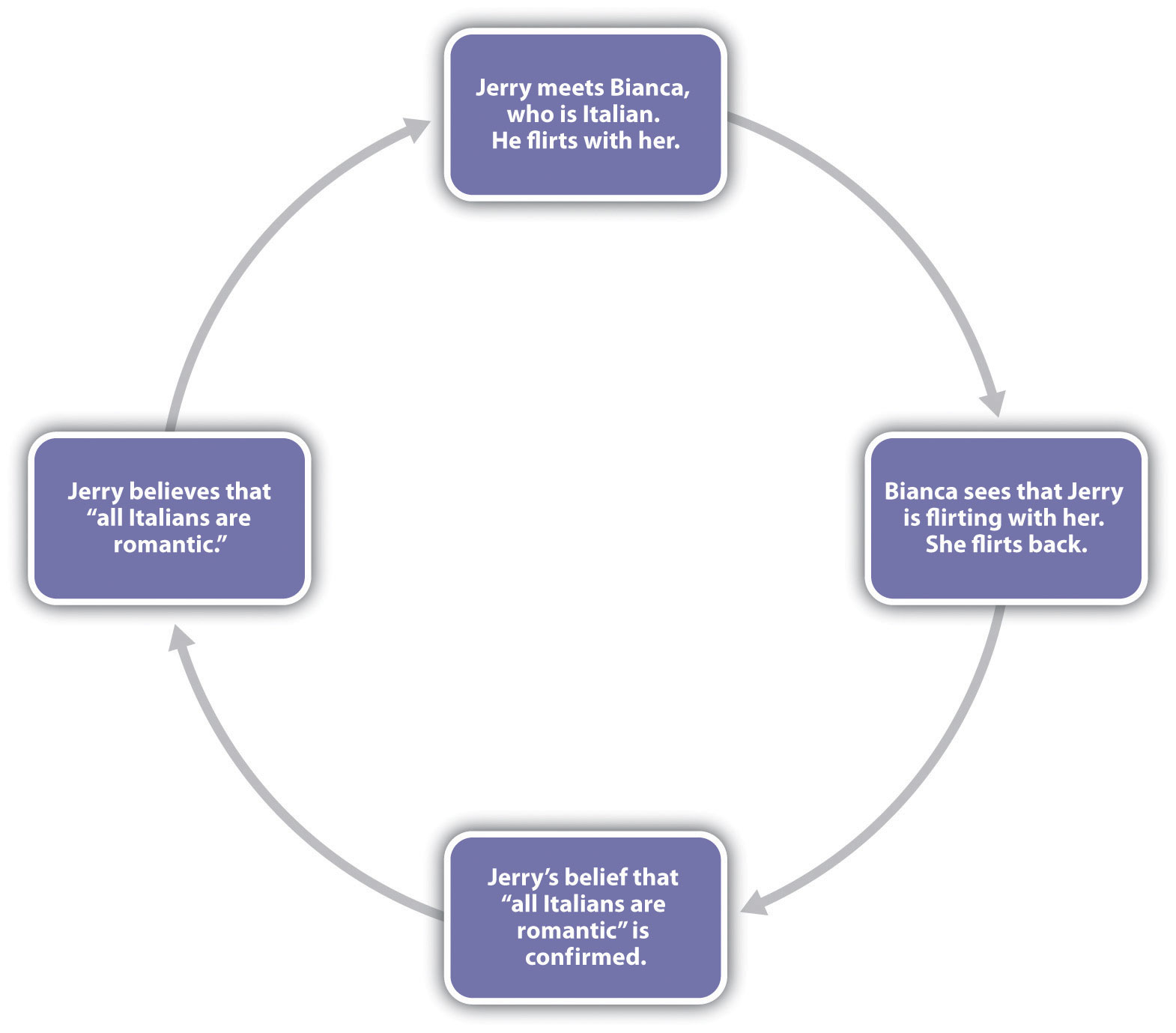
Self-fulfilling prophecies occur when our existing expectations influence our behavior toward others, thereby creating responses in those others that reinforce our existing expectations.
We can now begin to see why an individual who initially makes a judgment that a person has engaged in a given behavior (e.g., an eyewitness who believes that they saw a given person commit a crime) will find it very difficult to change his or her mind about that decision later. Even if the individual is provided with evidence that suggests that he or she was wrong, that individual will likely assimilate that information to the existing belief. Assimilation is thus one of many factors that help account for the inaccuracy of eyewitness testimony.
Basic Page
This basic page is a general-purpose layout that includes a banner.
Easy Editing Using the HTML Editor
You can use the HTML editor to make quick and easy changes without needing any knowledge of HTML. Enter your content and use the available controls to apply formatting to your text.
Changing the Banner
To Update the Banner: Make sure that the new image has dimensions similar to 1200 pixels in width x 300 pixels in height. To update the current banner enter the HTML editor, highlight the banner, and click the Insert Image icon.
To Remove the Banner: Enter the HTML editor, highlight the banner, and use the <backspace>or <enter> key.
Copying Text
Pro Tip: When writing content, it is a great practice to first write content in a document, such as Microsoft Word. It allows stakeholders to easily collaborate and track changes to content. It also allows you to spot spelling and grammar errors early on.
When pasting text from a Word document into the HTML editor, however, some of the document’s text styling will copy over. This will clash with the styles that are carefully crafted for this template. So, we recommend pasting the text without formatting.
To paste text without formatting, you can use Ctrl+Shift+V (Cmd+Shift+V on Mac) to paste copied text as unformatted text to HTML editor.
For basic editing, please check Brightspace Help: Format HTML course content. this link opens in a new window/tab)

