NFL 4 C Analysis (Commerce,Careers,Community,Culture)
 omeryalcin
 ABriefHistoryoftheNFL.doc
A Brief History of the NFL
The National Football League was founded in Canton, Ohio, by a group of seven individuals representing four clubs. The 1920 season was comprised of 14 teams in cities such as Akron, Ohio, and Rock Island, Illinois, playing before small crowds and receiving very little public notice.
In the eight decades since its inaugural season, the NFL has grown to 32 clubs and has become America’s biggest and most popular sports league. According to a recent Harris poll, 30% of those surveyed selected the NFL as their favorite sport, equal to the popularity of professional baseball (15%), professional basketball (7%) and auto racing (7%) combined. Approximately 120 million fans watch NFL football on television or in stadiums every weekend during the season. Super Bowl XXXVIII between New England and Carolina was the most-watched television program ever, with 144.4 million viewers worldwide. The top 10 most-watched television shows in history are all Super Bowls.
Under the direction of the Commissioner, the National Football League, with headquarters in New York City, represents the NFL and its member clubs on a variety of matters.
The NFL Office’s responsibilities include broadcasting, public relations, government affairs, business development, officiating, football operations and security, plus the operation of the Super Bowl, AFC and NFC Championship Games, and the Pro Bowl.
The NFL Management Council represents the NFL clubs in bargaining with the National Football League Players Association and supervises the administration of the Collective Bargaining Agreement between the NFL clubs and the players union.
NFL Business Ventures oversees the licensing, sponsorship, marketing and publishing arm of the NFL and its clubs. Its goal is to promote involvement with the game of football while seeking the greatest value for the clubs and League trademarks. The financial success of NFL Business Ventures also provides funding for NFL Charities.
The NFL’s Media division administers the broadcast, cable and satellite television agreements as well as NFL.com, the NFL’s Web site, which attracts more than 12 million visitors each month during the season.
The NFL Network, the first and only television channel created and owned by the National Football League, was launched on November 4, 2003. It provides millions of NFL fans with a network to call their own. The NFL Network takes over 80 years of NFL history and combines it with the latest technology to bring television viewers sports entertainment at its highest level.
NFL Films produces more than 400 hours of programming each year for distribution to network, cable and syndicated television, plus home video. NFL Films, located in New Jersey, has earned 87 Emmys.
NFL International coordinates the NFL’s worldwide initiatives. These efforts include the American Bowl series of international NFL preseason games and NFL Europe, a six-team league in three European countries that plays a 10-week season each spring. NFL Europe’s overseas headquarters is in London, England. NFL International has offices in New York, Canada and Mexico.
The NFL, including its clubs and all its entities, has made American football the preeminent spectator sporting experience live, on television and on the Internet.
A Brief History of the NFL
1. 1. THE NFL A BRIEF HISTORY OF BRUCESTREBINGER.NET
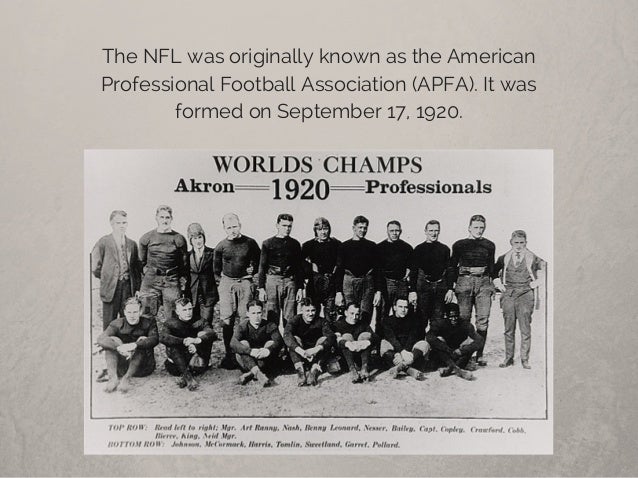
2. 2. The NFL was originally known as the American Professional Football Association (APFA). It was formed on September 17, 1920.
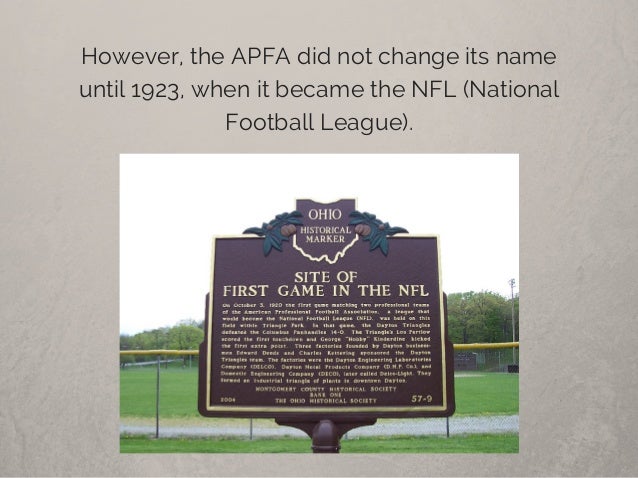
3. 3. However, the APFA did not change its name until 1923, when it became the NFL (National Football League).
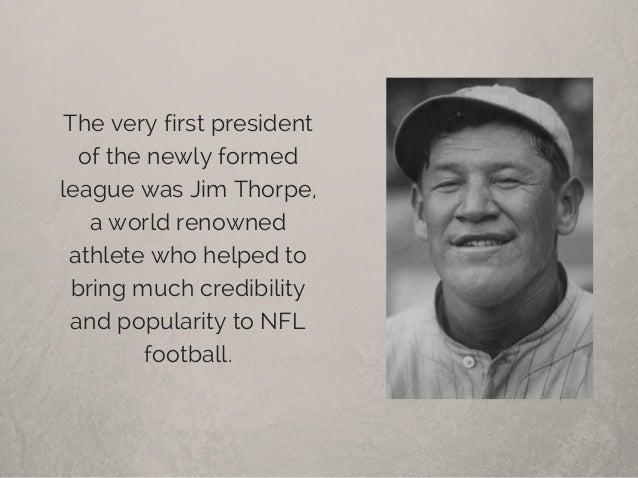
4. 4. The very first president of the newly formed league was Jim Thorpe, a world renowned athlete who helped to bring much credibility and popularity to NFL football.
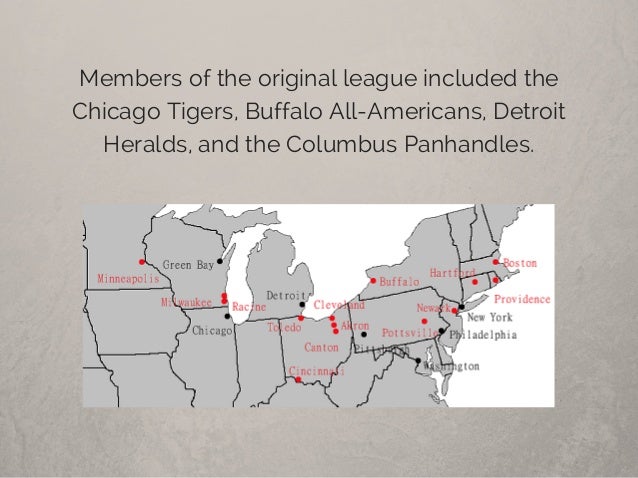
5. 5. Members of the original league included the Chicago Tigers, Buffalo All-Americans, Detroit Heralds, and the Columbus Panhandles.
6. 6. Today, only two of the original teams are still active in the NFL, the Chicago Bears (formerly known as the Decatur Staleys) and the Arizona Cardinals (formerly known as the Chicago Cardinals).
7. 7. THE FIRST NFL GAME
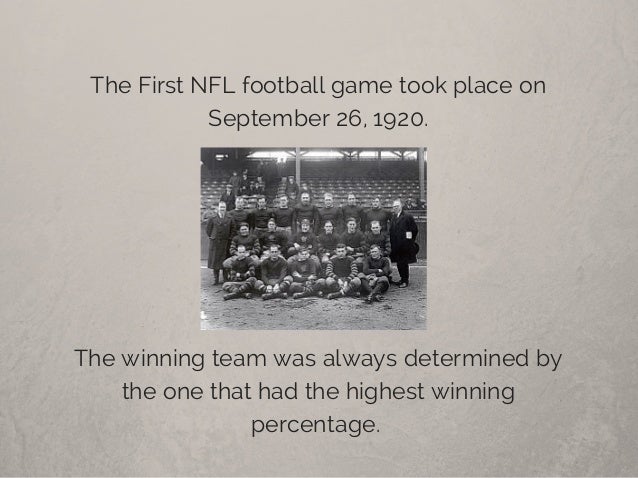
8. 8. The First NFL football game took place on September 26, 1920. The winning team was always determined by the one that had the highest winning percentage.
9. 9. Since 1920, ties were settled by having the top two teams play each other twice, with the winner being the team that won the last game. However, in 1921, the Chicago Bears and the Portsmouth Spartans both tied for first place because they had the same winning stats, resulting in a need for an alternative way to determine the winning team.
10. 10. THE NFL TODAY
11. 11. Currently, the NFL consists of 32 teams, with half belonging to the American Football Conference (AFC) and the other half belonging to the National Football Conference (NFC).
12. 12. The regular season runs for 17 weeks, starting the week after Labor Day. Once the regular season ends, six teams, three from each division go on to compete in the playoffs. Winners from the playoffs then go on to compete in the Super Bowl.
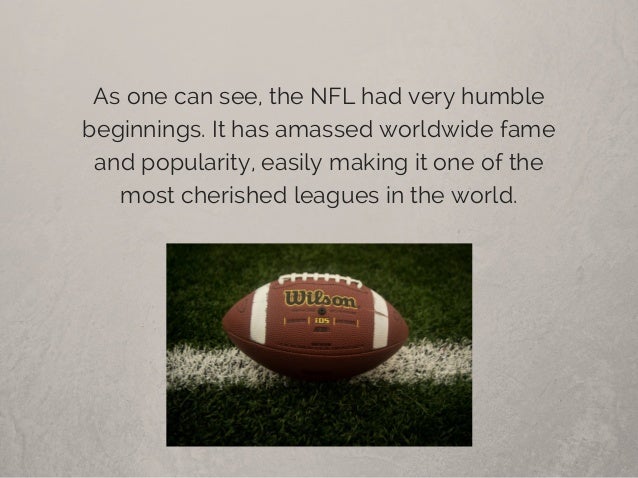
13. 13. As one can see, the NFL had very humble beginnings. It has amassed worldwide fame and popularity, easily making it one of the most cherished leagues in the world.
14. 14. FOR MORE SPORTS INFO, CHECKOUT MY BLOG BRUCESTREBINGER.NET
NFL owners' proposed crackdown on anthem protests will create new problems cnbc.com
· NFL owners who locked arms with players during National Anthem protests are now ready to reverse course.
· They are considering a new rule that would force players to stand for the anthem.
· The "hypocritical" move is not about unity. It's all about money.
· If the league's priority is truly healing, then it needs to address the fact that there are very few black coaches and no black owners in its franchises.
NFL players who squared off against President Trump by staging widespread silent protests may now find themselves locked in a new battle – this time, against the NFL owners who are considering a rule that would make standing for the national anthem mandatory.