Untest Assignment HIST 1301
 darthoten
 8.TheMarketRevolution_THEAMERICANYAWP.pdf
4/11/2021 8. The Market Revolution | THE AMERICAN YAWP
www.americanyawp.com/text/08-the-market-revolution/ 1/31
I. Introduction | II. Early Republic Economic Development | III. The Decline of Northern Slavery
and the Rise of the Cotton Kingdom | IV. Changes in Labor Organization | V. Changes in Gender
Roles and Family Life | VI. The Rise of Industrial Labor in Antebellum America | VII. Conclusion |
VIII. Primary Sources | IX. Reference Material
THE AMERICAN YAWP
8. The Market Revolution
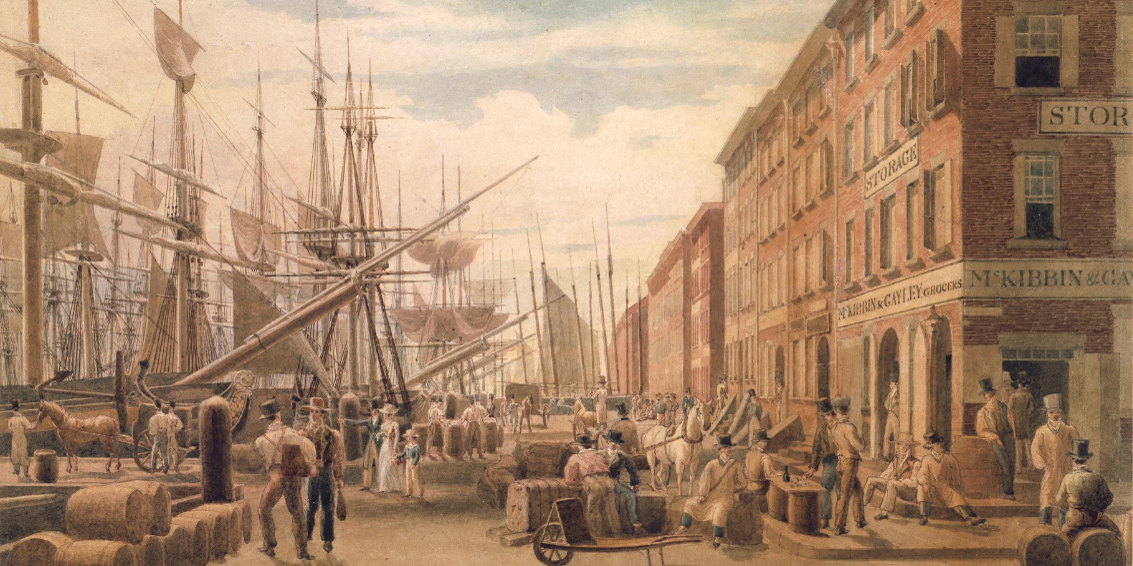
William James Bennett, View of South Street, from Maiden Lane, New York City, c. 1827, via Metropolitan Museum of New York
*The American Yawp is an evolving, collaborative text. Please click here to improve this chapter.*
I. Introduction
4/11/2021 8. The Market Revolution | THE AMERICAN YAWP
www.americanyawp.com/text/08-the-market-revolution/ 2/31
In the early years of the nineteenth century, Americans’ endless commercial ambition—what one
Baltimore paper in 1815 called an “almost universal ambition to get forward”—remade the nation.
Between the Revolution and the Civil War, an old subsistence world died and a new more-commer-
cial nation was born. Americans integrated the technologies of the Industrial Revolution into a new
commercial economy. Steam power, the technology that moved steamboats and railroads, fueled the
rise of American industry by powering mills and sparking new national transportation networks. A
“market revolution” remade the nation.
The revolution reverberated across the country. More and more farmers grew crops for pro�t, not
self-su�ciency. Vast factories and cities arose in the North. Enormous fortunes materialized. A new
middle class ballooned. And as more men and women worked in the cash economy, they were freed
from the bound dependence of servitude. But there were costs to this revolution. As northern textile
factories boomed, the demand for southern cotton swelled, and American slavery accelerated.
Northern subsistence farmers became laborers bound to the whims of markets and bosses. The mar-
ket revolution sparked explosive economic growth and new personal wealth, but it also created a
growing lower class of property-less workers and a series of devastating depressions, called “panics.”
Many Americans labored for low wages and became trapped in endless cycles of poverty. Some work-
ers, often immigrant women, worked thirteen hours a day, six days a week. Others labored in slavery.
Massive northern textile mills turned southern cotton into cheap cloth. And although northern
states washed their hands of slavery, their factories fueled the demand for slave-grown southern cot-
ton and their banks provided the �nancing that ensured the pro�tability and continued existence of
the American slave system. And so, as the economy advanced, the market revolution wrenched the
United States in new directions as it became a nation of free labor and slavery, of wealth and inequal-
ity, and of endless promise and untold perils.
II. Early Republic Economic Development
The growth of the American economy reshaped American life in the decades before the Civil War.
Americans increasingly produced goods for sale, not for consumption. Improved transportation en-
abled a larger exchange network. Labor-saving technology improved e�ciency and enabled the sepa-
ration of the public and domestic spheres. The market revolution ful�lled the revolutionary
generation’s expectations of progress but introduced troubling new trends. Class con�ict, child la-
1
4/11/2021 8. The Market Revolution | THE AMERICAN YAWP
www.americanyawp.com/text/08-the-market-revolution/ 3/31
bor, accelerated immigration, and the expansion of slavery followed. These strains required new fam-
ily arrangements and transformed American cities.
American commerce had proceeded haltingly during the eighteenth century. American farmers in-
creasingly exported foodstu�s to Europe as the French Revolutionary Wars devastated the continent
between 1793 and 1815. America’s exports rose in value from $20.2 million in 1790 to $108.3 mil-
lion by 1807. But while exports rose, exorbitant internal transportation costs hindered substantial
economic development within the United States. In 1816, for instance, $9 could move one ton of
goods across the Atlantic Ocean, but only thirty miles across land. An 1816 Senate Committee Re-
port lamented that “the price of land carriage is too great” to allow the pro�table production of
American manufactures. But in the wake of the War of 1812, Americans rushed to build a new na-
tional infrastructure, new networks of roads, canals, and railroads. In his 1815 annual message to
Congress, President James Madison stressed “the great importance of establishing throughout our
country the roads and canals which can best be executed under national authority.” State govern-
ments continued to sponsor the greatest improvements in American transportation, but the federal
government’s annual expenditures on internal improvements climbed to a yearly average of
$1,323,000 by Andrew Jackson’s presidency. .
2
3
4
4/11/2021 8. The Market Revolution | THE AMERICAN YAWP
www.americanyawp.com/text/08-the-market-revolution/ 4/31
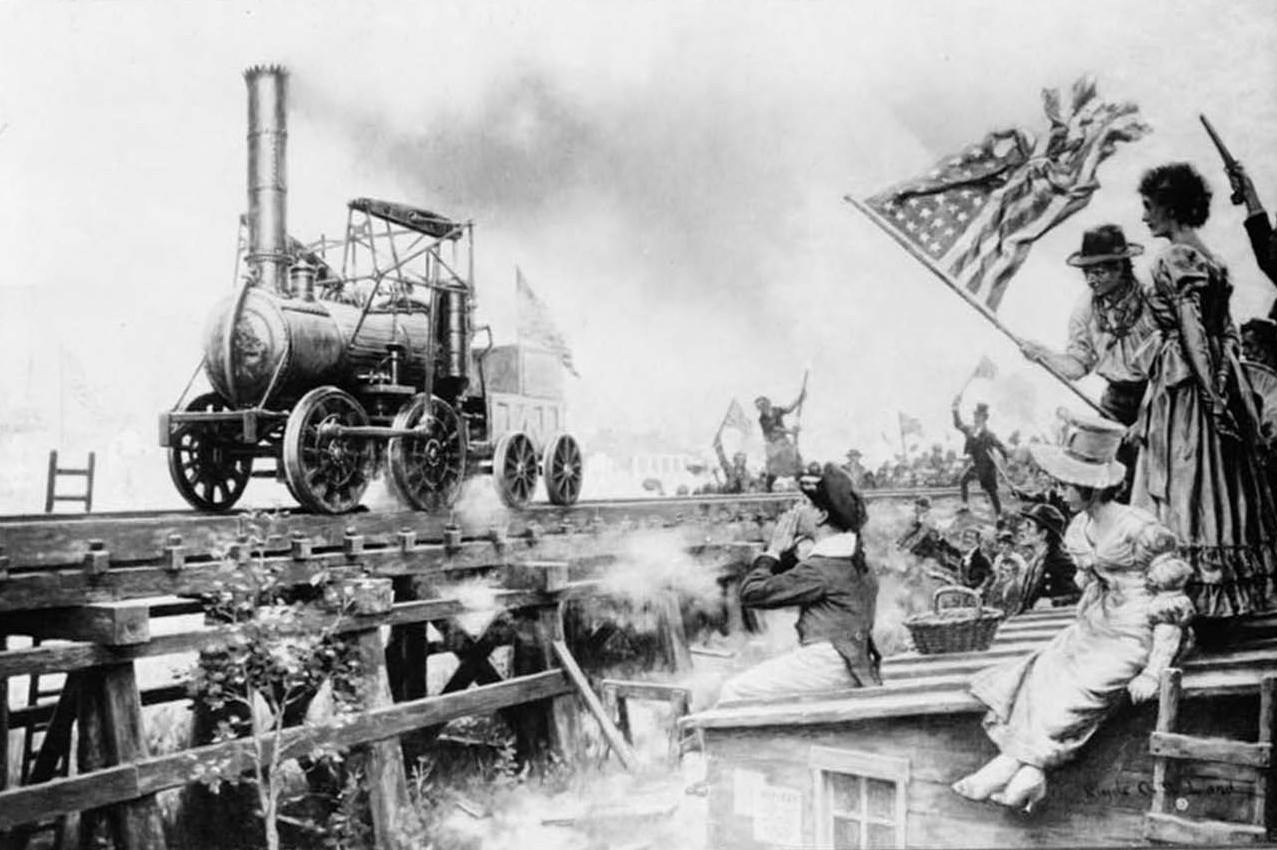
Clyde Osmer DeLand, “The First Locomotive. Aug. 8th, 1829. Trial Trip of the “Stourbridge Lion,” 1916. Library of Congress.
State legislatures meanwhile pumped capital into the economy by chartering banks. The number of
state-chartered banks skyrocketed from 1 in 1783, 266 in 1820, and 702 in 1840 to 1,371 in 1860.
European capital also helped build American infrastructure. By 1844, one British traveler declared
that “the prosperity of America, her railroads, canals, steam navigation, and banks, are the fruit of
English capital.”
Economic growth, however, proceeded unevenly. Depressions devastated the economy in 1819,
1837, and 1857. Each followed rampant speculation in various commodities: land in 1819, land and
enslaved laborers in 1837, and railroad bonds in 1857. Eventually the bubbles all burst. The spread
of paper currency untethered the economy from the physical signi�ers of wealth familiar to the colo-
nial generation, namely land. Counterfeit bills were endemic during this early period of banking.
With so many fake bills circulating, Americans were constantly on the lookout for the “con�dence
man” and other deceptive characters in the urban landscape. Prostitutes and con men could look like
regular honest Americans. Advice literature o�ered young men and women strategies for avoiding
hypocrisy in an attempt to restore the social �ber. Intimacy in the domestic sphere became more im-
portant as duplicity proliferated in the public sphere. Fear of the con�dence man, counterfeit bills,
and a pending bust created anxiety in the new capitalist economy. But Americans refused to blame
the logic of their new commercial system for these depressions. Instead, they kept pushing “to get
forward.”
The so-called Transportation Revolution opened the vast lands west of the Appalachian Mountains.
In 1810, before the rapid explosion of American infrastructure, Margaret Dwight left New Haven,
Connecticut, in a wagon headed for Ohio Territory. Her trip was less than �ve hundred miles but
took six weeks to complete. The journey was a terrible ordeal, she said. The roads were “so rocky &
so gullied as to be almost impassable.” Ten days into the journey, at Bethlehem, Pennsylvania,
Dwight said “it appeared to me that we had come to the end of the habitable part of the globe.” She
�nally concluded that “the reason so few are willing to return from the Western country, is not that
the country is so good, but because the journey is so bad.” Nineteen years later, in 1829, English
traveler Frances Trollope made the reverse journey across the Allegheny Mountains from Cincinnati
to the East Coast. At Wheeling, Virginia, her coach encountered the National Road, the �rst feder-
ally funded interstate infrastructure project. The road was smooth and her journey across the Al-
leghenies was a scenic delight. “I really can hardly conceive a higher enjoyment than a botanical tour
5
6
7
8
4/11/2021 8. The Market Revolution | THE AMERICAN YAWP
www.americanyawp.com/text/08-the-market-revolution/ 5/31
among the Alleghany Mountains,” she declared. The ninety miles of the National Road was to her
“a garden.”
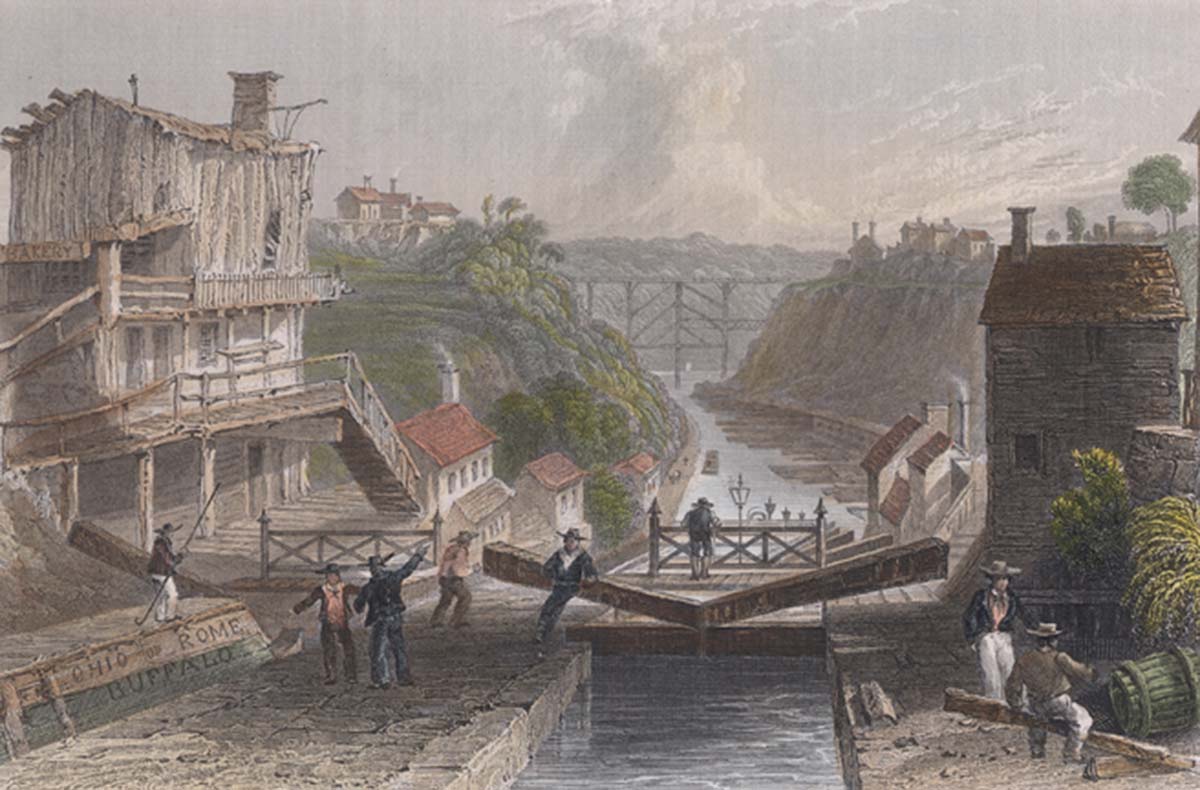
Engraving based on W.H. Bartlett, “Lockport, Erie Canal,” 1839. Wikimedia.
If the two decades between Margaret Dwight’s and Frances Trollope’s journeys transformed the
young nation, the pace of change only accelerated in the following years. If a transportation revolu-
tion began with improved road networks, it soon incorporated even greater improvements in the
ways people and goods moved across the landscape.
New York State completed the Erie Canal in 1825. The 350-mile-long human-made waterway linked
the Great Lakes with the Hudson River and the Atlantic Ocean. Soon crops grown in the Great
Lakes region were carried by water to eastern cities, and goods from emerging eastern factories made
the reverse journey to midwestern farmers. The success of New York’s “arti�cial river” launched a
canal-building boom. By 1840 Ohio created two navigable, all-water links from Lake Erie to the
Ohio River.
Robert Fulton established the �rst commercial steamboat service up and down the Hudson River in
New York in 1807. Soon thereafter steamboats �lled the waters of the Mississippi and Ohio Rivers.
9
4/11/2021 8. The Market Revolution | THE AMERICAN YAWP
www.americanyawp.com/text/08-the-market-revolution/ 6/31
Downstream-only routes became watery two-way highways. By 1830, more than two hundred
steamboats moved up and down western rivers.
The United States’ �rst long-distance rail line launched from Maryland in 1827. Baltimore’s city
government and the state government of Maryland provided half the start-up funds for the new Bal-
timore & Ohio (B&O) Rail Road Company. The B&O’s founders imagined the line as a means to
funnel the agricultural products of the trans-Appalachian West to an outlet on the Chesapeake Bay.
Similar motivations led citizens in Philadelphia, Boston, New York City, and Charleston, South Car-
olina to launch their own rail lines. State and local governments provided the means for the bulk of
this initial wave of railroad construction, but economic collapse following the Panic of 1837 made
governments wary of such investments. Government supports continued throughout the century,
but decades later the public origins of railroads were all but forgotten, and the railroad corporation
became the most visible embodiment of corporate capitalism.
By 1860 Americans had laid more than thirty thousand miles of railroads. The ensuing web of rail,
roads, and canals meant that few farmers in the Northeast or Midwest had trouble getting goods to
urban markets. Railroad development was slower in the South, but there a combination of rail lines
and navigable rivers meant that few cotton planters struggled to transport their products to textile
mills in the Northeast and in England.
Such internal improvements not only spread goods, they spread information. The transportation
revolution was followed by a communications revolution. The telegraph rede�ned the limits of hu-
man communication. By 1843 Samuel Morse had persuaded Congress to fund a forty-mile telegraph
line stretching from Washington, D.C., to Baltimore. Within a few short years, during the Mexican-
American War, telegraph lines carried news of battle�eld events to eastern newspapers within days.
This contrasts starkly with the War of 1812, when the Battle of New Orleans took place nearly two
full weeks after Britain and the United States had signed a peace treaty.
The consequences of the transportation and communication revolutions reshaped the lives of Amer-
icans. Farmers who previously produced crops mostly for their own family now turned to the mar-
ket. They earned cash for what they had previously consumed; they purchased the goods they had
previously made or went without. Market-based farmers soon accessed credit through eastern banks,
which provided them with the opportunity to expand their enterprise but left also them prone be-
fore the risk of catastrophic failure wrought by distant market forces. In the Northeast and Midwest,
where farm labor was ever in short supply, ambitious farmers invested in new technologies that
10
4/11/2021 8. The Market Revolution | THE AMERICAN YAWP
www.americanyawp.com/text/08-the-market-revolution/ 7/31
promised to increase the productivity of the limited labor supply. The years between 1815 and 1850
witnessed an explosion of patents on agricultural technologies. The most famous of these, perhaps,
was Cyrus McCormick’s horse-drawn mechanical reaper, which partially mechanized wheat harvest-
ing, and John Deere’s steel-bladed plow, which more easily allowed for the conversion of unbroken
ground into fertile farmland.
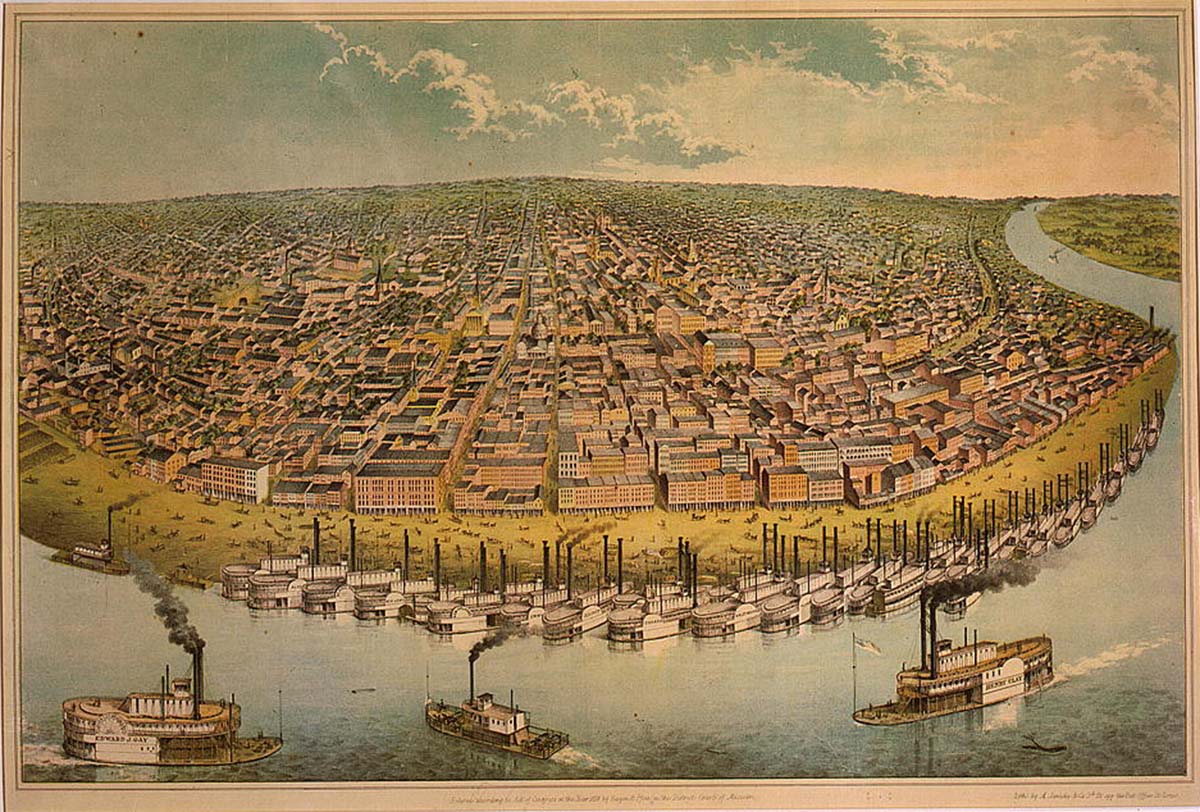
A. Janicke & Co., “Our City, (St. Louis, Mo.),” 1859. Library of Congress.
Most visibly, the market revolution encouraged the growth of cities and reshaped the lives of urban
workers. In 1820, only New York had over one hundred thousand inhabitants. By 1850, six Ameri-
can cities met that threshold, including Chicago, which had been founded fewer than two decades
earlier. New technology and infrastructure paved the way for such growth. The Erie Canal cap-
tured the bulk of the trade emerging from the Great Lakes region, securing New York City’s posi-
tion as the nation’s largest and most economically important city. The steamboat turned St. Louis
and Cincinnati into centers of trade, and Chicago rose as it became the railroad hub of the western
Great Lakes and Great Plains regions. The geographic center of the nation shifted westward. The
development of steam power and the exploitation of Pennsylvania coal�elds shifted the locus of
11
4/11/2021 8. The Market Revolution | THE AMERICAN YAWP
www.americanyawp.com/text/08-the-market-revolution/ 8/31
American manufacturing. By the 1830s, for instance, New England was losing its competitive ad-
vantage to the West.
Meanwhile, the cash economy eclipsed the old, local, informal systems of barter and trade. Income
became the measure of economic worth. Productivity and e�ciencies paled before the measure of
income. Cash facilitated new impersonal economic relationships and formalized new means of pro-
duction. Young workers might simply earn wages, for instance, rather than receiving room and
board and training as part of apprenticeships. Moreover, a new form of economic organization ap-
peared: the business corporation.
States o�ered the privileges of incorporation to protect the fortunes and liabilities of entrepreneurs
who invested in early industrial endeavors. A corporate charter allowed investors and directors to
avoid personal liability for company debts. The legal status of incorporation had been designed to
confer privileges to organizations embarking on expensive projects explicitly designed for the public
good, such as universities, municipalities, and major public works projects. The business corpora-
tion was something new. Many Americans distrusted these new, impersonal business organizations
whose o�cers lacked personal responsibility while nevertheless carrying legal rights. Many wanted
limits. Thomas Je�erson himself wrote in 1816 that “I hope we shall crush in its birth the aristocracy
of our monied corporations which dare already to challenge our government to a trial of strength,
and bid de�ance to the laws of our country.” But in Dartmouth v. Woodward (1819) the Supreme
Court upheld the rights of private corporations when it denied the attempt of the government of
New Hampshire to reorganize Dartmouth College on behalf of the common good. Still, suspicions
remained. A group of journeymen cordwainers in New Jersey publically declared in 1835 that they
“entirely disapprov[ed] of the incorporation of Companies, for carrying on manual mechanical busi-
ness, inasmuch as we believe their tendency is to eventuate and produce monopolies, thereby crip-
pling the energies of individual enterprise.”
III. The Decline of Northern Slavery and the Rise of the Cotton
Kingdom
Slave labor helped fuel the market revolution. By 1832, textile companies made up 88 out of 106
American corporations valued at over $100,000. These textile mills, worked by free labor, never-
12
13
14
4/11/2021 8. The Market Revolution | THE AMERICAN YAWP
www.americanyawp.com/text/08-the-market-revolution/ 9/31
theless depended on southern cotton, and the vast new market economy spurred the expansion of
the plantation South.
By the early nineteenth century, states north of the Mason-Dixon Line had taken steps to abolish
slavery. Vermont included abolition as a provision of its 1777 state constitution. Pennsylvania’s
emancipation act of 1780 stipulated that freed children must serve an indenture term of twenty-
eight years. Gradualism brought emancipation while also defending the interests of northern en-
slavers and controlling still another generation of Black Americans. In 1804 New Jersey became the
last of the northern states to adopt gradual emancipation plans. There was no immediate moment of
jubilee, as many northern states only promised to liberate future children born to enslaved mothers.
Such laws also stipulated that such children remain in indentured servitude to their mother’s en-
slaver in order to compensate the enslaver’s loss. James Mars, a young man indentured under this sys-
tem in Connecticut, risked being thrown in jail when he protested the arrangement that kept him
bound to his mother’s enslaver until age twenty-�ve.
Quicker routes to freedom included escape or direct emancipation by enslavers. But escape was dan-
gerous and voluntary manumission rare. Congress, for instance, made the harboring of a freedom-
seeking enslaved person a federal crime as early as 1793. Hopes for manumission were even slimmer,
as few northern enslavers emancipated their own enslaved laborers. Roughly one �fth of the white
families in New York City owned enslaved laborers, and fewer than eighty enslavers in the city volun-
tarily manumitted their enslaved laborers between 1783 and 1800. By 1830, census data suggests
that at least 3,500 people were still enslaved in the North. Elderly enslaved people in Connecticut
remained in bondage as late as 1848, and in New Jersey slavery endured until after the Civil War.
Emancipation proceeded slowly, but proceeded nonetheless. A free Black population of fewer than
60,000 in 1790 increased to more than 186,000 by 1810. Growing free Black communities fought
for their civil rights. In a number of New England locales, free African Americans could vote and
send their children to public schools. Most northern states granted Black citizens property rights and
trial by jury. African Americans owned land and businesses, founded mutual aid societies, estab-
lished churches, promoted education, developed print culture, and voted.
Nationally, however, the enslaved population continued to grow, from less than 700,000 in 1790 to
more than 1.5 million by 1820. The growth of abolition in the North and the acceleration of slav-
ery in the South created growing divisions. Cotton drove the process more than any other crop. Eli
Whitney’s cotton gin, a simple hand-cranked device designed to mechanically remove sticky green
15
16
17
4/11/2021 8. The Market Revolution | THE AMERICAN YAWP
www.americanyawp.com/text/08-the-market-revolution/ 10/31
seeds from short staple cotton, allowed southern planters to dramatically expand cotton production
for the national and international markets. Water-powered textile factories in England and the
American Northeast rapidly turned raw cotton into cloth. Technology increased both the supply of
and demand for cotton. White southerners responded by expanding cultivation farther west, to the
Mississippi River and beyond. Slavery had been growing less pro�table in tobacco-planting regions
like Virginia, but the growth of cotton farther south and west increased the demand for human
bondage. Eager cotton planters invested their new pro�ts in more enslaved laborers.
The cotton boom fueled speculation in slavery. Many enslavers leveraged potential pro�ts into loans
used to purchase ever increasing numbers of enslaved laborers. For example, one 1840 Louisiana
Courier ad warned, “it is very di�cult now to �nd persons willing to buy slaves from Mississippi or
Alabama on account of the fears entertained that such property may be already mortgaged to the
banks of the above named states.”
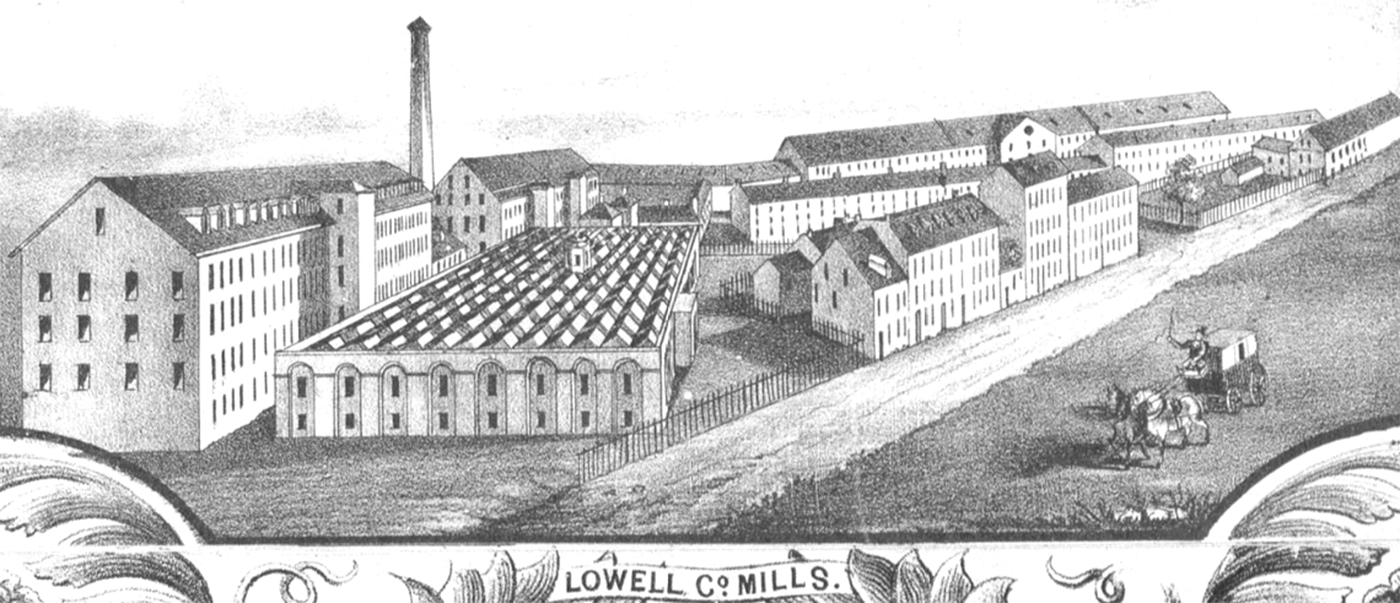
Sidney & Ne�, Detail from Plan of the City of Lowell, Massachusetts, 1850. Wikimedia Commons.
New national and international markets fueled the plantation boom. American cotton exports rose
from 150,000 bales in 1815 to 4,541,000 bales in 1859. The Census Bureau’s 1860 Census of Manu-
factures stated that “the manufacture of cotton constitutes the most striking feature of the industrial
history of the last �fty years.” Enslavers shipped their cotton north to textile manufacturers and to
northern �nancers for overseas shipments. Northern insurance brokers and exporters in the North-
east pro�ted greatly.
18
19
4/11/2021 8. The Market Revolution | THE AMERICAN YAWP
www.americanyawp.com/text/08-the-market-revolution/ 11/31
While the United States ended its legal participation in the global slave trade in 1808, slave traders
moved one million enslaved people from the tobacco-producing Upper South to cotton �elds in the
Lower South between 1790 and 1860. This harrowing trade in human �esh supported middle-
class occupations in the North and South: bankers, doctors, lawyers, insurance brokers, and ship-
ping agents all pro�ted. And of course it facilitated the expansion of northeastern textile mills.
IV. Changes in Labor Organization
While industrialization bypassed most of the American South, southern cotton production never-
theless nurtured industrialization in the Northeast and Midwest. The drive to produce cloth trans-
formed the American system of labor. In the early republic, laborers in manufacturing might typi-
cally have been expected to work at every stage of production. But a new system, piecework, divided
much of production into discrete steps performed by di�erent workers. In this new system, mer-
chants or investors sent or “put out” materials to individuals and families to complete at home.
These independent laborers then turned over the partially �nished goods to the owner to be given to
another laborer to �nish.
As early as the 1790s, however, merchants in New England began experimenting with machines to
replace the putting-out system. To e�ect this transition, merchants and factory owners relied on the
theft of British technological knowledge to build the machines they needed. In 1789, for instance, a
textile mill in Pawtucket, Rhode Island, contracted twenty-one-year-old British immigrant Samuel
Slater to build a yarn-spinning machine and then a carding machine. Slater had apprenticed in an
English mill and succeeded in mimicking the English machinery. The fruits of American industrial
espionage peaked in 1813 when Francis Cabot Lowell and Paul Moody re-created the powered loom
used in the mills of Manchester, England. Lowell had spent two years in Britain observing and tour-
ing mills in England. He committed the design of the powered loom to memory so that, no matter
how many times British customs o�cials searched his luggage, he could smuggle England’s indus-
trial know-how into New England.
Lowell’s contribution to American industrialism was not only technological, it was organizational.
He helped reorganize and centralize the American manufacturing process. A new approach, the
Waltham-Lowell System, created the textile mill that de�ned antebellum New England and Ameri-
20
4/11/2021 8. The Market Revolution | THE AMERICAN YAWP
www.americanyawp.com/text/08-the-market-revolution/ 12/31
can industrialism before the Civil War. The modern American textile mill was fully realized in the
planned mill town of Lowell in 1821, four years after Lowell himself died. Powered by the Merri-
mack River in northern Massachusetts and operated by local farm girls, the mills of Lowell central-
ized the process of textile manufacturing under one roof. The modern American factory was born.
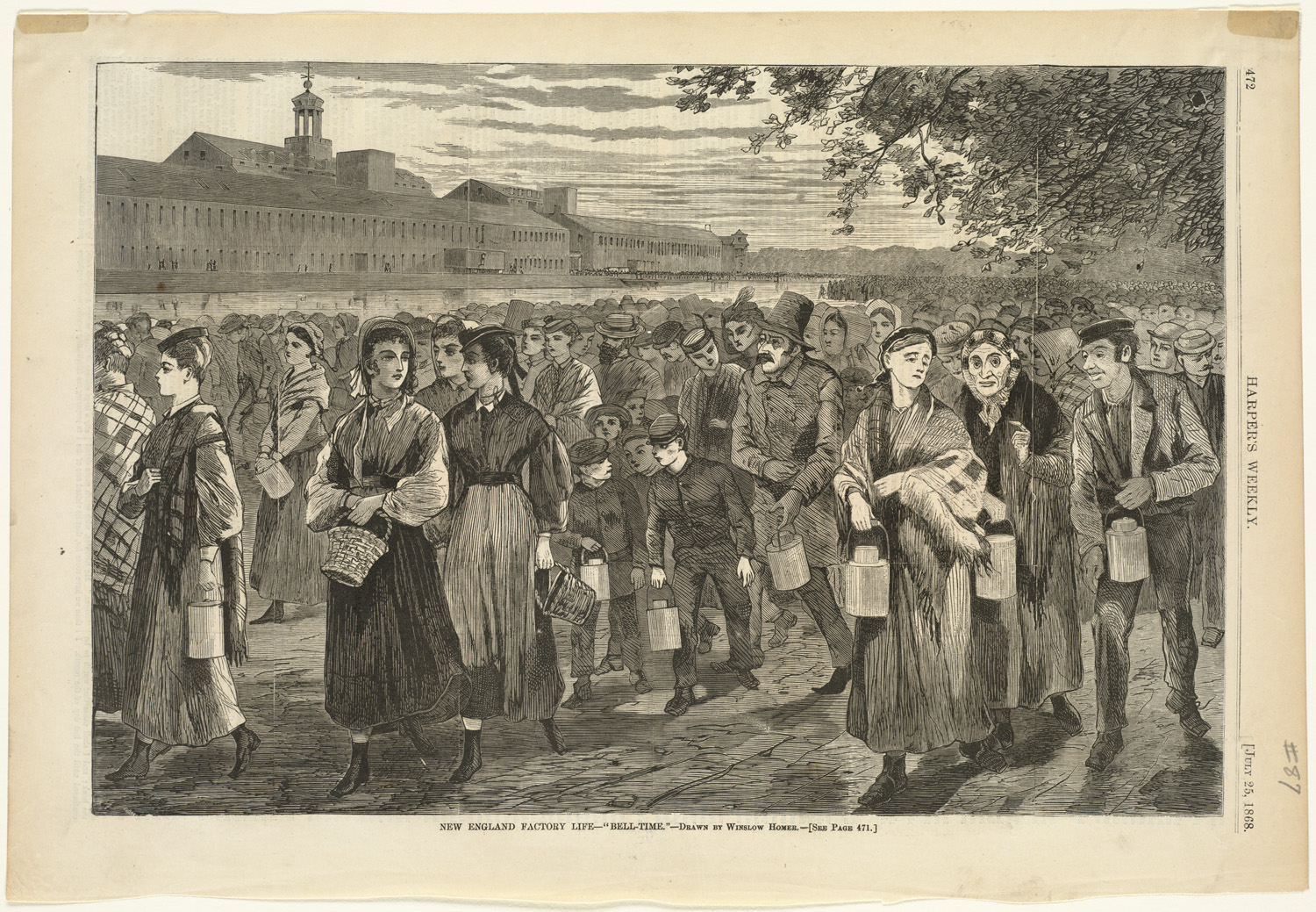
Soon ten thousand workers labored in Lowell alone. Sarah Rice, who worked at the nearby Millbury
factory, found it “a noisy place” that was “more con�ned than I like to be.” Working conditions
were harsh for the many desperate “mill girls” who operated the factories relentlessly from sunup to
sundown. One worker complained that “a large class of females are, and have been, destined to a
state of servitude.” Female workers went on strike. They lobbied for better working hours. But the
lure of wages was too much. As another worker noted, “very many Ladies . . . have given up
millinery, dressmaking & school keeping for work in the mill.” With a large supply of eager work-
ers, Lowell’s vision brought a rush of capital and entrepreneurs into New England. The �rst Ameri-
can manufacturing boom was under way.
Winslow Homer, “Bell-Time,” Harper’s Weekly vol. 12 (July 1868): 472. Wikimedia.
The market revolution shook other industries as well. Craftsmen began to understand that new mar-
kets increased the demand for their products. Some shoemakers, for instance, abandoned the tradi-
21
22
23
4/11/2021 8. The Market Revolution | THE AMERICAN YAWP
www.americanyawp.com/text/08-the-market-revolution/ 13/31
tional method of producing custom-built shoes at their home workshops and instead began produc-
ing larger quantities of shoes in ready-made sizes to be shipped to urban centers. Manufacturers
wanting increased production abandoned the old personal approach of relying on a single live-in ap-
prentice for labor and instead hired unskilled wage laborers who did not have to be trained in all as-
pects of making shoes but could simply be assigned a single repeatable aspect of the task. Factories
slowly replaced shops. The old paternalistic apprentice system, which involved long-term obligations
between apprentice and master, gave way to a more impersonal and more �exible labor system in
which unskilled laborers could be hired and �red as the market dictated. A writer in the New York
Observer in 1826 complained, “The master no longer lives among his apprentices [and] watches over
their moral as well as mechanical improvement.” Masters-turned-employers now not only had
fewer obligations to their workers, they had a lesser attachment. They no longer shared the bonds of
their trade but were subsumed under new class-based relationships: employers and employees, bosses
and workers, capitalists and laborers. On the other hand, workers were freed from the long-term, pa-
ternalistic obligations of apprenticeship or the legal subjugation of indentured servitude. They could
theoretically work when and where they wanted. When men or women made an agreement with an
employer to work for wages, they were “left free to apportion among themselves their respective
shares, untrammeled . . . by unwise laws,” as Reverend Alonzo Potter rosily proclaimed in 1840.
But while the new labor system was celebrated throughout the northern United States as “free la-
bor,” it was simultaneously lamented by a growing powerless class of laborers.
As the northern United States rushed headlong toward commercialization and an early capitalist
economy, many Americans grew uneasy with the growing gap between wealthy businessmen and im-
poverished wage laborers. Elites like Daniel Webster might defend their wealth and privilege by in-
sisting that all workers could achieve “a career of usefulness and enterprise” if they were “industrious
and sober,” but labor activist Seth Luther countered that capitalism created “a cruel system of ex-
traction on the bodies and minds of the producing classes . . . for no other object than to enable the
‘rich’ to ‘take care of themselves’ while the poor must work or starve.”
Americans embarked on their Industrial Revolution with the expectation that all men could start
their careers as humble wage workers but later achieve positions of ownership and stability with hard
work. Wage work had traditionally been looked down on as a state of dependence, suitable only as a
temporary waypoint for young men without resources on their path toward the middle class and the
economic success necessary to support a wife and children ensconced within the domestic sphere.
Children’s magazines—such as Juvenile Miscellany and Parley’s Magazine—glori�ed the prospect of
24
25
26
4/11/2021 8. The Market Revolution | THE AMERICAN YAWP
www.americanyawp.com/text/08-the-market-revolution/ 14/31
moving up the economic ladder. This “free labor ideology” provided many northerners with a keen
sense of superiority over the slave economy of the southern states.
But the commercial economy often failed in its promise of social mobility. Depressions and down-
turns might destroy businesses and reduce owners to wage work. Even in times of prosperity un-
skilled workers might perpetually lack good wages and economic security and therefore had to for-
ever depend on supplemental income from their wives and young children.
Wage workers—a population disproportionately composed of immigrants and poorer Americans—
faced low wages, long hours, and dangerous working conditions. Class con�ict developed. Instead of
the formal inequality of a master-servant contract, employer and employee entered a contract pre-
sumably as equals. But hierarchy was evident: employers had �nancial security and political power;
employees faced uncertainty and powerlessness in the workplace. Dependent on the whims of their
employers, some workers turned to strikes and unions to pool their resources. In 1825 a group of
journeymen in Boston formed a Carpenters’ Union to protest their inability “to maintain a family at
the present time, with the wages which are now usually given.” Working men organized unions to
assert themselves and win both the respect and the resources due to a breadwinner and a citizen.
For the middle-class managers and civic leaders caught between workers and owners, unions en-
�amed a dangerous antagonism between employers and employees. They countered any claims of
inherent class con�ict with the ideology of social mobility. Middle-class owners and managers justi-
�ed their economic privilege as the natural product of superior character traits, including decision
making and hard work. One group of master carpenters denounced their striking journeymen in
1825 with the claim that workers of “industrious and temperate habits, have, in their turn, become
thriving and respectable Masters, and the great body of our Mechanics have been enabled to acquire
property and respectability, with a just weight and in�uence in society.” In an 1856 speech in Kala-
mazoo, Michigan, Abraham Lincoln had to assure his audience that the country’s commercial trans-
formation had not reduced American laborers to slavery. Southerners, he said, “insist that their slaves
are far better o� than Northern freemen. What a mistaken view do these men have of Northern
labourers! They think that men are always to remain labourers here—but there is no such class. The
man who laboured for another last year, this year labours for himself. And next year he will hire oth-
ers to labour for him.” This essential belief undergirded the northern commitment to “free labor”
and won the market revolution much widespread acceptance.
27
28
29
30
4/11/2021 8. The Market Revolution | THE AMERICAN YAWP
www.americanyawp.com/text/08-the-market-revolution/ 15/31
V. Changes in Gender Roles and Family Life
In the �rst half of the nineteenth century, families in the northern United States increasingly partici-
pated in the cash economy created by the market revolution. The �rst stirrings of industrialization
shifted work away from the home. These changes transformed Americans’ notions of what consti-
tuted work and therefore shifted what it meant to be an American woman and an American man.
As Americans encountered more goods in stores and produced fewer at home, the ability to remove
women and children from work determined a family’s class status. This ideal, of course, ignored the
reality of women’s work at home and was possible for only the wealthy. The market revolution there-
fore not only transformed the economy, it changed the nature of the American family. As the market
revolution thrust workers into new systems of production, it rede�ned gender roles. The market in-
tegrated families into a new cash economy. As Americans purchased more goods in stores and pro-
duced fewer at home, the purity of the domestic sphere—the idealized realm of women and children
—increasingly signi�ed a family’s class status.
Women and children worked to supplement the low wages of many male workers. Around age
eleven or twelve, boys could take jobs as o�ce runners or waiters, earning perhaps a dollar a week to
support their parents’ incomes. The ideal of an innocent and protected childhood was a privilege for
middle- and upper-class families, who might look down upon poor families. Joseph Tuckerman, a
Unitarian minister who served poor Bostonians, lamented the lack of discipline and regularity
among poor children: “At one hour they are kept at work to procure fuel, or perform some other ser-
vice; in the next are allowed to go where they will, and to do what they will.” Prevented from at-
tending school, poor children served instead as economic assets for their destitute families.
Meanwhile, the education received by middle-class children provided a foundation for future eco-
nomic privilege. As artisans lost control over their trades, young men had a greater incentive to invest
time in education to �nd skilled positions later in life. Formal schooling was especially important for
young men who desired apprenticeships in retail or commercial work. Enterprising instructors es-
tablished schools to assist “young gentlemen preparing for mercantile and other pursuits, who may
wish for an education superior to that usually obtained in the common schools, but di�erent from a
college education, and better adapted to their particular business,” such as that organized in 1820 by
Warren Colburn of Boston. In response to this need, the Boston School Committee created the
English High School (as opposed to the Latin School) that could “give a child an education that shall
31
32
4/11/2021 8. The Market Revolution | THE AMERICAN YAWP
www.americanyawp.com/text/08-the-market-revolution/ 16/31
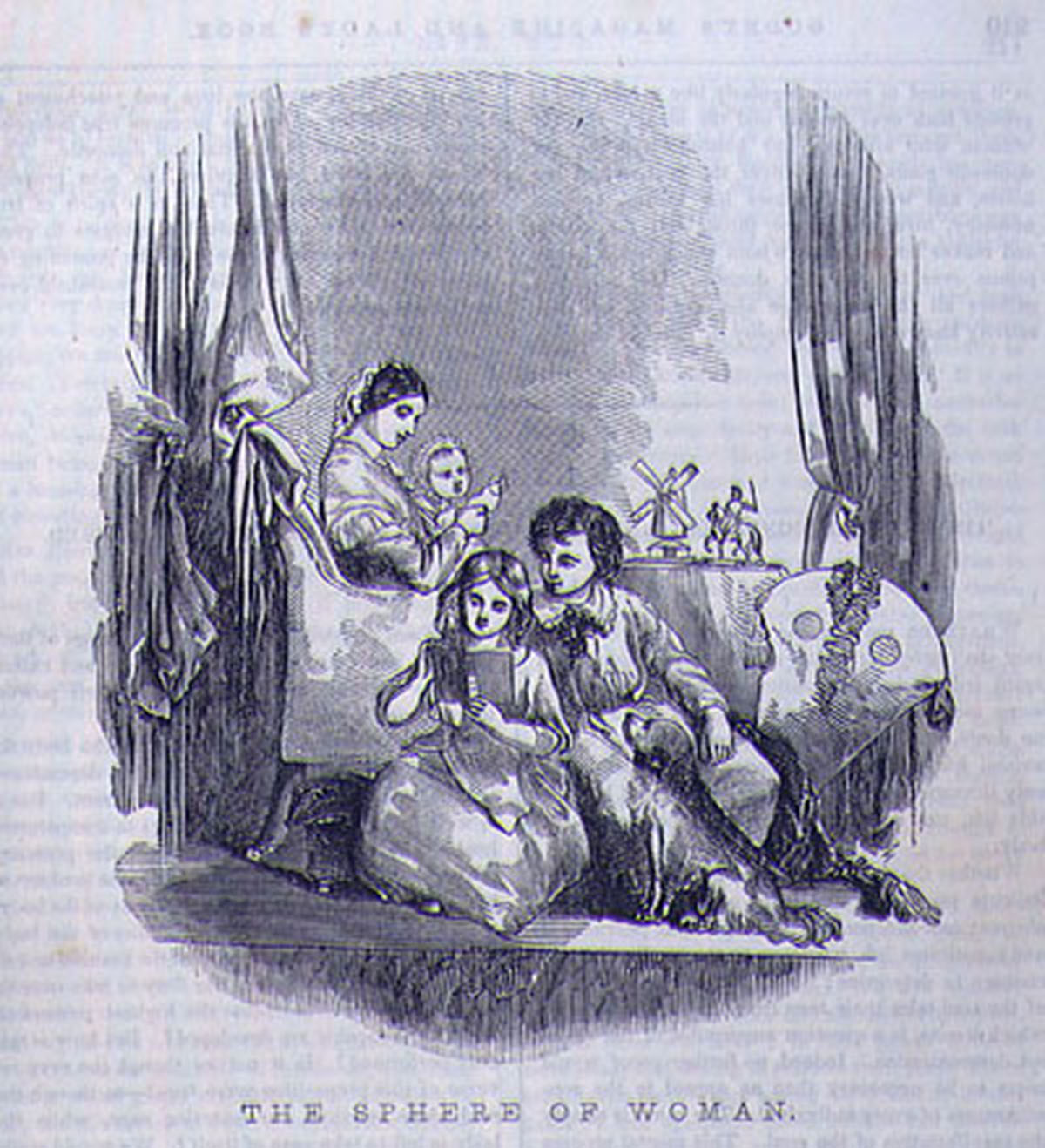
“The Sphere of Woman,” Godey’s Lady’s Book vol. 40 (March 1850): 209. University of Virginia.
�t him for active life, and shall serve as a foundation for eminence in his profession, whether Mercan-
tile or Mechanical” beyond that “which our public schools can now furnish.”
Edu-
catio
n
equip
ped
youn
g
wom
en
with
the
tools
to
live
so-
phis-
ticate
d,
gen-
teel
lives.
After
six-
teen-
year-
old
Eliza-
beth Davis left home in 1816 to attend school, her father explained that the experience would “lay a
foundation for your future character & respectability.” After touring the United States in the
1830s, Alexis de Tocqueville praised the independence granted to the young American woman, who
had “the great scene of the world . . . open to her” and whose education prepared her to exercise both
reason and moral sense. Middling young women also used their education to take positions as
33
34
35
4/11/2021 8. The Market Revolution | THE AMERICAN YAWP
www.americanyawp.com/text/08-the-market-revolution/ 17/31
schoolteachers in the expanding common school system. Bristol Academy in Tauten, Maine, for in-
stance, advertised “instruction . . . in the art of teaching” for female pupils. In 1825, Nancy Deni-
son left Concord Academy with references indicating that she was “quali�ed to teach with success
and pro�t” and “very cheerfully recommend[ed]” for “that very responsible employment.”
Middle-class youths found opportunities for respectable employment through formal education,
but poor youths remained in marginalized positions. Their families’ desperate �nancial state kept
them from enjoying the fruits of education. When pauper children did receive teaching through in-
stitutions such the House of Refuge in New York City, they were often simultaneously indentured
to successful families to serve as �eld hands or domestic laborers. The Society for the Reformation of
Juvenile Delinquents in New York City sent its wards to places like Sylvester Lusk’s farm in En�eld,
Connecticut. Lusk took boys to learn “the trade and mystery of farming” and girls to learn “the
trade and mystery of housewifery.” In exchange for “su�cient Meat, Drink, Apparel, Lodging, and
Washing, �tting for an Apprentice,” and a rudimentary education, the apprentices promised obedi-
ence, morality, and loyalty. Poor children also found work in factories such as Samuel Slater’s tex-
tile mills in southern New England. Slater published a newspaper advertisement for “four or �ve ac-
tive Lads, about 15 Years of Age to serve as Apprentices in the Cotton Factory.”
And so, during the early nineteenth century, opportunities for education and employment often de-
pended on a given family’s class. In colonial America, nearly all children worked within their parent’s
chosen profession, whether it be agricultural or artisanal. During the market revolution, however,
more children were able to postpone employment. Americans aspired to provide a “Romantic
Childhood”—a period in which boys and girls were sheltered within the home and nurtured
through primary schooling. This ideal was available to families that could survive without their
children’s labor. As these children matured, their early experiences often determined whether they
entered respectable, well-paying positions or became dependent workers with little prospects for so-
cial mobility.
Just as children were expected to be sheltered from the adult world of work, American culture ex-
pected men and women to assume distinct gender roles as they prepared for marriage and family life.
An ideology of “separate spheres” set the public realm—the world of economic production and po-
litical life—apart as a male domain, and the world of consumers and domestic life as a female one.
(Even nonworking women labored by shopping for the household, producing food and clothing,
cleaning, educating children, and performing similar activities. But these were considered “domes-
tic” because they did not bring money into the household, although they too were essential to the
36
37
38
39
40
4/11/2021 8. The Market Revolution | THE AMERICAN YAWP
www.americanyawp.com/text/08-the-market-revolution/ 18/31
household’s economic viability.) While reality muddied the ideal, the divide between a private, fe-
male world of home and a public, male world of business de�ned American gender hierarchy.
The idea of separate spheres also displayed a distinct class bias. Middle and upper classes reinforced
their status by shielding “their” women from the harsh realities of wage labor. Women were to be
mothers and educators, not partners in production. But lower-class women continued to contribute
directly to the household economy. The middle- and upper-class ideal was feasible only in house-
holds where women did not need to engage in paid labor. In poorer households, women engaged in
wage labor as factory workers, pieceworkers producing items for market consumption, tavern- and
innkeepers, and domestic servants. While many of the fundamental tasks women performed re-
mained the same—producing clothing, cultivating vegetables, overseeing dairy production, and per-
forming any number of other domestic labors—the key di�erence was whether and when they per-
formed these tasks for cash in a market economy.
Domestic expectations constantly changed and the market revolution transformed many women’s
traditional domestic tasks. Cloth production, for instance, advanced throughout the market revolu-
tion as new mechanized production increased the volume and variety of fabrics available to ordinary
people. This relieved many better-o� women of a traditional labor obligation. As cloth production
became commercialized, women’s home-based cloth production became less important to house-
hold economies. Purchasing cloth and, later, ready-made clothes began to transform women from
producers to consumers. One woman from Maine, Martha Ballard, regularly referenced spinning,
weaving, and knitting in the diary she kept from 1785 to 1812. Martha, her daughters, and her fe-
male neighbors spun and plied linen and woolen yarns and used them to produce a variety of fabrics
to make clothing for her family. The production of cloth and clothing was a year-round, labor-inten-
sive process, but it was for home consumption, not commercial markets.
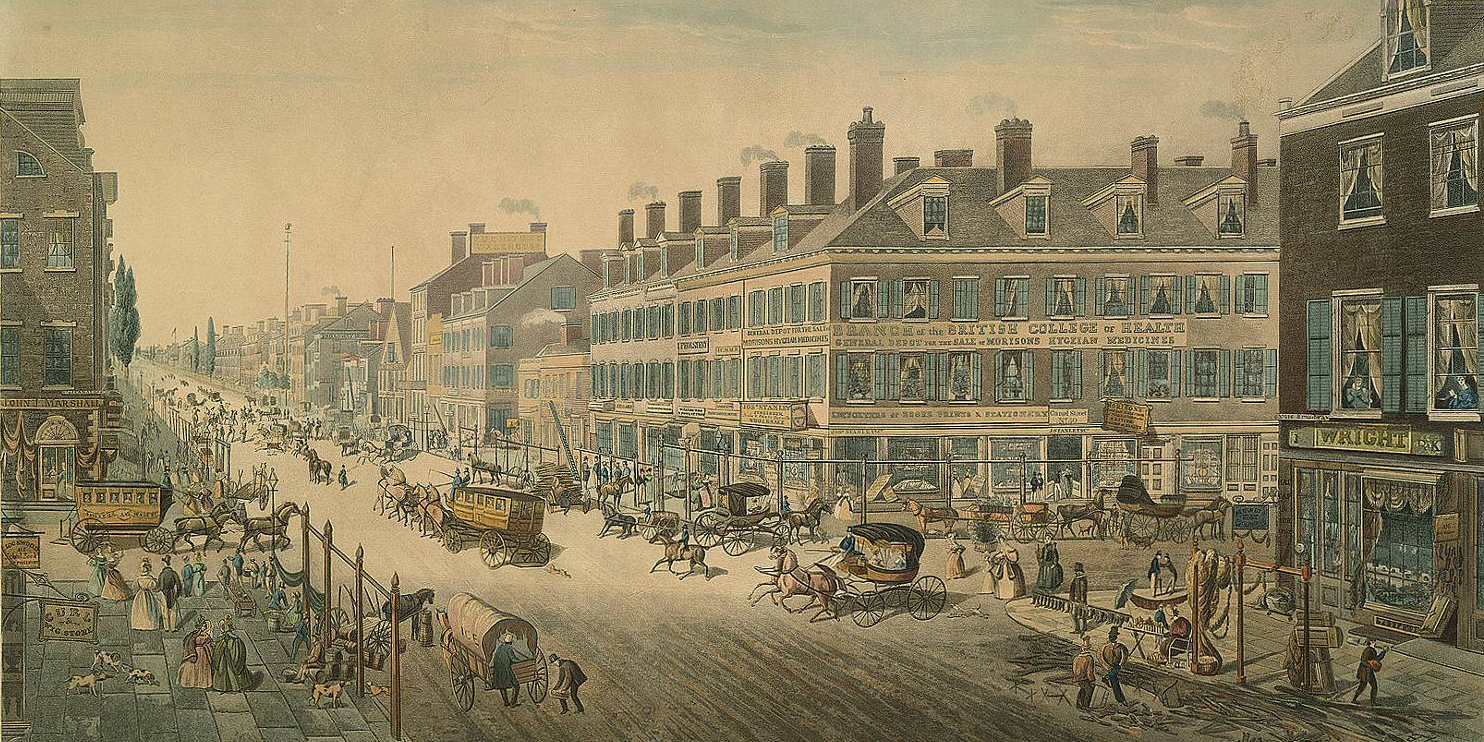
In cities, where women could buy cheap imported cloth to turn into clothing, they became skilled
consumers. They stewarded money earned by their husbands by comparing values and haggling over
prices. In one typical experience, Mrs. Peter Simon, a captain’s wife, inspected twenty-six yards of
Holland cloth to ensure that it was worth the £130 price. Even wealthy women shopped for high-
value goods. While servants or enslaved people routinely made low-value purchases, the mistress of
the household trusted her discriminating eye alone for expensive or speci�c purchases.
Women might also parlay their skills into businesses. In addition to working as seamstresses,
milliners, or laundresses, women might undertake paid work for neighbors or acquaintances or com-
41
42
4/11/2021 8. The Market Revolution | THE AMERICAN YAWP
www.americanyawp.com/text/08-the-market-revolution/ 19/31
bine clothing production with management of a boardinghouse. Even enslaved laborers with partic-
ular skill at producing clothing could be hired out for a higher price or might even negotiate to work
part-time for themselves. Most enslaved people, however, continued to produce domestic items, in-
cluding simpler cloths and clothing, for home consumption.
Thomas Horner, “Broadway, New York,” 1836. Smithsonian American Art Museum.
Similar domestic expectations played out in the slave states. Enslaved women labored in the �elds.
Whites argued that African American women were less delicate and womanly than white women
and therefore perfectly suited for agricultural labor. The southern ideal meanwhile established that
white plantation mistresses were shielded from manual labor because of their very whiteness.
Throughout the slave states, however, aside from the minority of plantations with dozens of slates,
most white women by necessity continued to assist with planting, harvesting, and processing agricul-
tural projects despite the cultural stigma attached to it. White southerners continued to produce
large portions of their food and clothing at home. Even when they were market-oriented producers
of cash crops, white southerners still insisted that their adherence to plantation slavery and racial hi-
erarchy made them morally superior to greedy northerners and their callous, cutthroat commerce.
Southerners and northerners increasingly saw their ways of life as incompatible.
While the market revolution remade many women’s economic roles, their legal status remained es-
sentially unchanged. Upon marriage, women were rendered legally dead by the notion of coverture,
the custom that counted married couples as a single unit represented by the husband. Without spe-
cial precautions or interventions, women could not earn their own money, own their own property,
4/11/2021 8. The Market Revolution | THE AMERICAN YAWP
www.americanyawp.com/text/08-the-market-revolution/ 20/31
sue, or be sued. Any money earned or spent belonged by law to their husbands. Women shopped on
their husbands’ credit and at any time husbands could terminate their wives’ access to their credit.
Although a handful of states made divorce available—divorce had before only been legal in Congre-
gationalist states such as Massachusetts and Connecticut, where marriage was strictly a civil contract
rather than a religious one—it remained extremely expensive, di�cult, and rare. Marriage was typi-
cally a permanently binding legal contract.
Ideas of marriage, if not the legal realities, began to change. This period marked the beginning of the
shift from “institutional” to “companionate” marriage. Institutional marriages were primarily la-
bor arrangements that maximized the couple’s and their children’s chances of surviving and thriving.
Men and women assessed each other’s skills as they related to household production, although looks
and personality certainly entered into the equation. But in the late eighteenth century, under the in-
�uence of Enlightenment thought, young people began to privilege character and compatibility in
their potential partners. Money was still essential: marriages prompted the largest redistributions of
property prior to the settling of estates at death. But the means of this redistribution was changing.
Especially in the North, land became a less important foundation for matchmaking as wealthy
young men became not only farmers and merchants but bankers, clerks, or professionals. The in-
creased emphasis on a�ection and attraction that young people embraced was facilitated by an in-
creasingly complex economy that o�ered new ways to store, move, and create wealth, which liberal-
ized the criteria by which families evaluated potential in-laws.
To be considered a success in family life, a middle-class American man typically aspired to own a
comfortable home and to marry a woman of strong morals and religious conviction who would take
responsibility for raising virtuous, well-behaved children. The duties of the middle-class husband
and wife would be clearly delineated into separate spheres. The husband alone was responsible for
creating wealth and engaging in the commerce and politics—the public sphere. The wife was respon-
sible for the private—keeping a good home, being careful with household expenses, and raising chil-
dren, inculcating them with the middle-class virtues that would ensure their future success. But for
poor families, sacri�cing the potential economic contributions of wives and children was an
impossibility.
VI. The Rise of Industrial Labor in Antebellum America
43
4/11/2021 8. The Market Revolution | THE AMERICAN YAWP
www.americanyawp.com/text/08-the-market-revolution/ 21/31
More than �ve million immigrants arrived in the United States between 1820 and 1860. Irish, Ger-
man, and Jewish immigrants sought new lives and economic opportunities. By the Civil War, nearly
one out of every eight Americans had been born outside the United States. A series of push and pull
factors drew immigrants to the United States.
In England, an economic slump prompted Parliament to modernize British agriculture by revoking
common land rights for Irish farmers. These policies generally targeted Catholics in the southern
counties of Ireland and motivated many to seek greater opportunity elsewhere. The booming Amer-
ican economy pulled Irish immigrants toward ports along the eastern United States. Between 1820
and 1840, over 250,000 Irish immigrants arrived in the United States. Without the capital and
skills required to purchase and operate farms, Irish immigrants settled primarily in northeastern
cities and towns and performed unskilled work. Irish men usually emigrated alone and, when possi-
ble, practiced what became known as chain migration. Chain migration allowed Irish men to send
portions of their wages home, which would then be used either to support their families in Ireland
or to purchase tickets for relatives to come to the United States. Irish immigration followed this pat-
tern into the 1840s and 1850s, when the infamous Irish Famine sparked a massive exodus out of Ire-
land. Between 1840 and 1860, 1.7 million Irish �ed starvation and the oppressive English policies
that accompanied it. As they entered manual, unskilled labor positions in urban America’s dirtiest
and most dangerous occupations, Irish workers in northern cities were compared to African Ameri-
cans, and anti-immigrant newspapers portrayed them with apelike features. Despite hostility, Irish
immigrants retained their social, cultural, and religious beliefs and left an indelible mark on Ameri-
can culture.
While the Irish settled mostly in coastal cities, most German immigrants used American ports and
cities as temporary waypoints before settling in the rural countryside. Over 1.5 million immigrants
from the various German states arrived in the United States during the antebellum era. Although
some southern Germans �ed declining agricultural conditions and repercussions of the failed revolu-
tions of 1848, many Germans simply sought steadier economic opportunity. German immigrants
tended to travel as families and carried with them skills and capital that enabled them to enter mid-
dle-class trades. Germans migrated to the Old Northwest to farm in rural areas and practiced trades
in growing communities such as St. Louis, Cincinnati, and Milwaukee, three cities that formed what
came to be called the German Triangle.
Catholic and Jewish Germans transformed regions of the republic. Although records are sparse,
New York’s Jewish population rose from approximately �ve hundred in 1825 to forty thousand in
44
45
4/11/2021 8. The Market Revolution | THE AMERICAN YAWP
www.americanyawp.com/text/08-the-market-revolution/ 22/31
1860. Similar gains were seen in other American cities. Jewish immigrants hailing from southwest-
ern Germany and parts of occupied Poland moved to the United States through chain migration and
as family units. Unlike other Germans, Jewish immigrants rarely settled in rural areas. Once estab-
lished, Jewish immigrants found work in retail, commerce, and artisanal occupations such as tailor-
ing. They quickly found their footing and established themselves as an intrinsic part of the American
market economy. Just as Irish immigrants shaped the urban landscape through the construction of
churches and Catholic schools, Jewish immigrants erected synagogues and made their mark on
American culture.
The sudden in�ux of immigration triggered a backlash among many native-born Anglo-Protestant
Americans. This nativist movement, especially fearful of the growing Catholic presence, sought to
limit European immigration and prevent Catholics from establishing churches and other institu-
tions. Popular in northern cities such as Boston, Chicago, Philadelphia, and other cities with large
Catholic populations, nativism even spawned its own political party in the 1850s. The American
Party, more commonly known as the Know-Nothing Party, found success in local and state elections
throughout the North. The party even nominated candidates for president in 1852 and 1856. The
rapid rise of the Know-Nothings, re�ecting widespread anti-Catholic and anti-immigrant sentiment,
slowed European immigration. Immigration declined precipitously after 1855 as nativism, the
Crimean War, and improving economic conditions in Europe discouraged potential migrants from
traveling to the United States. Only after the American Civil War would immigration levels match
and eventually surpass the levels seen in the 1840s and 1850s.
In industrial northern cities, Irish immigrants swelled the ranks of the working class and quickly en-
countered the politics of industrial labor. Many workers formed trade unions during the early re-
public. Organizations such as Philadelphia’s Federal Society of Journeymen Cordwainers or the Car-
penters’ Union of Boston operated within speci�c industries in major American cities. These unions
worked to protect the economic power of their members by creating closed shops—workplaces
wherein employers could only hire union members—and striking to improve working conditions.
Political leaders denounced these organizations as unlawful combinations and conspiracies to pro-
mote the narrow self-interest of workers above the rights of property holders and the interests of the
common good. Unions did not become legally acceptable until 1842 when the Massachusetts
Supreme Judicial Court ruled in favor of a union organized among Boston bootmakers, arguing that
the workers were capable of acting “in such a manner as best to subserve their own interests.” Even
after the case, unions remained in a precarious legal position.
46
47
4/11/2021 8. The Market Revolution | THE AMERICAN YAWP
www.americanyawp.com/text/08-the-market-revolution/ 23/31
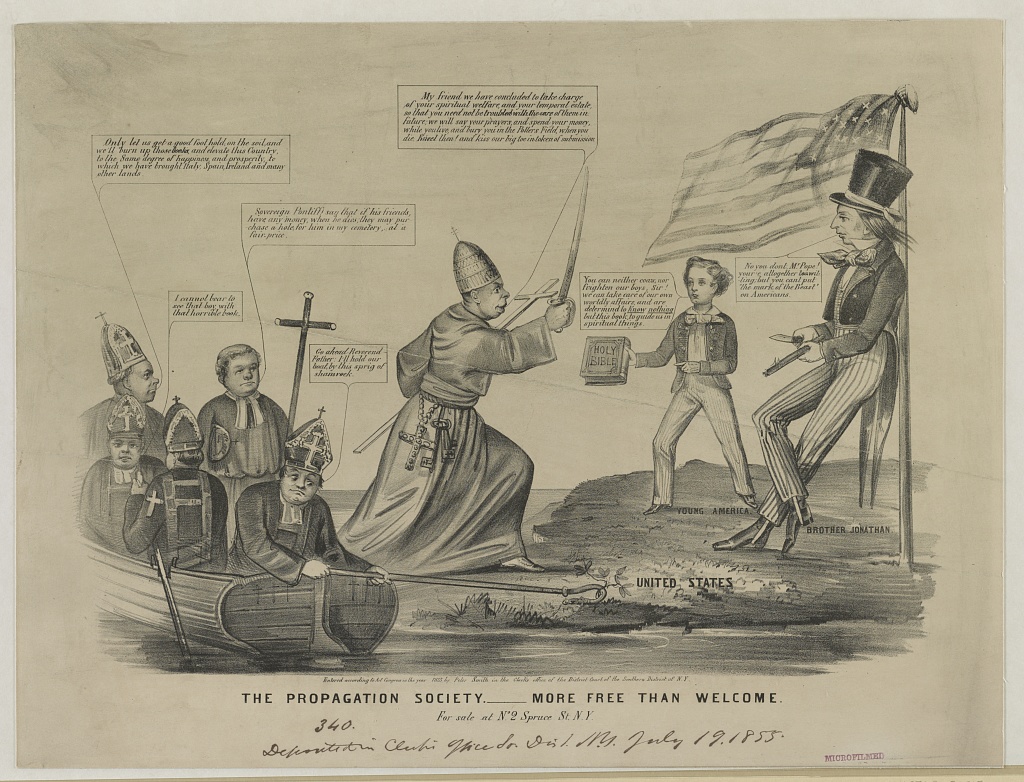
N. Currier, “The Propagation Society, More Free than Welcome,” 1855. Library of Congress.
In the 1840s, labor activists organized to limit working hours and protect children in factories. The
New England Association of Farmers, Mechanics and Other Workingmen (NEA) mobilized to es-
tablish a ten-hour workday across industries. They argued that the ten-hour day would improve the
immediate conditions of laborers by allowing “time and opportunities for intellectual and moral im-
provement.” After a citywide strike in Boston in 1835, the Ten-Hour Movement quickly spread to
other major cities such as Philadelphia. The campaign for leisure time was part of the male working-
class e�ort to expose the hollowness of the paternalistic claims of employers and their rhetoric of
moral superiority.
Women, a dominant labor source for factories since the early 1800s, launched some of the earliest
strikes for better conditions. Textile operatives in Lowell, Massachusetts, “turned out” (walked o�)
their jobs in 1834 and 1836. During the Ten-Hour Movement of the 1840s, female operatives pro-
vided crucial support. Under the leadership of Sarah Bagley, the Lowell Female Labor Reform Asso-
ciation organized petition drives that drew thousands of signatures from “mill girls.” Like male ac-
48
49
4/11/2021 8. The Market Revolution | THE AMERICAN YAWP
www.americanyawp.com/text/08-the-market-revolution/ 24/31
tivists, Bagley and her associates used the desire for mental improvement as a central argument for
reform. An 1847 editorial in the Voice of Industry, a labor newspaper published by Bagley, asked,
“who, after thirteen hours of steady application to monotonous work, can sit down and apply her
mind to deep and long continued thought?” Despite the widespread support for a ten-hour day,
the movement achieved only partial success. President Martin Van Buren established a ten-hour-day
policy for laborers on federal public works projects. New Hampshire passed a statewide law in 1847,
and Pennsylvania followed a year later. Both states, however, allowed workers to voluntarily consent
to work more than ten hours per day.
In 1842, child labor became a dominant issue in the American labor movement. The protection of
child laborers gained more middle-class support than the protection of adult workers. A petition
from parents in Fall River, a southern Massachusetts mill town that employed a high portion of
child workers, asked the legislature for a law “prohibiting the employment of children in manufac-
turing establishments at an age and for a number of hours which must be permanently injurious to
their health and inconsistent with the education which is essential to their welfare.” Massachusetts
quickly passed a law prohibiting children under age twelve from working more than ten hours a day.
By the midnineteenth century, every state in New England had followed Massachusetts’s lead. Be-
tween the 1840s and 1860s, these statutes slowly extended the age of protection of labor and the as-
surance of schooling. Throughout the region, public o�cials agreed that young children (between
ages nine and twelve) should be prevented from working in dangerous occupations, and older chil-
dren (between ages twelve and �fteen) should balance their labor with education and time for
leisure.
Male workers sought to improve their income and working conditions to create a household that
kept women and children protected within the domestic sphere. But labor gains were limited, and
the movement remained moderate. Despite its challenge to industrial working conditions, labor ac-
tivism in antebellum America remained largely wedded to the free labor ideal. The labor movement
later supported the northern free soil movement, which challenged the spread of slavery in the
1840s, simultaneously promoting the superiority of the northern system of commerce over the
southern institution of slavery while trying, much less successfully, to reform capitalism.
VII. Conclusion
50
51
52
4/11/2021 8. The Market Revolution | THE AMERICAN YAWP
www.americanyawp.com/text/08-the-market-revolution/ 25/31
During the early nineteenth century, southern agriculture produced by enslaved labor fueled north-
ern industry produced by wage workers and managed by the new middle class. New transportation,
new machinery, and new organizations of labor integrated the previously isolated pockets of the
colonial economy into a national industrial operation. Industrialization and the cash economy tied
diverse regions together at the same time that ideology drove Americans apart. By celebrating the
freedom of contract that distinguished the wage worker from the indentured servant of previous
generations or the enslaved laborer in the southern cotton �eld, political leaders claimed the Ameri-
can Revolution’s legacy for the North. But the rise of industrial child labor, the demands of workers
to unionize, the economic vulnerability of women, and the in�ux of non-Anglo immigrants left
many Americans questioning the meaning of liberty after the market revolution.
VIII. Primary Sources
1. James Madison asks Congress to support internal improvements, 1815
After the War of 1812, Americans looked to strengthen their nation through government
spending on infrastructure, or what were then called internal improvements. In his seventh an-
nual address to congress, Madison called for public investment to create national roads, canals,
and even a national seminary. He also called for a tari�, or tax on certain imports, designed to
make foreign goods more expensive, giving American producers an advantage in domestic
markets.
2. A traveler describes life along the Erie Canal, 1829
Basil Hall, a British visitor traveled along the Erie Canal and took careful notes on what he
found. In this excerpt, he described life in Rochester, New York. Rochester, and other small
towns in upstate New York, grew rapidly as a result of the Erie Canal.
3. Blacksmith apprentice contract, 1836
The factories and production of the Market Revolution eroded the wealth and power of skilled
small business owners called artisans. This indenture contract illustrated the former way of do-
4/11/2021 8. The Market Revolution | THE AMERICAN YAWP
www.americanyawp.com/text/08-the-market-revolution/ 26/31
ing things, where a young person would agree to serve for a number of years as an apprentice to
a skilled artisan before venturing out on his own.
4. Maria Stewart bemoans the consequences of racism, 1832
Maria Stewart electri�ed audiences in Boston with a number of powerful speeches. Her most
common theme was the evil of slavery. However, here she attacks the soul-crushing conse-
quences of racism in American capitalism, claiming that the lack of social and economic equal-
ity doomed Black Americans to a life of su�ering and spiritual death.
5. Rebecca Burlend recalls her emigration from England to Illinois, 1848
Rebecca Burlend, her husband, and children emigrated to Illinois from England in 1831. These
re�ections describe her reaction to landing in New Orleans, sailing up the Mississippi to St.
Louis, and �nally arriving at her new home in Illinois. This was her �rst experience encounter-
ing American slavery, the American landscape, and the rugged living conditions of her new
home.
6. Harriet H. Robinson remembers a mill workers’ strike, 1836
The social upheavals of the Market Revolution created new tensions between rich and poor,
particularly between the new class of workers and the new class of managers. Lowell, Massachu-
setts was the location of the �rst American factory. In this document, a woman reminisces about
a strike that she participated in at a Lowell textile mill.
7. Alexis de Toqueville, “How Americans Understand the Equality of the Sexes,” 1840
The French political thinker Alexis de Toqueville travelled extensively through the United States
in gathering research for his book Democracy In America. In this excerpt, he described the belief
that American men and women lived in “separate spheres:” men in public, women in the home.
This expectation justi�ed the denial of rights to women. All women were denied political rights
in nineteenth century America, but only a small number of wealthy families could a�ord to re-
move women from economic production, like de Toqueville claimed.
8. Abolitionist sheet music cover page, 1844
4/11/2021 8. The Market Revolution | THE AMERICAN YAWP
www.americanyawp.com/text/08-the-market-revolution/ 27/31
The “transportation revolution” shaped economic change in the early 1800s, but the massive
construction of railroads also had a profound impact on American politics and culture. This
sheet music title page shows how abolitionists used railroad imagery to advocate for the immedi-
ate emancipation of enslaved people and to promote their political platform before the 1844
presidential election.
9. Anti-Catholic cartoon, 1855
Irish immigration transformed American cities. Yet many Americans greeted the new arrivals
with suspicion or hostility. Nathanial Currier’s anti-Catholic cartoon re�ected the popular
American perception that Irish Catholic immigrants posed a threat to the United States.
IX. Reference Material
This chapter was edited by Jane Fiegen Green, with content contributions by Kelly Arehart, Myles
Beaurpre, Kristin Condotta, Jane Fiegen Green, Nathan Jeremie-Brink, Lindsay Keiter, Brenden
Kennedy, William Kerrigan, Christopher Sawula, David Schley, and Evgenia Shayder Shoop.
Recommended citation: Kelly Arehart et al., “Market Revolution,” Jane Fiegen Green, ed., in The
American Yawp, eds. Joseph Locke and Ben Wright (Stanford, CA: Stanford University Press, 2018).
Recommended Reading
Balleisen, Edward J. Navigating Failure: Bankruptcy and Commercial Society in Antebel-
lum America. Chapel Hill: University of North Carolina Press, 2001.
Blewett, Mary H. Men, Women, and Work: Class, Gender, and Protest in the New Eng-
land Shoe Industry, 1780–1910. Urbana: University of Illinois Press, 1988.
Boydston, Jeanne. Home and Work: Housework, Wages, and the Ideology of Labor in the
Early Republic. New York: Oxford University Press, 1990.
4/11/2021 8. The Market Revolution | THE AMERICAN YAWP
www.americanyawp.com/text/08-the-market-revolution/ 28/31
Dublin, Thomas. Transforming Women’s Work: New England Lives in the Industrial
Revolution. Ithaca, NY: Cornell University Press, 1994.
Faler, Paul G. Mechanics and Manufacturers in the Early Industrial Revolution: Lynn,
Massachusetts, 1760–1860. Albany: SUNY Press, 1981.
Foner, Eric. Free Soil, Free Labor, Free Men: The Ideology of the Republican Party Before
the Civil War. New York: Oxford University Press, 1970.
Greenberg, Joshua R. Advocating the Man: Masculinity, Organized Labor, and the
Household in New York, 1800–1840. New York: Columbia University Press, 2008.
Halttunen, Karen. Con�dence Men and Painted Women: A Study of Middle-Class Cul-
ture in America, 1830–1870. Yale University Press, 1982.
Hartigan-O’Connor, Ellen. The Ties That Buy: Women and Commerce in Revolutionary
America. Philadelphia: University of Pennsylvania Press, 2009.
Howe, Daniel Walker. What Hath God Wrought: The Transformation of America, 1815–
1848. New York: Oxford University Press, 2007.
Innes, Stephen, ed. Work and Labor in Early America. Chapel Hill: University of North
Carolina Press, 1988.
Jabour, Anya. Marriage in the Early Republic: Elizabeth and William Wirt and the Com-
panionate Ideal. Baltimore: Johns Hopkins University Press, 1998.
Larson, John Lauritz. The Market Revolution in America: Liberty, Ambition, and the
Eclipse of the Common Good. New York: Cambridge University Press, 2010.
Levy, Jonathan. Freaks of Fortune: The Emerging World of Capitalism and Risk in Amer-
ica. Cambridge, MA: Harvard University Press, 2012.
Luskey, Brian P. On the Make: Clerks and the Quest for Capital in Nineteenth-Century
America. New York: New York University Press, 2010.
Matson, Cathy, and Wendy A. Woloson. Risky Business: Winning and Losing in the Early
American Economy, 1780–1850. Philadelphia: Library Company of Philadelphia, 2003.
McNeur, Catherine. Taming Manhattan: Environmental Battles in the Antebellum City.
Cambridge, MA: Harvard University Press, 2014.
Melish, Joanne Pope. Disowning Slavery: Gradual Emancipation and “Race” in New Eng-
land, 1780–1860. Ithaca, NY: Cornell University Press, 1998.
Mihm, Stephen. A Nation of Counterfeiters: Capitalists, Con Men, and the Making of
the United States. Cambridge, MA: Harvard University Press, 2009.
4/11/2021 8. The Market Revolution | THE AMERICAN YAWP
www.americanyawp.com/text/08-the-market-revolution/ 29/31
Murphy, Teresa Anne. Ten Hours’ Labor: Religion, Reform, and Gender in Early New
England. Ithaca, NY: Cornell University Press, 1992.
Rice, Stephen P. Minding the Machine: Languages of Class in Early Industrial America.
Berkeley: University of California Press, 2004.
Rothenberg, Winifred Barr. From Market-Places to a Market Economy: The Transforma-
tion of Rural Massachusetts, 1750–1850. Chicago: University of Chicago Press, 1992.
Ryan, Mary P. Cradle of the Middle Class: The Family in Oneida County, New York,
1790–1865. New York: Cambridge University Press, 1981.
Sellers, Charles Grier. The Market Revolution: Jacksonian America, 1815–1846. New
York: Oxford University Press, 1991.
Tucker, Barbara M. Samuel Slater and the Origins of the American Textile Industry,
1790–1860. Ithaca, NY: Cornell University Press, 1984.
Notes
1. Niles’ Weekly Register (December 2, 1815), 238. [ ]
2. Douglass C. North, Economic Growth in the United States, 1790–1860 (Englewood Cli�s, NJ: Prentice-Hall,
1961), 25. [ ]
3. James Madison, Annual Message to Congress, December 5, 1815. [ ]
4. William L. Garrison and David M. Levinson, The Transportation Experience: Policy, Planning, and Deployment
(New York: Oxford University Press, 2014), 51. [ ]
5. Warren E. Weber, “Early State Banks in the United States: How Many Were There and When Did They Exist?”
Federal Reserve Bank of Minneapolis, Quarterly Review 30, no. 1 (September 2006): 28–40. [ ]
6. John Robert Godley, Letters from America (London: Murray, 1844), 267. [ ]
7. Margaret Van Horn Dwight, A Journey to Ohio in 1810, ed. Max Farrand (New Haven, CT: Yale University
Press, 1912), 13. [ ]
8. Ibid., 37. [ ]
9. Frances Trollope, Domestic Manners of the Americans, Vol. 1 (London: Whittaker, Treacher, 1832), 274. [ ]
10. Cathy Matson and Wendy A. Woloson, Risky Business: Winning and Losing in the Early American Economy,
1780–1850 (Philadelphia: Library Company of Philadelphia: 2003), 29. [ ]
11. Leonard P. Curry, The Corporate City: The American City as a Political Entity, 1800–1850 (Westport, CT:
Greenwood, 1997), 46. [ ]
12. Je�erson to George Logan, November 12, 1816, in Works of Thomas Je�erson, ed. Paul Leicester Ford, Federal
Edition, Vol. 12 (New York: 1904), 12–43 [ ]
13. Quoted in Michael Zakim and Gary John Kornblith, eds., Capitalism Takes Command: The Social Transforma-
tion of Nineteenth-Century America (Chicago: University of Chicago Press, 2012), 158. [ ]
4/11/2021 8. The Market Revolution | THE AMERICAN YAWP
www.americanyawp.com/text/08-the-market-revolution/ 30/31
14. Philip Scranton, Proprietary Capitalism: The Textile Manufacture at Philadelphia, 1800–1885 (New York: Cam-
bridge University Press, 1983), 12. [ ]
15. Robert J. Cottrol, ed., From African to Yankee: Narratives of Slavery and Freedom in Antebellum New England
(Armonk, NY: Sharpe, 1998), 62. [ ]
16. The 1830 census enumerates 3,568 enslaved people in the northern states (Connecticut, Illinois, Indiana, Massa-
chusetts, Michigan, New Hampshire, New Jersey, New York, Ohio, Pennsylvania, Rhode Island, and Vermont).
1830 U.S. Census data taken from Minnesota Population Center, National Historical Geographic Information
System: Version 2.0 (Minneapolis: University of Minnesota, 2011), http://www.nhgis.org; David Menschel,
“Abolition Without Deliverance: The Law of Connecticut Slavery 1784–1848,” Yale Law Journal 111, no. 1 (Oc-
tober 2001): 191; James J. Gigantino II, The Ragged Road to Abolition: Slavery and Freedom in New Jersey
1775–1865 (Philadelphia: University of Pennsylvania Press, 2015), 248. [ ]
17. Minnesota Population Center. National Historical Geographic Information System: Version 2.0. [ ]
18. Louisiana Courier, February 12, 1840. [ ]
19. U.S. Census O�ce 8th Census 1860 and James Madison Edmunds, Manufactures of the United States in 1860:
Compiled from the Original Returns of the Eighth Census, Under the Direction of the Secretary of the Interior
(Washington, DC: U.S. Government Printing O�ce, 1865). [ ]
20. Ira Berlin, Generations of Captivity: A History of African-American Slaves (Cambridge, MA: Belknap Press,
2003), 168–169. [ ]
21. Sarah “Sally” Rice to her father, February 23, 1845, published in The New England Mill Village, 1790–1860
(Cambridge, MA: MIT Press, 1982), 390. [ ]
22. Factory Tracts: Factory Life as It Is, no. 1 (Lowell, MA: Female Labor Reform Association 1845), 4]. [ ]
23. Malenda M. Edwards to Sabrina Bennett, April 4, 1839, quoted in Thomas Dublin, ed., Farm to Factory
Women’s Letters, 1830–1860 (New York: Columbia University Press, 1993), 74. [ ]
24. “Apprentices No. 2,” New York Observer, October 14, 1826. [ ]
25. Reverend Alonzo Potter, Political Economy: Its Objects, Uses, and Principles (New York: Potter, 1840), 92. [ ]
26. Daniel Webster, “Lecture Before the Society for the Di�usion of Useful Knowledge,” in The Writings and
Speeches of Daniel Webster: Writings and Speeches Hitherto Uncollected, vol. 1. Addresses on Various
Occasions, ed. Edward Everett (Boston: Little, Brown, 1903); Carl Siracusa, A Mechanical People: Perceptions of
the Industrial Order in Massachusetts, 1815–1880 (Middletown, CT: Wesleyan University Press, 1979), 157. [
]
27. Eric Foner, Free Soil, Free Labor, Free Men : The Ideology of the Republican Party Before the Civil War (New
York: Oxford University Press, 1970). [ ]
28. “Notice to House Carpenters in the Country,” Columbian Centinel, April 23, 1825. [ ]
29. John R. Commons, ed., A Documentary History of American Industrial Society (New York: Russell and Rus-
sell, 1958), Vol. 6: 79. [ ]
30. Abraham Lincoln, Speech at Kalamazoo, Michigan, Aug. 27, 1856, in Collected Works of Abraham Lincoln,
Vol. 2 (New Brunswick, NJ: Rutgers University Press, 1953), 364. [ ]
31. Joseph Tuckerman, Mr. Tuckerman’s Eight Semiannual Report in His Service as a Minister at Large in Boston
(Boston: Gray and Bowen, 1831), 21c. [ ]
4/11/2021 8. The Market Revolution | THE AMERICAN YAWP
www.americanyawp.com/text/08-the-market-revolution/ 31/31
32. Warren Colburn, “Advertisement for Colburn’s school for young gentlemen preparing for mercantile and other
pursuits, 19 Sep 1820,” Massachusetts Historical Society. [ ]
33. Proceedings of the School Committee, of the Town of Boston, respecting an English Classical School (Boston:
The Committee, 1820). [ ]
34. William Davis to Elizabeth Davis, March 21, 1816; June 23, 1816; November 17, 1816; Davis Family Papers,
Massachusetts Historical Society. [ ]
35. Alexis de Tocqueville, Democracy in America, Vol. II., ed. Phillips Bradley (New York: Knopf, 1945), 196. [ ]
36. A Catalogue of the O�cers, Teachers, and Pupils in Bristol Academy (Tauton, MA: Bradford and Amsbury,
1837). [ ]
37. Nancy Denison recommendation, May 1825, Titus Orcott Brown Papers, Maine Historical Society. [ ]
38. Indentures and Other Documents Binding Minor Wards of the Society for the Reformation of Juvenile Delin-
quents of the City of New York as apprentices to Sylvester Lusk of En�eld, 1828–1838, Sylvester Lusk Papers,
Connecticut Historical Society. [ ]
39. Advertisement in Providence Gazette, October 1794. [ ]
40. Steven Mintz, Huck’s Raft: A History of American Childhood (Cambridge, MA: Belknap Press, 2004). [ ]
41. Laurel Thatcher Ulrich, A Midwife’s Tale: The Life of Martha Ballard, Based on Her Diary, 1785–1812 (New
York: Knopf, 1990). [ ]
42. Ellen Hartigan-O’Connor, The Ties That Buy: Women and Commerce in Revolutionary America (Philadel-
phia: University of Pennsylvania Press, 2009), 138. [ ]
43. Anya Jabour, Marriage in the Early Republic: Elizabeth and William Wirt and the Companionate Ideal (Balti-
more: Johns Hopkins University Press, 1998). [ ]
44. Bill Ong Hing, De�ning America Through Immigration Policy (Philadelphia: Temple University Press, 2004),
278–284. [ ]
45. John Powell, Encyclopedia of North American Immigration (New York: Facts on File, 2005), 154. [ ]
46. H. B. Grinstein, The Rise of the Jewish Community in New York, 1654–1860 (Philadelphia: Jewish Publication
Society, 1945), 469. [ ]
47. Commonwealth v. Hunt, 45 Mass. 111 (1842). [ ]
48. New England Artisan and Laboring Man’s Repository (Pawtucket, Providence, and Boston), March 8, 1832. [
]
49. Teresa Anne Murphy, Ten Hours’ Labor: Religion, Reform, and Gender in Early New England (Ithaca, NY:
Cornell University Press, 1992). [ ]
50. [Sarah Bagley], “The Blindness of the Age,” Voice of Industry, April 23, 1847. [ ]
51. Legislative Documents, 1842, House, No. 4, p. 3, in Elizabeth Dabney Langhorne Lewis Otey, The Beginnings
of Child Labor Legislation in Certain States: A Comparative Study (New York: Arno Press, 1974), 78). [ ]
52. Miriam E. Loughran, “The Historical Development of Child-Labor Legislation in the United States,” PhD diss.,
Catholic University of America, 1921, p. 67. [ ]