


Paper
 tctson
The rapid growth of the national debt alarmed some politicians and created pressure for restricting Congress's unlimited ability to spend. After reviewing Chapter 10, Section 10.2 (see below): Efforts to Reduce the Deficit, discuss the actions taken by Congress since 1985 to reduce the budget deficits.
Use scholarly sources to support the current debate between the White House and Congress regarding what measures are necessary to address spending and revenues (e.g., news reports, official statements, press conferences, as well as numerous government websites).
Write a two- to three-page paper (not including title and reference pages), using at least three scholarly sources, including the textbook. The paper must be formatted according to APA style as outlined in your approved style guide.
Suggested references:
Congressional Budget Office: www.cbo.gov.
Internal Revenue Service: www.irs.gov.
The Executive Office of the President: www.whitehouse.gov.
Efforts to Reduce the Deficit
The rapid growth of the national debt alarmed some politicians and created pressure for restricting Congress's unlimited ability to spend. Aftermany years of talk about a balanced budget amendment to the Constitution, which would require a balanced budget on an annual basis,Congress passed the Gramm–Rudman–Hollings Act in 1985. This act set a timetable for reducing the deficit from over $200 billion in 1986 tozero in 1990. Targets were set for each year. Failure to meet the targets would automatically trigger painful across-the-board cuts in mostfederal spending programs. However, the president and Congress were required to meet the targets only in the projected budget (based onassumptions about economic conditions), not the actual budget.
The size of the deficits did decrease for several years, partly as a result of spending cuts and partly due to gradual increases in tax revenuesfrom economic growth. Part of the deficit reduction consisted of accounting tricks, sales of assets, and increased revenues in the Social Securitytrust fund. On the other hand, the unexpectedly high cost of the savings and loan bailout offset some of the other forces working to reduce thedeficit.
As deficits began to rise again, President Bush reached an agreement with Congress in 1990 to reduce the deficit with a combination of taxincreases and caps on spending. However, the 1990–1991 recession and the huge cost of the savings and loan bailout sharply increased deficitsin 1989 and afterwards. By 1992, the deficit had become a serious concern in the eyes of most voters and was a central issue in the electioncampaign. The outcome of that election campaign was the deficit reduction program of the Clinton administration, a combination of taxincreases and spending cuts designed to reduce the deficit by $500 billion over a 5-year period.
The budget efforts of the 1990s departed from the Gramm–Rudman–Hollings Act of 1985. The Budget Enforcement Act of 1990 was passed byCongress to enforce the deficit reduction accomplished by the Omnibus Budget Reconciliation Act of 1990 and also to revise the budget controlprocess of the federal government. These measures had the federal budget reporting its first surplus since 1969. In 1999, that surplus nearlydoubled, and then again in 2000.
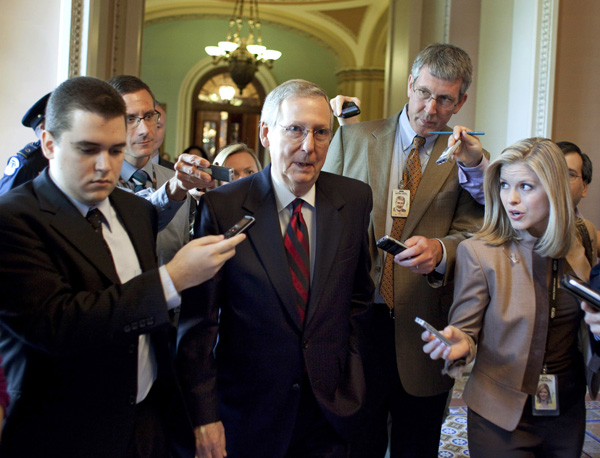
Associated Press
However, the early 2000s saw a dramatic increase in government spendingbecause of the dot-com bubble burst, the September 11th attacks, and theincrease in government spending due to military operations in Afghanistan andIraq. These events, coupled with a $1.35 trillion tax cut, forced the budget toreturn to a deficit basis. In fiscal year 2000, the budget had a $236 billionsurplus; by fiscal year 2004, it was a $413 billion deficit. By 2007, the deficit hadbeen reduced to less than half of what it was in 2004. Unfortunately, theeconomy began to enter a particularly severe recession in late 2007 and early2008. The credit crisis, the bankruptcy and federal takeovers of several majormortgage providers, and a global economic downturn led to the GreatRecession of 2007–2009. In an effort to fix these economic woes, the U.S.federal government passed a series of costly economic stimulus and bailoutpackages, dramatically increasing the deficit spending to nearly unrivaledamounts. In 2009, a growing number of people became increasingly concernedabout the massive government spending. Dubbed the "Tea Party movement,"one such group protested in support of reducing government spending, cuttingtaxes, and reducing the federal budget deficit and national debt (Wallsten &Yadron, 2010).
In 2011, the United States faced a financial crisis when Treasury SecretaryTimothy Geithner notified Congress that the country would soon reach the debt ceiling previously set at $14.294 trillion. What followed was along and arduous debate between Democrats, Republicans, and the new Tea Party politicians as to whether the debt ceiling should be raisedand what would happen to the U.S. economy without such an increase. The U.S. debt-ceiling crisis finally ended on July 31, 2011, whenPresident Obama and Speaker of the House John Boehner reached an agreement. Signed into law on August 2, 2011, the Budget Control Act of2011 immediately increased the debt limit by $400 billion. The bill also specified $917 billion in spending cuts over 10 years, among otherproposals to further reduce government spending (Mascaro & Hennessey, 2011).
Three days after the signing of the bill, the credit-rating agency Standard and Poor's downgraded the United States's credit rating for the firsttime to AA (from AAA). Global markets reacted strongly, with the Dow Jones Industrial Average falling more than 5% in one day (Winslow,2011). Although it was probably important to have a serious discussion about the budget deficit and size of the national debt, the distastefulexchanges and long, drawn-out process may have done more harm than good.
 11 years ago
 15
15
Purchase the answer to view it

 efforts_to_reduce_the_deficit.docx
- PSY 490 Week 4 Individual Assignment Pay it Forward
- Kim Woods
- Intro to Business Paper
- MGMT 524: Capstone Case Study - Henry Clements Car Rental Agency [Excel QM + all explanations]
- n Assignment 1, you investigated data analytics and the utilization of data analytics in business. In this assignment, use the company or industry that you selected in Assignment 1. Use the Internet or Strayer Library to explore the relationship between i
- Who can edit my paper by correcting grammar and spelling mistakes?
- International Trade
- FORENSIC BIO
- Banned ad
- Research the efforts to converge US GAAP and IFRS since 2002. Some of the efforts include undertaking projects such as leases, revenue recognition, investments, inventory costing, nonmonetary exchanges, fair value calculation, and share-based compensation

